Navy To Test Software To Make F/A-18 Carrier Landings Easier
Defense Daily Staff
SHARE:
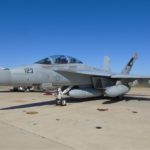
A Navy F/A-18 Super Hornet. (Photo: Boeing)
The Navy plans to conduct a three-day demonstration later this month of new F/A-18 flight control software designed to simplify aircraft carrier landings, a service official said April 13.The test will occur aboard an undisclosed carrier, said Capt. Frank Morley, the Navy’s F/A-18 and EA-18G program manager. The software, called the Maritime Augmented Guidance with Integrated Controls for Carrier Approach and Recovery Precision Enabling Technologies (MAGIC CARPET), has already been tested from land. If the carrier test is successful, MAGIC…
Defense Secretary Pete Hegseth said Wednesday the Trump administration plans to continue its push for at least $350 billion in defense funds via the reconciliation process “regardless of what happens […]
A small, bipartisan group of senators is backing the Fast Tracking European Investment in Ukraine’s Defense Act, S. 5175, to hasten the export of allied buys of U.S. munitions for […]
Rep. Jim Himes (D-Conn.), the ranking member of the House Permanent Select Committee on Intelligence, plans to increase the committee’s contractor oversight if the Democrats win control of the House […]
A new Congressional Budget Office report estimates the cost of the Iran war through Aug. 1 as $38 billion and says that the U.S. has likely depleted between one-half and […]
Navy To Test Software To Make F/A-18 Carrier Landings Easier
Defense Daily Staff
SHARE:
The Navy plans to conduct a three-day demonstration later this month of new F/A-18 flight control software designed to simplify aircraft carrier landings, a service official said April 13.
The test will occur aboard an undisclosed carrier, said Capt. Frank Morley, the Navy’s F/A-18 and EA-18G program manager. The software, called the Maritime Augmented Guidance with Integrated Controls for Carrier Approach and Recovery Precision Enabling Technologies (MAGIC CARPET), has already been tested from land. If the carrier test is successful, MAGIC CARPET could begin to enter the operational fleet in 2018 or 2019.
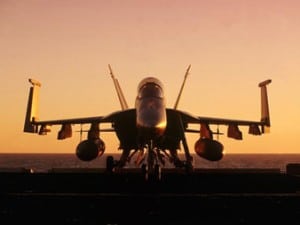
A Navy F/A-18 Super Hornet. Photo: Boeing
According to Naval Air Systems Command (NAVAIR), the software maintains a commanded glideslope and angle of attack, freeing the pilot to focus on keeping a proper line-up. Making landings easier will reduce training time, which will cut fuel consumption and wear-and-tear on the fighter jet, said Morley, who spoke during a media briefing at the Navy League’s Sea-Air-Space Exposition.
The Navy continues to explore other potential F/A-18 upgrades, including giving electro-optical/infrared sensors the ability to see more at high altitudes. Options under consideration include upgrading existing sensors and holding a competition for new ones, Morley said.
F/A-18 prime contractor Boeing [BA] continues to hope for more aircraft orders to extend the production line beyond 2017. The Navy recently sent Congress a special funding request for 12 F/A-18 Super Hornets. If that request is approved, those jets, combined with winning one of several ongoing international competitions, would extend the line through 2018 and into 2019, said Dan Gillian, Boeing vice president for F/A-18 and EA-18G programs.
Denmark and an undisclosed Middle Eastern country are both expected later this year to decide whether to buy the Super Hornet, Gillian told reporters.
NATIONAL HARBOR, Md. – A Senate Armed Services panel chair today said boosters of the Golden Dome program still have work to do to increase support on Capitol Hill while […]