Golden Dome Munitions Strategy. The House Armed Services Committee chairman’s mark of the FY ‘27 defense authorization bill includes a provision requiring the secretary of defense submit an alternative plan to Congress to procure munitions for the Golden Dome architecture. The plan is due within 18 days of the act becoming law and would include a summary of munitions and procurement quantities necessary to meet mission objectives by 2028, an assessment of current and near-term planned production capacity for each munition, an overview of alternative munitions with potential air and missile defense capability alongside their production capacities, and an evaluation of the feasibility of incorporating alternative munitions into the Golden Dome next-generation air and missile defense architecture and effects on operational performance.
….Distributed Shipbuilding Strategy. The chairman’s mark also includes the requirement for the secretary of the Navy to develop and implement a strategy to increase distributed shipbuilding within 180 days of the bill’s enactment. That provision also directs the secretary to give the defense committees a briefing on the strategy within 270 days of the bill becoming law.
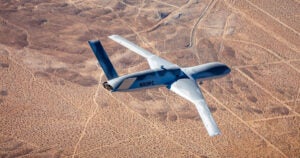
F-35 and Future CCA Teaming. The Air Force 461st and 370th Flight Test Squadrons at Edwards AFB, Calif., and F-35 Joint Program Office recently conducted a flight test of an F-35 fighter with a General Atomics Aeronautical Systems, Inc. (GA-ASI) MQ-20 Avenger drone, which the company has used for the last five years as a Collaborative Combat Aircraft (CCA) surrogate, GA-ASI said. The MQ-20 flew with GA-ASI’s Tactical Autonomy Ecosystem (TacACE) software, “based on the latest government reference autonomy software architecture,” GA-ASI said last week. “The demonstration utilized beyond line of sight communications between an airborne MQ-20 and an F-35 on the ground, enabling the F-35 pilot to send tactical autonomy commands via a tablet in the cockpit. These commands were relayed to the MQ-20’s TacACE, leveraging skills based on the autonomy government reference architecture, enabling rapid integration.” GA-ASI’s YFQ-42A Dark Merlin CCA prototype is competing against Anduril Industries’ YFQ-44A Fury CCA prototype for an Air Force CCA Increment 1 award this year.
Sentinel Fiber Optics. The Air Force owns 1,575 miles of 16.5 feet-wide perpetual easements that are supporting Hardened Intersite Cable System (HICS) copper wire communications for the Minuteman III ICBM in Wyoming, Nebraska, and Colorado in the operational area of the 90th Missile Wing at F.E. Warren AFB, Wyo. The central challenge in modernizing communications and replacing HICS with underground fiber optic cables for the LGM-35A Sentinel future ICBM by Northrop Grumman “is securing timely, compliant, and effective engagement with landowners across numerous tracts to ensure the government gains temporary construction access to land in time to install new fiber optic cables,” according to the Air Force Nuclear Weapons Center (AFNWC). To install conduit and the new fiber optic cables, AFNWC said it needs temporary access to 50 feet on each side of the permanent easement and that it plans to pay landowners $75 for each 16.5 foot unit. Similar offers may happen for the other missile wing bases–Malmstrom AFB, Mont., and Minot AFB, N.D.
NSSL Impact. A Blue Origin New Glenn rocket exploded on the launch pad at Cape Canaveral Space Force Station, Fla., last Thursday night during a hotfire test. Billionaire Jeff Bezos, the owner of Blue Origin and founder of Amazon, posted on X that the company is investigating the root cause. New Glenn was to carry Amazon Leo satellites into orbit on June 4. NASA Administrator Jared Isaacman said that “developing new heavy-lift launch capability is extraordinarily difficult” and that the NASA will “assess near-term mission impacts and get back to launching rockets.” New Glenn had its second certification flight for the U.S. Space Force National Security Space Launch (NSSL) program last November, but the third of four planned certification tests encountered a second stage failure that put a satellite into the wrong orbit last month. New Glenn is to be the Space Force’s third heavy launch rocket, after SpaceX’s Falcon Heavy and United Launch Alliance’s Vulcan Centaur.
…Still Committed. The afternoon before the New Glenn explosion, SSC awarded Blue Origin the National Reconnaissance Office (NRO) Task Order-4 for “one launch of a mission set for the NRO to be completed between fourth quarter calendar year 2027 and first quarter calendar year 2028,” SSC said late Friday afternoon. The command said that the Space Force and NRO “remain committed partners with Blue Origin and will work with them on the New Glenn vehicle anomaly experienced during its integrated vehicle hot fire test” yesterday evening. Some launches of SSC and NRO satellites are in NSSL Phase 3, Lane 1 for non-critical payloads. Rocket “certification is not required for Lane 1 missions,” according to SSC. SpaceX, ULA, and Blue Origin are the contractors for Phase 3, Lane 1 thus far.
Huge Software Award. The Pentagon has selected Dell Federal Systems for a new contract to oversee its procurement of Microsoft software for the department. Dell was awarded a five-year, $9.7 billion blanket purchase agreement for the work. “This $9.7 billion agreement is a foundational investment in decision advantage and to operate at the speed of relevance. We are fundamentally restructuring our Microsoft environment — shattering communication silos, aggressively driving efficiency, and employing a unified, collaboration environment required to defend, outmaneuver and defeat any cyber threats,” Kirsten Davies, the Pentagon’s chief information officer, said in a statement last Thursday evening. The enterprise agreement approach essentially consolidates the Pentagon’s existing contracts for Microsoft software and services within a single contract vehicle.
ICS Delivery. Lockheed Martin on May 28 announced it delivered the first Integrated Combat System (ICS)-enabled baseline to the Navy, Aegis BL9.C3.0. The company said the ICS baseline combines legacy combat system capability with modern infrastructure. It noted this is the first baseline compiled from the Forge development environment, introduces a re-architected display component called the Tactical Platform as a Service that establishes a foundation for containerized software, and a suite of new operational capabilities. The company said it will now work with the Navy and industry partners on a six-month “operating cadence” for updates and certifications across the fleet in order to keep the ICS continually refreshed.
New Javelin Launcher. RTX’s Raytheon and Lockheed Martin announced on May 26 their Javelin Joint Venture has delivered the first Lightweight Command Launch Units (LWCLU) to the Army. “The production and delivery of the LWCLU marks a pivotal step in modernizing the Javelin system for today’s warfighter,” Rich Liccion, Lockheed Martin’s Javelin program director, said in a statement. The LWCLU is the replacement for the Javelin’s legacy command launch unit and is designed to provide “twice the target detection and recognition range while reducing size by 30 percent and weight by 25 percent,” the companies noted.
Aussie P-8A. The Royal Australian Air Force (RAAF) took delivery of its 14th and last Boeing P-8A Poseidon maritime patrol and reconnaissance aircraft, the government announced on May 27. “The P‑8A Poseidon fleet is a critical capability that underpins our ability to maintain awareness of our maritime domain, and enhances Australia’s capacity to detect, deter and respond to threats across its maritime approaches,” Chief of Air Force Air Marshal Stephen Chappell said in a statement. Under the procurement program, long-term maintenance and modification will occur in Australia with Boeing’s local subsidiary at the new Deep Maintenance and Modification Facility at RAAF Base Edinburgh. The Australian government said it plans for the aircraft to go through future upgrades, including Increment Three Block Two modification.
…Navy P-8A. The U.S. Naval Air Systems Command awarded Boeing an $855 million modification on May 27 to add four more P-8A Poseidon Lot 13 aircraft for Foreign Military Sales (FMS) customers. The award also covers “additional non-recurring engineering for P-8A diminishing manufacturing sources and material shortages, software integration, and hardware updates” for the Navy and FMS customers. Most of the work will occur in Seattle, Wash., and is expected to be finished by Sept. 2030. Funding is coming largely from $853 million in FMS funds plus $2 million in FY ‘24 Navy aircraft procurement, all of it obligated at the time of award.
NASAMS Award. The Army on May 26 awarded RTX’s Raytheon a $1.02 billion contract for procurement of National Advanced Surface-To-Air Missile System (NASAMS) fire units set to be delivered to Kuwait under a previously approved foreign military sale. Raytheon and Norway’s Kongsberg jointly developed the NASAMS air defense system, which brings together Raytheon’s Sentinel radar and Advanced Medium Range Air-to-Air Missiles with Kongsberg’s Fire Distribution Center. The State Department approved the FMS case for NASAMS with Kuwait in October 2022.
Soft Kill APS. BAE Systems said on May 27 it has been awarded the Soft Kill Active Protection System contract from the Army, where it will work on equipping ground vehicles with advanced electronic warfare capabilities. The company noted the program leverages its Rapid Optical Observation and Kill (ROOK) system designed to defeat drones and anti-tank guided missiles, and supports continued development of its Stormcrow and TERRA RAVEN countermeasure systems. BAE Systems has not disclosed the specific vehicles that it will receive the Soft Kill APS capabilities. “ROOK is a leading soft-kill countermeasure system, providing improved situational awareness and threat response in complex battlefield conditions. The system’s electronic countermeasures defeat threats before they reach the vehicle by confusing or jamming their guidance systems. This renders the threats ineffective while preserving the limited magazine depth of hard-kill kinetic countermeasures,” BAE said in a statement.
Successful SDA Review. Rocket Lab has successfully passed a systems requirements review (SRR) for the Space Development Agency’s (SDA) Tranche 3 Tracking Layer of missile warning and tracking satellites. “The SRR milestone confirms that Rocket Lab’s proposed solution meets SDA’s operational requirements and establishes the technical baseline for the program,” the company said on May 27. Rocket Lab’s Tranche 3 Tracking spacecraft are based on the company’s Lightening satellite and will be integrated with in-house subsystems including its Phoenix infrared wide field-of-view sensor payload, solar arrays, avionics, optical terminals, propulsion systems, and StarLite sensors to protect against directed energy threats.
New Energetics Hub. The American Center for Manufacturing and Innovation (ACMI) last week broke ground in Indian Head, Md., on the Maryland Energetics Innovation Hub (MEIH), which will host companies and research institutions focused on modernizing the development, testing and manufacturing of energetics to meet military needs. The MEIH is backed by a $50 million award from the Naval Surface Warfare Center (NSWC) Indian Head Division and expects to attract another $200 million in private investment. The first tenants of the MEIH are the non-profit Energetics Technology Center and Applied Research Associates. Located just outside NSWC Indian Head, the Navy’s energetics center of excellence, “MEIH brings together the infrastructure, capital, and private-sector talent needed to rapidly advance new producers and technologies,” John Burer, ACMI’s CEO, said in a statement. The hub expects to begin initial operations in 2027.
More DE Investment. A draft bill by House Armed Services Committee (HASC) leadership “encourages” the Defense Department to further invest in non-kinetic directed energy (DE) systems to counter-unmanned aircraft system (C-UAS) swarms at military installations. The draft bill, introduced by Committee Chairman Mike Rogers (R-Ala.), will be marked up on June 4. The bill suggests additional investments in high-power microwave systems, including the RTX-built Coyote Block III, high energy lasers and radio frequency systems. HASC wants a report from the Pentagon’s counter-drone task force by Dec. 1 on plans “to complete development and begin procurement of low collateral, non-kinetic solutions for c-UAS.”
Maritime Drone Autonomy. Autonomous drone navigation startup Tycho.AI last week said it received a $2 million Tactical Funding Increase award from the Air Force Research Laboratory to accelerate testing and integration of its Voyager autonomy stack for overland and over water operations in GPS-denied and degraded environments. Tycho.AI, which emerged from stealth last fall, said work under the Tracking & Resilient Inertial-Derived Estiation for Naval Targets (TRIDENT) contract includes test flights and experimentation with rotary- and fixed-wing platforms to collect data in multiple domains to mature the Voyager vision-based navigation technology. The TRIDENT contract is for multi-domain navigation and long-range intelligence, surveillance and reconnaissance. Tycho.AI said it will match the Air Force award with $2 million of internal investments.
Unmanned Vehicles. American Rheinmetall and electric vehicle startup Harbinger announced on May 27 they have formed a partnership to develop unmanned vehicles to support Pentagon requirements, with an initial focus targeting potential Army requirements for autonomous tactical wheeled vehicles, contested-logistics resupply and next-generation robotic platforms. “The teaming pairs American Rheinmetall’s combat-proven vehicle integration, mission systems and modular architecture development with Harbinger’s commercially based, autonomy-ready hybrid vehicle platform to deliver affordable, scalable robotic solutions that can be fielded at the pace of relevance,” Rheinmetall said in a statement. “Under the agreement, the companies will jointly pursue current and emerging [Pentagon] programs where commercial-derived, hybrid-electric and fully drive-by-wire architectures can accelerate the delivery of robotic combat, logistics and sustainment capabilities.” The companies said they expect to begin joint demonstrations this summer.
KC Drone Protection. Australia-based DroneShield is providing a multi-site counter-unmanned aircraft system (C-UAS) solution in the Kansas City, Mo.-region for the FIFA World Cup 2026 games that will be played there this summer. DroneShield is providing its radio frequency detection, counter-drone, and sensor fusion capabilities and is teamed with radar provider Echodyne for a layered airspace security architecture.
EdgeRunner AI. EdgeRunner AI has announced its completed a Joint Readiness Training Center rotation with the Army’s 101st Airborne Division Sustainment Brigade where its AI capability was integrated with brigade staff elements to support planning, analysis and execution across logistics, intelligence and command post operations. “The EdgeRunner system was integrated in the brigade’s battle rhythm while running completely locally on standard government hardware while disconnected from the network, simulating a fully Denied, Disrupted, Intermittent and Low Bandwidth warfighting environment,” EdgeRunner AI said in a statement.