In Memo, Top Navy Officials Direct LCS Office, N9 to Develop Mine Countermeasures Plan
Valerie Insinna
SHARE:
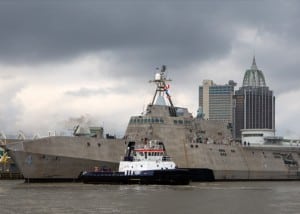
The USS Coronado (LCS 4) Independence-variant Littoral Combat Ship sailing away. Photo: U.S. Navy
The Littoral Combat Ship program office and Deputy Chief of Naval Operations for Warfare Systems (N9) have one month to develop an implementation plan that will put recommendations made by the Remote Minehunting System’s independent review team into action.According to a memo signed by Chief of Naval Operations Adm. John Richardson and the service head of acquisition Sean Stackley earlier this week, “The plan will coordinate experimentation, technology maturation, concept of operations and concept of employment development, and industry and…
A small, bipartisan group of senators is backing the Fast Tracking European Investment in Ukraine’s Defense Act, S. 5175, to hasten the export of allied buys of U.S. munitions for […]
Rep. Jim Himes (D-Conn.), the ranking member of the House Permanent Select Committee on Intelligence, plans to increase the committee’s contractor oversight if the Democrats win control of the House […]
A new Congressional Budget Office report estimates the cost of the Iran war through Aug. 1 as $38 billion and says that the U.S. has likely depleted between one-half and […]
NATIONAL HARBOR, Md. – A Senate Armed Services panel chair today said boosters of the Golden Dome program still have work to do to increase support on Capitol Hill while […]
In Memo, Top Navy Officials Direct LCS Office, N9 to Develop Mine Countermeasures Plan
Valerie Insinna
SHARE:
The Littoral Combat Ship program office and Deputy Chief of Naval Operations for Warfare Systems (N9) have one month to develop an implementation plan that will put recommendations made by the Remote Minehunting System’s independent review team into action.
Lockheed Martin’s Remote Minehunting System deploys from the USS Independence (LCS 2).
According to a memo signed by Chief of Naval Operations Adm. John Richardson and the service head of acquisition Sean Stackley earlier this week, “The plan will coordinate experimentation, technology maturation, concept of operations and concept of employment development, and industry and fleet engagement leading to a supportable MCM [mine countermeasures] capability, tested and delivered before legacy systems reach end of life.”
The memo also establishes a governance board co-chaired by N9 and the principal military deputy to the Navy’s acquisition directorate, which will “ensure all elements within the Navy are aligned and on track for delivering an affordable and capable” mine countermeasures module to the fleet.
The Navy opted not to proceed with low rate initial production (LRIP) 2 of the Remote Minehunting System after reviewing the recommendations of the team, Defense Daily learned on Tuesday (Defense Daily, Feb. 23). RMS, which is manufactured by Lockheed Martin [LMT], consists of a diesel-powered semi-submersible called the Remote Multi-Mission Vehicle (RMMV) that tows the AN/AQS-20A sonar made by Raytheon [RTN].
The service planned to incorporate RMS as a key element of the Littoral Combat Ship’s (LCS) mine countermeasures mission package and use the system to detect and identify bottom and moored mines. However, during technical evaluations last year, the RMMV did not meet reliability requirements, encountering a far greater number of operational failures than expected.
“This thing can find mines, it can fix them, and it can eliminate. [But] we are not satisfied with the reliability of the RMMV [in the] Remote Minehunting Vehicle,” Navy Secretary Ray Mabus said Friday at the Brookings Institute. “So we’ve got 10 of these. We’re going to upgrade them to make them more reliable, but it’s not a long term answer.”
According to the memo, the implementation plan will address “clear lines of accountability” for delivering MCM capability, cost and recommended budgetary actions, concept development and testing for LCS and non LCS systems, and the employment of expeditionary MCM capability for LCS and other Navy ships.
It will also focus on how the service can use the RMMVs to gain operational experience, as well as a future “fleet assessment” for MCM capabilities—including RMMV, unmanned surface vehicles and unmanned underwater vessels—that could be incorporated into the program of record.
“We appreciate the work done by the IRT [independent review team] and will this opportunity to reset the Navy’s approach to mine warfare,” the memo concluded.
The problems the Navy has had with RMS is emblematic of why rapid prototyping and experimentation needs to become a critical part of the service’s acquisition strategy, Richardson said Friday at Brookings.
“If we had some kind of a rapid prototyping approach earlier in this program, I think we would be in a different place with respect to this tow vehicle,” he said. “We would have rung that out a lot faster, and we would have gone to a different solution earlier.”
An HII [HII] shipbuilding executive last week told lawmakers how the company plans to improve and accelerate shipbuilding throughout via workforce improvements, adding new shipbuilding infrastructure and reinforcing distributed shipbuilding […]