 By
By 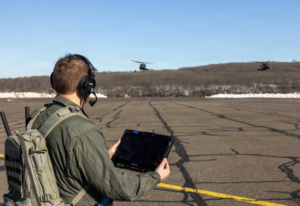
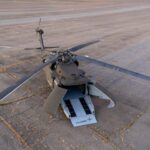
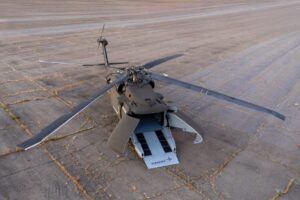
NASHVILLE, Tenn.–Army and Sikorsky [LMT] officials said Thursday the service’s new Black Hawk outfitted to fly autonomously is serving as a testbed for bringing autonomy capability to the future MV-75 Cheyenne II Future Long Range Assault Aircraft (FLRAA).
The update follows the Army’s recent acceptance of the first H-60Mx, integrated with Sikorsky’s MATRIX autonomy suite, which is now set to undergo extensive experimentation and testing to inform scaling of autonomy efforts.
“I won’t speak to what technology they’re going to shift from that standpoint, but they are using Black Hawk as a testbed to de-risk MV-75 and other platforms they want [bring autonomy] on because we’ve done all this work to this point,” Rich Benton, vice president and general manager of Sikorsky, told Defense Daily in an interview at the Army Aviation Association of America’s annual conference here.
Brig Gen. David Phillips, deputy program acquisition executive for maneuver air, later told reporters the ongoing experimentation with H-60Mx is “laying the foundation” for autonomy discussions with the MV-75.
“You’ve got a fly-by-wire [FLRAA] aircraft from day one. And then how we translate that [autonomy] knowledge into MV-75 will be accelerated because of these efforts,” Phillips said.
The H-60Mx, the second Black Hawk outfitted with Sikorsky’s MATRIX technology along with the company’s own “Optimally Piloted Vehicle” (OPV) helicopter, were borne out of the Defense Advanced Research Projects Agency’s (DARPA) Aircrew Labor In-Cockpit Automation System (ALIAS) with an aim to enable a helicopter to fly with or without a pilot at the controls.
In February 2022, DARPA and Sikorsky conducted the first ever completely unmanned, autonomous flight with a Black Hawk as part of an ALIAS demonstration with no safety pilots onboard (Defense Daily, Feb. 9, 2022).
The Army in March announced it officially accepted the first H-60Mx after several years of DARPA and Sikorsky testing, with the service now planning for “advanced operational testing” with the aircraft (Defense Daily, March 20).
“They’re going to use that aircraft to further develop those interfaces between the autonomy stack, flight controls and really determine the best sensor packages to go along with that. That’s really the testbed for autonomy for other aircraft as well,” Phillips said.
Sikorsky has noted that its MATRIX technology allows a Black Hawk to be operated from a tablet, and last fall a U.S. Army soldier for the first time employed an autonomous helicopter to conduct a series of logistics missions at an exercise (Defense Daily, Oct. 30, 2025).
Benton noted the forthcoming experimentation with the H-60Mx is likely to inform the Army’s tactics, techniques and procedures for autonomous operations as well as providing insight into how such capabilities should be employed and how many Black Hawks it may want to retrofit or buy in an OPV-configuration.
“I think they’re going to look and see how they can solve missions and where they want to employ it,” Benton said. “It’s not just going to be the Black Hawk. They want to look at…how do I put autonomy in other aircraft that’s in their inventory and make them complementary.”
The Army this week officially announced the Bell [TXT]-built MV-75 FLRAA tiltrotor aircraft has been designated as the Cheyenne II, and senior leaders affirmed plan to equip a first unit with two dozen initial aircraft in fiscal year 2030 (Defense Daily, April 15).
Army Secretary Dan Driscoll told lawmakers on Thursday the service wants “to over-invest in FLRAA to get it online as quickly as possible,” planning to spend more than $2 billion in FY ‘27 to support the program’s acceleration effort (Defense Daily, April 16).
During the competitive development phase to inform initial FLRAA requirements, Bell confirmed that in December 2019 it completed a successful autonomous test flight with its V-280 Valor platform (Defense Daily, Jan. 9 2020).
Benton noted that, while he does not necessarily see “a world where all Black Hawks are flying autonomously,” he anticipates increasing interest in scaling the technology, noting there are conversations between DARPA and other undisclosed customers on potentially providing OPV aircraft.
“When you look at the rest of the world, I absolutely believe within the next 10 years you will see missions that are being traditionally done with some of our platforms being offloaded into an autonomous platform. The economics are there. The technology is getting there. And it’s really filling some of those gaps that we continue to fill every year,” Benton said. “I think the threat will help accelerate the capability, because we’re actually going to get a safer outcome by adopting autonomy than putting lives in harm’s way. And when you look at it that way, to me, the evolution is inevitable.”