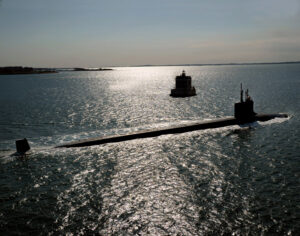
Sub Contract Close. Navy officials on May 19 told the Senate Armed Services Committee (SASC) the service is close to finalizing a contract with General Dynamics’ Electric Boat and HII on 10 Block VI Virginia-class attack submarines and two Columbia-class ballistic missile submarines but they are trying to get the language right and better than in past agreements. SASC ranking member Jack Reed (D-R.I.) indicated the Navy last provided an update to the committee two weeks ago that contract negotiations “are very close to being finalized” and asked what the current status was. Chief of Naval Operations Adm. Daryl Caudle said they need to get the contract done “but we want to make sure what’s baked into it, the lessons we’ve learned on poor contracting strategies that we’ve not always been in the right position to have the right oversight and the right incentives and the right mechanisms to ensure we get them delivered on time.” He added the Navy acquisition team and Secretary of Defense’s team have provided a “thoughtful approach” to get it right and while he cannot give a specific time, they expect the contract to be finalized “at any time…and we’re just making sure that we get that contract language correct.”
Sub Tenders. The Navy’s acting head of acquisition on May 20 told lawmakers the Navy’s next-generation submarine tenders are “probably going to be online in the early 2030s, realistically.” Jason Potter told the House Armed Services Seapower subcommittee that the Navy is continually assessing service life extensions for its current fleet, including the Emory S. Land-class submarine tenders. When asked about tenders by Rep. Scott DesJarlais (R-Tenn.), Potter noted the Navy is focused on finishing the next-gen tender design with General Dynamics and getting the first ship under construction. “We’ve had a good process here to work through the requirements,” Potter said. It’s the first time we’ve built a sub tender in a while, and kind of making sure it’s going to have the maintenance capability to maintain our latest Virginia-class submarines, and the quantities took a measure twice, cut once approach over the last few years. So, I think we’re there, we need to finish the design and get into construction.” The Navy’s FY 2027 budget request seeks $4.4 billion to start procuring two new tenders and projects contract awards in April 2027 and delivery by November 2033 and May 2034.
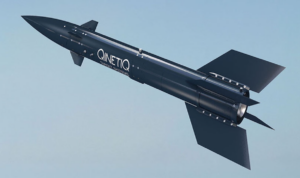
Mach Deal. Startup Mach Industries last week said it has acquired Exquadrum, Inc., a developer and manufacturer of solid rocket motor propulsion technologies, launch capabilities, divert and attitude control systems, munitions, testing and technical services. The acquisition helps with Mach’s vertical integration and will accelerate development cycles reduce costs through tighter integration between propulsion, energetics, guidance, control and airframes. Terms of the deal were not disclosed. Mach is developing cruise missiles, a drone interceptor, munitions, a transonic glider munitions dispenser, and microturbine engines. Exquadrum is now Mach Energetics, and brings with it a 70,000 square-foot facility in Victorville, Calif.
Havoc Spear. Air Force Special Operations Command’s (AFSOC) moniker for the Leidos-built AGM-190A small cruise missile is Havoc Spear, the command announced at the Special Operations Forces Week annual conference in Tampa, Fla. During a visit to AFSOC headquarters at Hurlburt Field, Fla., last November, Air Force Secretary Troy Meink dubbed the AGM-190A as Havoc Spear–“a capabilities descriptor of widespread destruction via mass attack (Havoc) and precision targeting from afar (Spear),” according to AFSOC.
…MQ-9s and SDBs. This spring, AFSOC added the Boeing-built GBU-39B Small Diameter Bomb, first fielded in 2006, to the arsenal of MQ-9 Reapers at the 27th Special Operations Wing at Cannon AFB, N.M. The 60-mile range of the 250-pound SDB “guarantees we can stay in a fight under hostile threats and continue to solve the joint force’s hard tactical problems,” according to Air Force Lt. Col. Joshua Swann, an MQ-9 squadron commander with the 27th Special Operations Wing.
THAAD Investment. Lockheed Martin last week broke ground on a new 87,000 square foot Munitions Production Center in Troy, Ala., that will support the Terminal High Altitude Area Defense (THAAD) interceptor program and future work on the Next Generation Interceptor. The Defense Department and Lockheed Martin earlier this year signed a framework agreement to quadruple production of THAAD interceptors over seven years.
…BAE Facilities. BAE Systems also last week said it will invest $135 million to enhance facilities in New Hampshire and Texas to speed deliveries of systems and software in support of U.S. military readiness. About $85 million will be spent on modernizing and reconfiguring the Hudson, N.H., campus to improve workflow. In Austin, Texas, BAE is doing a $50 million manufacturing overhaul to meet requirements for affordable precision munitions.
Ukraine FMS. The State Department on May 21 said it has approved a potential $108.1 million foreign military sale with Ukraine covering sustainment support for HAWK missile systems. Under the deal, Ukraine would receive erectable mast trailers, major modifications and maintenance support, spare parts, repair and return support and program support for the FrankenSAM initiative, which modifies U.S.-made missile equipment for use on the country’s legacy launcher capabilities. “The proposed sale will improve Ukraine’s capability to meet current and future threats by further equipping it to conduct self-defense and regional security missions with a more robust integrated air defense capability,” the State Department said in a statement. Sierra Nevada Corporation would be the prime contractor for the work.
Comptroller Nominee. President Donald Trump has officially nominated Jay Hurst III to serve as the Pentagon’s comptroller, according to a notification delivered to Congress on May 20. Hurst has held the chief financial officer role in an acting capacity since August 2025, and has recently taken the lead in detailing the department’s $1.5 trillion fiscal year 2027 budget request. His prior roles include acting assistant secretary of defense for manpower and reserve affairs and under secretary of defense for personnel and readiness.
Aussies Extending Subs. The Australian Defense Ministry on May 19 announced life extension of the first of its six Collins-class submarines will begin at the end of the month, to be performed by ASC, starting with the HMAS Farncomb. The government said this will entail a conditions-based sustainment approach to retain and restore base components while upgrading weapons and other systems. Australia plans to extend the life of its six submarines as it transitions to procuring three to five U.S.-made Virginia-class attack submarines in the 2030s before ultimately starting to produce its own SSN-AUKUS submarines in the 2040s. “Extending the life of all six Collins class submarines is critical to maintaining that edge as we transition the Navy from conventional to nuclear-powered submarines,” Deputy Prime Minister of Minister of Defense Richard Marles said in a statement.
DDG-140. General Dynamics’ Bath Iron Works (BIW) marked the start of fabrication of the future USS Thomas G. Kelley (DDG-140) Arleigh Burke-class destroyer on May 21 at the shipyard’s Structural Fabrication Facility in Brunswick, Maine. DDG0140 will be the 48th destroyer in its class built at BIWand the seventh Flight III version to start construction in Maine. The ship is named in honor of a Vietnam War medal of Honor recipient. Beyond DDG-140, BIW currently has under construction the Flight IIA destroyer Patrick Gallagher (DDG-127) plus other Flight III destroyers Louis H. Wilson Jr. (DDG-126), William Charette (DDG-130), Quentin Walsh (DDG-132), John E. Kilmer (DDG-134), Richard G. Lugar (DDG-136) and J. William Middendorf (DDG-138).
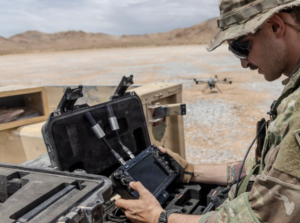
Scarlet Dragon. During the Scarlet Dragon experimentation exercise, command and control data platform provider Picogrid and tethered drone maker Hoverfly demonstrated a persistent low-altitude threat detection capability. Unlike battery-powered drones that have to land and recharge or swap out their power source, Hoverfly’s Spectre tethered drone can sense indefinitely from 200 feet. In the exercise at Fort Bragg, N.C., Picogrid’s Legion platform enabled data from Spectre to flow into the wider operational network to fuse with data from other sensors. “Whether it’s supporting base defense or moving with a unit in the field, the ability to add persistent, elevated sensing without creating another isolated system changes how that data can actually be used,” Cam Kondo, deployment strategist at Picogrid, said in a statement.
C-UAS Marketplace. Australia, Poland and South Korea have signed agreements with the U.S. Army to participate in the Joint Interagency Task Force (JIATF)-401’s marketplace for new counter-unmanned aircraft systems (C-UAS). “The drone defense marketplace connects a diverse array of solutions with an expanding network of users who need scalable, effective and interoperable technologies. The initiative aligns with the Army secretary’s goal of providing partner nations with timely access to essential capabilities and highlights JIATF-401’s central role in advancing that mission,” the JIATF-401 said in a statement on May 19. The addition of the three nations follows the U.K. and Romania previously joining the JIATF-401 marketplace, with the Army having set a goal for 25 partner nations to be part of the framework for interoperable C-UAS by this summer.
Army Drone Award. The Army’s 1st Aviation Brigade, Army Aviation Center of Excellence, has awarded Redwire Corp. a $15 million follow-on order for the company’s Stalker Group 2 unmanned aircraft system (UAS), which will be used for training by tactical UAS specialists, the company said last week. It is the third order from the brigade in the past eight months, with total awards at $24.8 million. The fixed-wing Stalker can takeoff and land autonomously. Redwire last week also said it received a “high-eight figures” contract from a NATO ally to supply the Penguin Mk3 UAS.
Navy PAE Strategic Systems. The Senate confirmed the promotion of Rear Adm. Douglas Williams to vice admiral as he moves from director for test at the Missile Defense Agency to Portfolio Acquisition Executive (PAE) Strategic Systems Programs (SSP) in June. Williams will succeed Vice Adm. Johnny Wolfe, current director for PAE SSP, who is set to retire in June following a career of over 37 years. PAE SSP manages sustainment of the nuclear weapon systems on the Ohio-class ballistic missile submarines (SSBNs) and supports integration of the D5LE weapon system on the new Columbia-class SSBNs.
SubSea Craft. United Kingdom-based maritime technology and defense firm SubSea Craft on May 20 announced its plans to expand into Virginia Beach, where it will hire positions ranging from leadership to operations, field engineering and technicians. The company specializes in developing maritime platforms and technologies designed to support modern naval and defense operations in complex environments, including its VICTA advanced diver delivery craft and MARS unmanned surface vehicle. The Virginia Beach site will serve as a strategic location as SubSea expands engagement with U.S. defense and maritime industry partners, including local company Global Technical Systems. The project was led by Virginia Beach Economic Development and the Hampton Roads Alliance and received an economic grant from the Virginia Beach Development Authority. SubSea Craft underscored its continuing participation with AUKUS industry partners under the Pillar II non-submarine technology sharing initiatives.
Anduril-Booz Partnership. Booz Allen Hamilton says its mission software and cybersecurity capabilities are running on Anduril Industries’ Menace compute and communications systems and its Lattice software. Booz’s Sitx is on Menace and enables the sharing of situational awareness information between coalition partners without the need for a common architecture. The company’s Dynamic Effects Tasking System is a Lattice-integrated application on Menace and enables operators to create cyber and radio frequency effects on the same system they use for their command and control workflows. Booz’s Zero Trust solutions are also on Menace to provide policy enforcement, logging and security controls across all applications.
People News. The board of Airbus U.S. Space and Defense has appointed Alex Veneziano as CEO, effective immediately, succeeding Robert Geckle, who is leaving the company for another opportunity. Veneziano was previously the company’s chief administrative officer. Sean Plankey, the former nominee to run the Cybersecurity and Infrastructure Security Agency, and who also served as a Coast Guard advisor, has been appointed as the U.S. CEO of the unmanned systems startup UFORCE. London-based UFORCE consists of a number of Ukrainian defense companies. Space domain awareness company LeoLabs has named Jonathan Moneymaker as chairman of its board. He led BlueHalo prior to its acquisition by AeroVironment.
Dividend Jump. Northrop Grumman’s board last week approved a nearly 7 percent increase in its quarterly dividend to $2.47 per share versus the current $2.31 per share. The dividend is payable June 17. The company said it “continues to execute a disciplined capital allocation strategy that prioritizes investments in the manufacturing capabilities and capacity needed to deliver differentiating technologies quickly for our customers.”
Predictive Logistics. Rune Technologies said on May 21 its artificial intelligence-enabled TyrOS predictive logistics software has been selected for the Marine Corps’ Project Dynamis command and control modernization effort. “Rune’s role on Project Dynamis brings predictive logistics into the MAGTF C2 architecture for the first time. TyrOS ingests data from across the force to track assets and anticipate shortfalls, even when communications are denied, degraded, or intermittent. This gives Marine commanders real-time visibility into sustainment across distributed operations,” the company said in a statement.
Rads to Watts. City Labs, which is developing nuclear micropower technology based on tritium, has received a $1.5 million contract from the Defense Advanced Research Projects Agency (DARPA) to develop a new class of high-power radiovoltaic energy systems that could be used in deep-space operations, national security systems and long-duration autonomous systems. The award was made under DARPA’s Rad to Watts program that is focused on converting nuclear radiation energy into electricity.
Editor’s Note: In observance of the Memorial Day holiday, Defense Daily will not publish on Monday, May 25. Your next issue will be dated Wednesday, May 27.