
MQ-9 Follow-On. As the U.S. Air Force considers a follow-on to the MQ-9 Reaper by General Atomics, the service has received more than 50 responses to a request for information (RFI) last month on a future attritable intelligence, surveillance, and reconnaissance (ISR) aircraft, says Lt. Gen. Luke Cropsey, the military deputy to acting Air Force acquisition chief William Bailey. “I think there is a burgeoning interest across the broader defense industrial base on what comes next, and I think we have enough interest to get some interesting proposals back,” Cropsey says. The RFI says missions for such a future drone would include “but are not limited to: battle damage assessment, full motion video (FMV) monitoring, and signal detection and characterization” and that personnel would use the drone “to collect a range of ISR data, including but not limited to: electro-optical/infrared, FMV, and/or signal detection and characterization.” Such data collection and characterization “must support processing, exploitation, and dissemination based multidimensional information fusion,” according to the RFI by Air Force Life Cycle Management Center’s ISR and Special Operations Forces directorate.
158 F-35s. As of the end of last September, 158 F-35s out of 812 fielded across the Air Force, Marine Corps, and Navy have a Technology Refresh-3 (TR-3) configuration to enable Block 4 weapons and sensor upgrades, but the TR-3 software is “not currently combat coded because of the developmental issues we’re working through so the aircraft that are deployed are using an older software that is fully combat capable,” says Air Force Maj. Gen. Christopher Niemi, the Air Force’s head of force modernization. “I’m confident that we will get there on TR-3.” The F-35 program is also facing delays in equipping the fighter with the Northrop Grumman AN/APG-85 radar to replace the AN/APG-81, also by Northrop Grumman.
Early Sub Work. The Navy on May 11 awarded General Dynamics’ Electric Boat another not-to-exceed $2.3 billion undefinitized contract action modification focused on long-lead time material and early manufacturing for Block VI Virginia-class submarines. The work is expected to be finished by Sept. 2035 and $1.97 billion in fiscal year 2026 shipbuilding funds were obligated at the time of award. Rep. Joe Courtney (D-Conn.), whose district includes the shipyard, said the award “demonstrates that not only Congress but the Navy is investing in the Virginia-class supply chain.” However, he said the Navy still needs to finalize an expected 10 submarine Block VI construction contract that Congress authorized 29 months ago. “It’s been long enough. The Department of the Navy needs to finalize the contract so that the full array of submarine suppliers have a clear picture of what their investment decisions must be.”
Two Subs Per Year. Chief of Naval Operations Adm. Daryl Caudle told the House Appropriations Defense subcommittee on May 12 that the Navy expects industry to hit a production rate of two Virginia-class attack submarines (SSNs) per year by 2032 “based on the things we’ve done in place and the things we have now, we should be at the two per year in the early 2030s, real early 2030s.” This is in line with the Navy’s justification of its $6.2 billion submarine industrial base spending pushing to production of two SSNs and one Columbia-class ballistic missile submarine per year in the long-term shipbuilding plan released on May 11. Over the past years Navy officials have described the SSN production rate as hovering around the 1.3 per year rate.
…AUKUS. Caudle also said he is optimistic about the progress of AUKUS and reaching to establishment of Submarine Rotational Force-West as the next big step, although he said there are “a couple of things they’re behind on I’m frustrated with with that are part of the support system there, like some of the skiff work and that kind of thing, but all the production work there on the pier and all that, they’re making their mark.” Integration of Australian sailors, officers and maintenance personnel with U.S. Navy and industry groups are proceeding well, “so this is working, and we want to support them, and it is going to turn out really great, when we get it delivered,” he added.
E-7 Funding. Defense Secretary Pete Hegseth told House appropriators on May 12 that the Pentagon has submitted an amendment with the Office of Management and Budget to request funding in fiscal year 2027 for the E-7A Wedgetail airborne early warning aircraft, after the Air Force did not include funding for additional aircraft in its budget request. “I know our department had taken the position that it was other satellite ISR that was probably going to be capable of a lot of that in the future. But I think that mindset was indicative of a mindset that we’ve shed which is the divest to invest mindset, which was an austerity mindset,” Hegseth said during a hearing. “I think [the E-7] has a future. It has a place on the battlefield. And we’ll get more information for you on that as well.”
NGC2/Balikatan. Lockheed Martin has said its team supporting the Army’s Next-Generation Command and Control (NGC2) prototyping with the 25th Infantry Division recently conducted a successful demonstration as part of the Balikatan exercise between the U.S. and Philippines where it integrated “sensors, fires systems and airspace management through a unified data platform to compress sensor-to-shooter timelines, accelerate warfighter capability and provide a real-time view of the battlefield across the Indo-Pacific.” “NGC2 linked sensors and edge nodes in the Philippines with command nodes in Hawaii and the continental United States with cloud-enabled operations support, providing U.S. and allied forces a live, unified battlefield picture across a distributed, contested theater,” Lockheed Martin said.
“Battle Manager.” Anduril said on May 12 the Army has awarded it a contract to develop a “Battle Manager” prototype that will serve as an “integrated command-and-control platform designed to defend against a variety of air and missile threats, with an eye toward bolstering capabilities in the Western Pacific. “Through Anduril’s Lattice software platform, the Army will be able to integrate information from existing joint missile defense systems, turning large volumes of data into a single, coherent operating picture for comprehensive battle management. The modular, open systems architecture fuses data across disconnected sensors and effectors into a joint track picture,” Anduril said in a statement. “This is an especially important dynamic in the defense of the Western Pacific and its extant missile defense systems are composed of a layered mix of systems from across multiple services and domains.” Further details on the contract specifics have not yet been disclosed.
GOP Rebukes Poland Decision. Republicans on the House Armed Services Committee (HASC) rebuked Defense Secretary Pete Hegseth’s recent decision to cancel the planned deployment of 4,000 troops with the 2nd Armored Brigade Combat Team, 1st Cavalry Division to Poland, pressing Army senior leaders during a hearing on May 15 for additional details. “But know, we are going to mandate that the department follow the statutory minimums that are set in statute on force posture. And if there are attempted deviations, we will remedy them and impose pain if they aren’t complied with,” said HASC Chair Mike Rogers (R-Ala.), while noting the last minute call was “not the fault” of Army leaders. Rep. Don Bacon (R-Neb.) called the decision “reprehensible,” noting it follows a similar decision last year to pull U.S. troops from Romania. “It’s an embarrassment to our country what we just did to Poland, in my view,” Bacon said. “We’re sending a terrible message to Russia and to our allies.”
…Army Leaders’ Context. Army Secretary Dan Driscoll said he was informed of the decision “just a couple days ago,” while Acting Army Chief Gen. Christopher LaNeve said he had conversations with Gen. Alexus Grynkewich, commander of U.S. European Command (EUCOM), over the last two weeks to consult on the move. “I had consultations with Gen. Grynkewich on different elements that are in Europe and what would be the most prudent one to stop,” LaNeve said. “As they reviewed the force structure, the conclusion was we could bring back one brigade that’s in the rotation pool that we send over to Europe.”
…Poland ‘Blindsided.’ Bacon said he was notified by Polish officials that they were not informed of the decision ahead of time. “They did not know. They were blindsided. These are some of our best allies and they had no idea,” he said. Bacon added he also heard that EUCOM communicated that the decision to halt the deployment “carries risk.” “So in order words it was coordinated with EUCOM but they did not say this was a low risk decision,” Bacon said. “So the Secretary of Defense made this decision over some objections of the EUCOM commander, that’s what I submit here.”
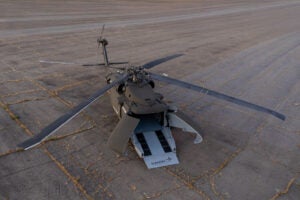
HH-60Ws for DC. The Air Force program of record for the combat search and rescue mission is 76 aircraft, and the service will meet that number even after a final transfer of some HH-60W helicopters to the Air Force District of Washington to take over the VIP transport and other missions of around 20 aging UH-1Ns there, says Lt. Gen. David Tabor, the Air Force’s deputy chief of staff for plans and programs. The service has funded 91 HH-60Ws. On April 3, the Pentagon used two HH-60Ws to rescue the pilot of an F-15E Strike Eagle downed during strikes on Iran.
Havoc Raise. Havoc last week said it raised $100 million in a Series A round that included new investors such as Science Applications International Corp. and existing investors such as Lockheed Martin to accelerate deployment of its all-domain collaborative autonomy stack. Havoc has more built and deployed more than 100 autonomous surface vessels with various customers, including more than 30 for the Defense Department, and is also using its technology in air and land domains. The Rhode Island-based startup has more than 200 employees.
USAF OWA Drones. The Air Force has awarded AEVEC Corp. an $18.5 million contract to supply autonomous, Group 3 one-way attack (OWA) drones and engineering and field support, the company said last week. AEVEX says the drones are built with additive manufacturing processes. AEVEX did not disclose which of the company’s drones is being contracted for but said “The platform is designed for affordability, manufacturability, and mission flexibility, incorporating autonomy-enabling frameworks that help reduce operator workload and support diverse operational needs.”
Saildrones Up North. Saildrone has a new $15.5 million contract with the Coast Guard to operate 16 of its Voyager unmanned surface vessels (USVs) in the Great Lakes and Northeast, the company said last week. The new missions—Saildrone already operates USVs in the Atlantic and Pacific Oceans and the Gulf of Mexico—would be for northern border security, and illegal, unreported, and unregulated fishing patrols in the North Atlantic.
High North GARC. BlackSea Technologies on May 15 revealed it participated in the February NATO Arctic Sentry 2026 exercise in the high north, demonstrating its Global Autonomous Reconnaissance Craft (GARC) in Ramsund, Norway. The GARC was attached to Commander, Task Force 66 and operating with the U.S. 6th Fleet, U.S. Unmanned Surface Vessel Squadron 3 (USVRON-3) and the Royal Norwegian Navy. BlackSea Technologies mission director Lunsford Schock said this event proved GARC can “operate effectively in dynamic, contested maritime environments north of the Arctic Circle.”
New SMASH Contract. The Army Portfolio Acquisition Executive Defense Fires has awarded Smart Shooter a follow-on contract valued at $10.7 million for its SMASH 2000LE fire control system, which integrates with assault weapons to make them smart for use as individual counter-drone systems. Smart… Shooter last week said the contract will be executed through Atlantic Diving Supply, Inc. The contract follows awards the company received from the Army and Marine Corps in 2025, and the Joint Interagency Task Force-401 in March for the Air Force (Defense Daily, March 25).
New Drones. AIRO Group Holdings last week introduced a new long-range, vertical takeoff and landing unmanned aircraft system (UAS), the RQ-70 Dainn, for intelligence, surveillance, reconnaissance and target acquisition missions. The RQ-70 builds on the company’s RQ-35 used by Ukrainian forces and features eight hours of endurance, 62 miles of operating range, modular payload architecture, resilience in GPS-denied environments, singe operator deployment and autonomous mission operations and recovery.
…DZYNE’s Blitz. DZYNE Technologies last week unveiled Blitz, its expendable Group 1 UAS designed to operate as a single asset or in swarms for reconnaissance, electronic warfare or strike missions. The fixed-wing, electric-powered 15-pound drones can launch from a small container—the BlitzBox housing multiple drones—hand-launched, and rail-launched, and feature one to two hours of endurance and a range over 90 miles.
…Bumblebees. Touting the accelerated procurement timelines enabled by the Army Transformation Initiative, Army Secretary Dan Driscoll last week told the Senate Armed Services Committee that after spending five days assessing a need in U.S. Central Command during Operation Epic Fury, by day 10 the service had contracted for 23,000 MEROPS drone interceptors and Bumblebee first person view drones and by day 20 they had begun deliveries into theater. Last month, Driscoll said the Army had acquired 13,000 MEROPS after Epic Fury began on Feb. 28, suggesting that the Bumblebee purchase awas 10,000 units (Defense Daily, April 16). MEROPS are built by Swift Beat and Bumblebees by Perennial Autonomy, two startups backed by former Google CEO Eric Schmidt.
…Drone Help. BAE Systems and Vantor last week announced a partnership to ensure that drone platforms deliver analysts accurate targeting and intelligence data in contested environments. The partnership combine’s BAE’s Geospatial eXploitation Products (GXP) software for intelligence workflows with Vantor’s Raptor vison-based software that enables autonomous systems to navigate, orient and obtain accurate ground coordinates in GPS-denied environments. “By including Raptor directly into our GXP intelligence workflows, we are providing analysts with the ability to maintain absolute targeting confidence, even when the platform’s systems or inertial sensors lack high absolute accuracy,” Kurt de Venicia, product development director for GXP, said in a statement.
DIU USVs. HII on May 15 announced that in December that it delivered and tested two Romulus-25 autonomous unmanned surface vessels (USVs), in partnership with MetalCraft Marine, as part of a Defense Innovation Unit (DIU) contract for smal autonomous boat prototypes for the Marine Corps. These 27-foot high-speed interceptor vessels are designed to deliver up to a 1,000 pound payload with a range of up to 1,000 nautical miles and are capable of fully autonomous operation with HII’s Odyssey autonomy suite. HII noted the two USVs were successfully tested and demonstrated advanced autonomous mission behaviors at sea.
Self-Propelled Howitzers. The Army on May 14 awarded BAE Systems a $535.6 million deal for production of more M109A7 self-propelled howitzers. Work on the deal is expected to be completed by the end of 2029. The number of self-propelled howitzers covered by the new order has not yet been disclosed.
ENVG-B Order. Elbit Systems of America said on May 12 it has received a $212 million order from the Army to deliver additional Enhanced Night Vision Goggle–Binocular (ENVG-B) systems. “The Army has historically split production for ENVG-B systems among multiple vendors, however Elbit America was the only prime supplier selected for this delivery order,” the company said in a statement. The Army over the last several years has placed ENVG-B delivery orders with both Elbit America and L3Harris Technologies. “Our ENVG-B systems offer information at the edge, as they integrate advanced low light performance, thermal imaging, and augmented reality into a single platform, enabling soldiers to detect threats faster, identify targets sooner, and maneuver with greater confidence in all weather, lighting, and battlefield conditions,” Erik Fox, Elbit America’s senior vice president of warfighter systems, stated.
MSSP. According to a May 13 notice, Naval Sea Systems Command (NAVSEA) will host a virtual industry day on May 28 to discuss the upcoming DDG-51 Class Multi-Ship Sustainment Partnership (MSSP) acquisition. NAVSEA said the event will give an overview of the government’s acquisition strategy and solicit feedback from industry before finalizing a Request for Proposals. The Navy said it intends to award several single-award contract indefinite delivery, indefinite quantity (IDIQ) contracts to “establish a pool of qualified contractors for the emergent and continuous maintenance, modernization, and repair of DDG-51 class ships.” The service added that “MSSP SA IDIQ contracts are envisioned to reduce contracting timelines and result in increased communication across the ships being serviced.” Event registration is due by May 21.
DDG-118. The Navy announced the Arleigh Burke-class guided-missile destroyer USS Daniel Inouye (DDG-118) rejoined the Pacific Fleet in April after completing a complex maintenance period eight days ahead of schedule. Officials from U.S. Pacific Fleet and the Hawaii Regional Maintenance Center (HRMC) marked the early work completion during a ceremony at Joint Base Pearl Harbor-Hickam on March 19. Maintenance was managed by HRMC and executed by lead contractor Pacific Shipyards International. The ship is named for the late Senator from Hawaii who was a World War II Medal of Honor recipient.
LCS-31. The Navy plans to commission the future USS Cleveland (LCS-31), the 16th and final Freedom-variant littoral combat ship on May 16 in Cleveland, Ohio. Following its commissioning, LCS-31 will be based in Mayport, Fla. with its sister ships.
CVN-78 Home. Chief of Naval Operations Adm. Daryl Caudle told lawmakers on Thursday that the USS Gerald R. Ford (CVN-78) would return home to Naval Station Norfolk on May 16 following a record-breaking 324 days at sea. CVN-78 broke the previous carrier record by USS Abraham Lincoln’s (CVN-72) of being underway for 294 days in 2019 and 2020–both ships being at sea the longest since the Vietnam War. However, the long deployment will ultimately cost it in increased maintenance needs. On Tuesday, acting Secretary of the Navy Hung Cao told the House Appropriations Committee that for every 30 days a ship like CVN-78 is extended on deployment it adds six percent of maintenance, so five months would add 30 percent in extra needed maintenance.
TrustPoint TACFI. TrustPoint has received a $4 million Tactical Funding Increase (TACFI) award from the Space Force’s SpaceWERX innovation unit to buildout four satellites and four ground stations for an end-to-end demonstration of an affordable positioning, navigation and timing service independent of GPS. The company says the satellites, which will operate in C-band, are expected to be launched into low Earth orbit in the first half of 2027. The small satellites “all support the end use case, whether it’s a warfighter in Eastern Europe or the Asia Pacific or a civilian user, and here in the United States, across Europe or elsewhere, where resilience matters, Patrick Shannon, co-founder and CEO of TrustPoint, told our sister publication Via Satellite.