 By
By 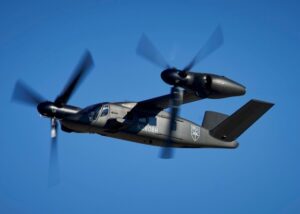
NASHVILLE, Tenn. – The Army announced Wednesday it has officially designated its MV-75 Future Long Range Assault Aircraft (FLRAA) as the Cheyenne II, with senior leaders affirming a plan to equip a first unit with two dozen initial aircraft in fiscal year 2030.
Army officials ahead of the naming announcement at the Army Aviation Association of America’s annual conference here declined to offer further dates for specific milestones on the accelerated program timeline, citing supply chain variables and the need for stable funding.
“I don’t want to commit to dates just because I don’t own all the variables there. Like I said, it is a very success-oriented schedule. If everything goes well, we’ll probably see it flying inside of the next two years. But if we run into some challenges, that’s going to push things off to the right,” Maj. Gen. Clair Gill, portfolio acquisition executive (PAE) for maneuver air, told reporters last week. “We’ve taken as much slack out of the system as we possibly could, but that doesn’t allow for anything to go wrong either.”
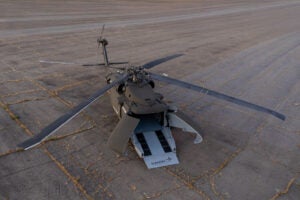
Bell’s [TXT] V-280 Valor tiltrotor aircraft was named the winner of the FLRAA competition in December 2022, which aimed to find a platform that could eventually replace a sizable portion of the Black Hawk fleet. The Army awarded the company an initial deal worth up to $1.3 billion that could total $7 billion if all options are picked up.
The Army in August 2024 approved the Milestone B decision to move the FLRAA program into the Engineering and Manufacturing Development phase, to include picking up the next contract option that will cover the build of six prototype aircraft (Defense Daily, Aug. 2 2024).
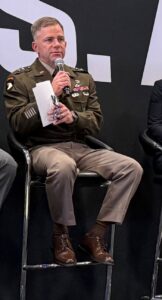
“This is a generational leap in capability for the Army. [It’s] an aircraft that flies twice as far, twice as fast as our current fleet. [It] truly fundamentally changes how commanders think about distance, time and maneuver on the battlefield. It combines the vertical lift of a helicopter with the speed and range of an airplane, allowing us to project combat power from safer distances, penetrate deeper into contested environments and deliver soldiers where they are needed most, faster than we ever have before,” Brent Ingraham, the Army’s top acquisition official, told reporters.
Gill notes the MV-75 Cheyenne II is the first entirely new aircraft introduced into the Army’s inventory since the 1980s, describing it as “complex [a program] as we could have.”
“We feel good about it. But I don’t want to be overly optimistic and commit to something that, two years from now, I would potentially look back and say there were so many factors in there that I didn’t control and we didn’t understand till we got to that point,” Gill said.
The Army over the last year has detailed a push for an accelerated timeline for the newly-named MV-75 Cheyenne II, previously noting an aim to make an early production decision in fiscal year 2028, a year earlier than originally scheduled, and outlining plans to begin delivering the first aircraft to the 101st Airborne Division by late 2028 or early 2029 (Defense Daily, Oct. 13, 2025).
Gill noted the future MV-75 Cheyenne II remains on a “very aggressive schedule,” while declining to provide further specifics on when the Army expects to achieve program goals in the lead up to the first unit equipped milestone in FY ‘30.
“What I would caution is, because this is such a complex system and the first of its kind, in terms of how we’re developing it, there’s a lot that we have to learn along the way. And so I would say we have some very optimistic goals about when we’re going to deliver a first aircraft and when we’re going to deliver a first formation. And so, we’re pretty excited about what Bell is doing and Textron, but we also acknowledge that we have a lot of complexity that we’ve got to consider. And so, we’re going to take it day by day, week by week and month by month, as we work through their integrated master schedule that they have developed with us,” Gill said.
“A battalion of 24 [aircraft] is what we’re shooting for. How we get there…includes a lot of variables,” Gill added. “If I owned every one of those variables, I would tell you exactly what date it’s going to come off the production line, what date it’s going to break friction with the ground, what date that it’s going to start its flight test envelope expansion. The problem is I don’t own every single one of those variables until we know that the parts suppliers are delivered and that the engineers have done enough modeling in the simulator. So that’s why I’m not willing to commit to tell you exactly when something’s going to happen.”
When asked about the dates discussed over the last year in regards to the accelerated program timeline, Deputy PAE Maneuver Air Brig. Gen. David Phillips told reporters those “are still valid.”
“Without committing to a scheduled date, the work to get to a baseline schedule is 100 percent what the teams have been working toward over the past two years,” Phillips said.
Phillips said much of the acceleration effort to date has focused on ensuring the supply chain for MV-75 Cheyenne II was ready to “to really keep up with the plan to get to that first unit equipped,” noting there are around 200-300 tier one and two suppliers and another 2,000 tier three and four suppliers contributing to the program.
“What we’re looking at is the realities of the supply chain and the suppliers and making sure we can line up each of those components for those suppliers in the supply chain to arrive on time, on time for testing, on time for qualification and really then assembling all that in the next year, so we’ll have an aircraft ready to test,” Phillips said.
Bell told Defense Daily last May it was “confident” it can meet the Army’s accelerated timeline for FLRAA (Defense Daily, May 19 2025).
Rolls-Royce is currently testing the new AE 1107 engines set to power the MV-75 Cheyenne II, and Scott Ames, the company’s senior vice president for the MV-75 program, has also expressed confidence in supporting the more rapid schedule (Defense Daily, Dec. 16, 2025).
“We support the Army’s plan to accelerate the MV-75 FLRAA program. We are confident in the steps we’ve taken to meet a faster timeline, including the use of digital engineering and virtual prototyping, as well as close collaboration with Bell and the Army throughout the process. We are currently conducting engine integration testing that gives us greater confidence every day that we will be able to deliver,” Ames said. “That being said, we will continue testing in 2026 and are on track to deliver the first set of engines prior to Bell’s delivery of the MV-75 FLRAA prototype to the U.S. Army.”
Awaiting Budget Details
Budget documents released to date outlining the Pentagon’s FY ‘27 spending request do not appear to provide much insight into the Army’s MV-75 Cheyenne II plans, while the department and the service is set to roll out a more detailed budget next week.
“As the full budget rolls out, you’ll see where we’re focused on not only introducing this new aircraft but ensuring that we maintain and keep the operational fleet we’ve got today,” Ingraham said, while declining to provide specifics on MV-75 budget numbers at the moment.
“This name reflects more than heritage. It reflects identity. The Cheyenne people inhabited the Great Plains for 400 years, adopting to a harsh and unforgiving environment as highly proficient hunters and gatherers,” Ingraham said of the new designation. “Today, the Cheyenne are represented by the Northern Cheyenne tribe in Montana [and] in the Cheyenne and Arapaho tribes in Oklahoma, whose legacy reflects the proud and enduring warrior tradition, ground and protection, provision and leadership. Those values demand capability, and in today’s fight, that capability comes in the form of speed, range, lethality and adaptability, that spirit of mobility, resilience and discipline, strength is what the name Cheyenne II represents.”
The Army previously used the Cheyenne name in the late 1960s for the Lockheed-developed and subsequently cancelled AH-56 high-speed attack helicopter, which Gill noted represented a similar “transformational leap ahead technology” approach to the FLRAA effort.
“While the AH-56 program did not move forward, its legacy of innovation and speed lives on in the new tiltrotor platform,” the Army said in a statement on Wednesday.
Cal Biesecker contributed to this story