 By
By 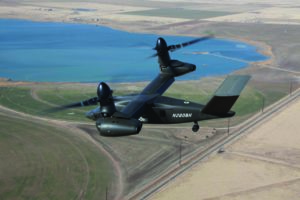
A lead official on Monday detailed the Army’s plan to speed up the Future Long Range Assault Aircraft (FLRRA) timeline as the service now looks to receive the first Bell [TXT]-built prototype in early fiscal year 2027 and plans for an early production decision in FY ‘28.
Col. Jeffrey Poquette, project manager for FLRAA, said Army budget officials have also affirmed the ability to move “billions of dollars to the left” in funding plans in order to support the program acceleration.
“What we’ve said is can we make an early production decision at the right risk levels with the right authorities earlier than Milestone C. So we pulled that early production decision to the left. The Army’s still got time to make it. It is a decision. It is not a foregone conclusion,” Poquette said during a Defense News panel at the Association of the U.S. Army conference in Washington, D.C.
Bell’s V-280 Valor tiltrotor aircraft was named the winner of the FLRAA competition in December 2022, which aimed to find a platform that could eventually replace a sizeable portion of the Black Hawk fleet, awarding the company a deal worth up to $1.3 billion that could total $7 billion if all options are picked up.
Army leaders in May first detailed an intent to speed up fielding of the MV-75 FLRAA by two years, with an aim to now deliver the first aircraft to the 101st Airborne Division by late 2028 or early 2029 (Defense Daily, May 14).
Poquette on Monday noted the Army was expecting to have the first prototype from Bell in mid-2027, before Army Secretary Dan Driscoll directed that be achieved in 2026, with the new date now set for early FY ‘27.
Additionally, the early production decision is also expected to occur a year earlier than originally planned, with the Army looking to consolidate the concurrent testing and production timelines.
Bell told Defense Daily in May it was “confident” it can meet the Army’s accelerated timeline for FLRAA (Defense Daily, May 19).
To achieve the acceleration, Poquette said the Army will look to move into production before completely finishing developmental testing on the initial FLRAA prototypes.
“We don’t see it as risky as in the past. Some programs have done development tests and operational tests at the same time. We’re not doing that. [This is] developmental tests, production alongside [that] and then operational test when the right risk authority is comfortable putting that airframe in the air with operators,” Poquette said.
The early production decision will be informed by data gathered in testing to date, a successful critical design review and ensuring the first prototype flies properly, Poquette added.
“If all that happens then the Army acquisition executive can make an early production decision and say, ‘I’m willing to accept the risk that they won’t be perfect but they will be valuable to the operator,” Poquette said.
The House’s version of the next National Defense Authorization Act includes a provision supporting the use of early production contracts for FLRAA (Defense Daily, July 24).
On the budget aspect for the FLRAA acceleration, Poquette noted the Army doesn’t plan to spend more money but rather will look to allocate those funds earlier than previously projected.
“It was a hard thing for [the Army G-8] to do. Make no mistake, it’s a lot of money. It’s bringing billions of dollars to the left. Again, we’re spending [that] earlier. It’s not more [money],” Poquette said.
The timeline would allow for a company’s worth of aircraft to be delivered 18 months earlier, a battalion of 24 aircraft 18 months earlier as well, and a brigade of aircraft 30 months earlier, according to Poquette.
“So not only are we making an early production decision but we’re ramping up our production [plans],” Poquette said.
In working with Bell, Poquette said the Army’s priorities for “right to repair” language and building on a modular open systems architecture were “non-negotiable” when looking at how to speed up the timeline.