SASC Bill Caps RD-180 Purchases, Sets Up Potential Battle With HASC
Pat Host
SHARE:
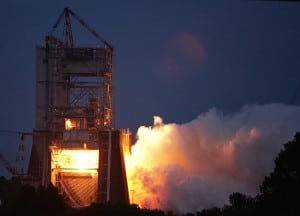
NASA engineers successfully test the Russian-built RD-180 in 1998 at the Marshall Space Flight Center (MSFC) in Huntsville, Ala. Photo: NASA.
The Senate Armed Services Committee (SASC) is setting up a battle with its House counterparts over the RD-180 as it banned use of the Russian-developed rocket engine beyond those permitted in National Defense Authorization Acts (NDAA) for fiscal years 2015 and 2016.The SASC bill summary, released late Thursday, said once those nine RD-180s are expended, the Air Force would be authorized to use only launch vehicles that do not require engines designed or manufactured in Russia. The HASC bill permits…
Defense Secretary Pete Hegseth said Wednesday the Trump administration plans to continue its push for at least $350 billion in defense funds via the reconciliation process “regardless of what happens […]
A small, bipartisan group of senators is backing the Fast Tracking European Investment in Ukraine’s Defense Act, S. 5175, to hasten the export of allied buys of U.S. munitions for […]
Rep. Jim Himes (D-Conn.), the ranking member of the House Permanent Select Committee on Intelligence, plans to increase the committee’s contractor oversight if the Democrats win control of the House […]
A new Congressional Budget Office report estimates the cost of the Iran war through Aug. 1 as $38 billion and says that the U.S. has likely depleted between one-half and […]
SASC Bill Caps RD-180 Purchases, Sets Up Potential Battle With HASC
Pat Host
SHARE:
The Senate Armed Services Committee (SASC) is setting up a battle with its House counterparts over the RD-180 as it banned use of the Russian-developed rocket engine beyond those permitted in National Defense Authorization Acts (NDAA) for fiscal years 2015 and 2016.
The SASC bill summary, released late Thursday, said once those nine RD-180s are expended, the Air Force would be authorized to use only launch vehicles that do not require engines designed or manufactured in Russia. The HASC bill permits the use of an additional 18 RD-180s. If both houses approve their authorization bills without changes to these provisions, the differences will have to be sorted out in conference.
NASA engineers successfully test the Russian-built RD-180 in 1998 at the Marshall Space Flight Center (MSFC) in Huntsville, Ala. Photo: NASA.
To help the Air Force get off the RD-180 quicker, the SASC bill allows for up to half of the funds made available for the development of a replacement launch vehicle or launch propulsion system to be made available for offsetting any potential increase in launch costs as a result of prohibitions on Russian rocket engines.
The committee said it believes there is “more than sufficient funding” available and budgeted for a replacement propulsion system or launch vehicle and to offset any additional costs considering, SASC said, $1.2 billion has been budgeted from fiscal years 2017 to 2021 for the launch replacement effort with $453 million already appropriated in fiscal years 2015 and 2016.
The Air Force uses the RD-180 in its Atlas V launch vehicle, which is developed by United Launch Alliance (ULA). Without the use of the Atlas V, the Air Force would be forced to rely upon ULA’s American-made Delta IV launch vehicle, which is significantly more expensive than both the Atlas V and Space Exploration Technology Corp.’s (SpaceX) Falcon 9.
The Falcon 9 is the only other launch vehicle certified to perform national security missions. A ULA official said Friday the SASC provision effectively limits the company to the use of four RD-180s in future missions as five have already been assigned to other missions. The Air Force doesn’t expect a new launch vehicle ready for use until the early 2020s at the earliest.
The House is expected to take up the HASC bill the week of May 16. The full SASC bill language should also be available the same week.
ULA is a joint venture of Lockheed Martin [LMT] and Boeing [BA].
NATIONAL HARBOR, Md. – A Senate Armed Services panel chair today said boosters of the Golden Dome program still have work to do to increase support on Capitol Hill while […]