The Defense Department’s top secret laboratories are working on artificial intelligence (AI) that will allow military aircraft to think, learn and adapt to threats mid-flight.Arati Prabhakar, director of the Defense Advanced Research Projects Agency, said the ability of robotic brains to operate in the physical world is still relatively limited, so fears of rogue humanoid Terminators are unfounded. Within the digital world, AI can allow unique versatility and adaptability for military platforms, including software-defined combat aircraft.“Today our aircraft go out.…
Defense Secretary Pete Hegseth said Wednesday the Trump administration plans to continue its push for at least $350 billion in defense funds via the reconciliation process “regardless of what happens […]
A small, bipartisan group of senators is backing the Fast Tracking European Investment in Ukraine’s Defense Act, S. 5175, to hasten the export of allied buys of U.S. munitions for […]
Rep. Jim Himes (D-Conn.), the ranking member of the House Permanent Select Committee on Intelligence, plans to increase the committee’s contractor oversight if the Democrats win control of the House […]
A new Congressional Budget Office report estimates the cost of the Iran war through Aug. 1 as $38 billion and says that the U.S. has likely depleted between one-half and […]
The Defense Department’s top secret laboratories are working on artificial intelligence (AI) that will allow military aircraft to think, learn and adapt to threats mid-flight.
Arati Prabhakar, director of the Defense Advanced Research Projects Agency, said the ability of robotic brains to operate in the physical world is still relatively limited, so fears of rogue humanoid Terminators are unfounded. Within the digital world, AI can allow unique versatility and adaptability for military platforms, including software-defined combat aircraft.
“Today our aircraft go out. They are loaded with a set of jamming profiles that allow them, when pinged by an adversary’s radar, they have a library of jamming profiles that they can transmit to protect themselves,” she said Monday at the Atlantic Council’s Global Strategy Forum in Washington, D.C. “Today, they are finding they are getting pinged by signals we’ve never encountered before and it’s just one reflection of how rapidly technology is changing in the world.”
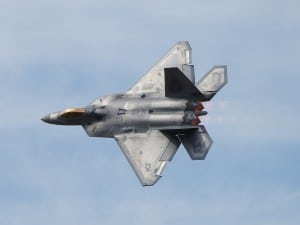
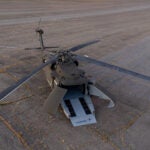
An Air Force official said the F-22 is an early adopter of Open Mission System (OMS) standards. Photo: Air Force.
Developing an effective jamming signal for a novel radar signal can take weeks or months, she said. With DARPA’s new machine learning system, the aircraft will be able to scan the radio spectrum in real time to characterize the enemy radar’s signal and immediately create an effective jamming profile.
“We are seeing this burgeoning of commercial applications for AI. At DARPA we are harvesting that research and some of that commercial technology for national security needs. As we apply AI to whole new fields like spectrum, we are creating a set of opportunities for military needs–something that is critical for DoD–but in the process we are laying the groundwork for the next generation of new commercial opportunities.”
Current iterations of artificial intelligence are embedded in both military and consumer technologies and operate largely without notice, she said. Facebook [FB] uses a version of AI when its algorithms perform face recognition on photos uploaded to its site. Google and other search engines use artificial intelligence to complete even obscure search queries as they are typed.
“We see something that is very powerful, very valuable for military application, but something that is quite fundamentally limited,” she said. “Where it works well, we are finding amazing new applications for artificial intelligence.”
She gave the example of the Sea Hunter, an autonomous naval vessel christened in April. It is designed to be able to leave port and navigate by itself without a single sailor onboard. Its ability to avoid obstacles and navigate between points is based on basic AI capabilities developed at DARPA.
Early government investment in basic scientific research has produced technologies–the Internet, the Global Positioning System, Google Maps–that have roots in military laboratories but gained universal commercial applications. Prabhakar called for a continuation in R&D funding so the United States and its military can remain dominant in an era when technology is rapidly proliferating.
Every nation, especially developed and developing states, have significantly ramped up investment in basic research and development in the last several decades. While the United States was the global powerhouse in strength and technology for a period after World War II, it now has peers on the world stage that are developing new capabilities.
“The U.S. is still in a very, very strong position in R&D,” she said. “What’s different is we’re no longer alone. This is good for the world because these investments are critical to propelling economies forward, to lifting people out of poverty, to connecting us in ways we’ve never been connected before.”
While all that goodness is happening in the world, it still requires new thinking here at home about how we operate in this kind of world.
In the U.S. and elsewhere, much of the growth in R&D spending has been by the private sector, and has outpaced the average growth in gross domestic product for many developed nations, she said. Government spending on research has not kept up with GDP, but “remains critically important first for government missions like national security…[and to] lay a foundation of basic research that is critical for our public needs, and also fuels that private growth.”
NATIONAL HARBOR, Md. – A Senate Armed Services panel chair today said boosters of the Golden Dome program still have work to do to increase support on Capitol Hill while […]


 By
By