 By
By 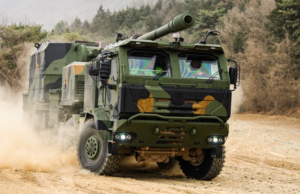
The Army recently ordered three more Mobile Tactical Cannon-Wheeled prototypes, a Hanwha Defense USA (HDUSA) official has said, detailing the company’s plan for transitioning K9 Mobile Howitzer production work to the U.S. from South Korea.
Mike Smith, HDUSA’s chief operating officer and president of land systems, also confirmed to reporters that the company plans to pursue the Army’s new tracked howitzer modernization effort
“Are we interested? Absolutely, very interested in that. When you think of artillery as a system, it becomes that much more valuable the more commonality you have between your platforms,” Smith said during a briefing ahead of the Association of the U.S. Army’s annual conference in Washington D.C.
Following a demonstration period with industry, the Army formalized a plan to find a wheeled 155mm self-propelled howitzer solution to replace its M777 towed howitzers, ultimately selecting HDUSA’s K9 Mobile Howitzer in August (Defense Daily, Aug. 18).
HDUSA was awarded a deal initially worth $100.3 million to provide six of its wheeled howitzer platforms, with the contract including an option for up to 12 more prototypes and potentially totalling up to $292.9 million.
Smith noted the MTC-Wheeled award is HDUSA’s first prime contract with the Pentagon.
HDUSA has said it expects the first MTC-Wheeled prototype to be delivered this fall and the sixth within a year of the award (Defense Daily, Aug. 19).
The award for the next three K9 Mobile Howitzers under the contract option was awarded on Sept. 24, according to Smith. He declined to disclose the value of the order, but added it’s “in line with what we would expect.”
“And there’s some other things in that option that were ordered. So I’m going to hang fire on that one because the Army hasn’t published that yet,” Smith said, adding the service is looking at ways to accelerate MTC because “they’re seeing that we can take more on.”
Smith said HDUSA expects that most of the prototype manufacturing will occur in South Korea, while the company works to ramp up the amount of work occurring in the U.S. in the lead-up to a planned production contract.
“However, we’re going to get to a point where we’re going to graduate from vehicle integration and fire control integration to the integration…of taking the turret assembly and mating that with the truck itself. The vehicle over time will be assembled in the U.S. as well,” Smith said. “The gun will be broken into five different sub-assemblies, and the truck will eventually be assembled in the United States. So much of that touch labor is going to happen in the U.S. It’ll happen just before we get to full rate production, which would be vehicle number 19.”
The South Korea-based Hanwha announced in the spring it had officially picked Opelika, Ala., as the location for its new site to support U.S.-based integration and testing of its K9 family of mobile howitzers, signing a three-year lease for the project, which is part of the company’s effort to establish a multi-site, U.S.-based Artillery Production Complex (Defense Daily, May 1).
Smith added that a production contract is anticipated to be awarded in late 2028, and could cover 24 K9 Mobile Howitzers plus 24 resupply vehicles.
“The Army would like to see that rate go up even more if they can ressource it. We can handle it because we have a backstop in Korea. But we’re looking to outfit a facility that can support, without question, 48 vehicles a year,” Smith said.
For future production, the Army has stated that a “foundational requirement” for the howitzer program is that “substantial final assembly” must occur in the U.S. and said that proposals detailing a plan to establish domestic manufacturing on a timeline greater than two years “will be considered but will be viewed less favorably.”
Smith said the Army views localization of production as relating to capability for “substantial [final] assembly” occurring in the U.S.
“That will start happening during those first 18 prototypes, but will substantially occur in full rate production. Now, if the Army decides to change its definition, then we’ll look at how we want to throttle that transition. But for us, and for now, what the Army really wants is to see substantial assembly in the United States. And that’s what we’re planning through those first 18 prototype vehicles,” Smith said.
“What the Army cares about the most [is] speed of delivery. They want capability in soldiers’ hands quickly,” Smith added.
Lt. Gen. Frank Lozano, program acquisition executive for fires, told reporters last month the Army is planning a “very aggressive” effort to move out on its new MTC-Tracked effort in the first half of 2027, with plans for competitive prototype selections around February to April and an aim to pick a winner by July (Defense Daily, Sept. 10).
Lozano said that, similar to the MTC-Wheeled pick of Hanwha’s K9 Mobile, the Army is interested in mature, non-developmental offerings to support the rapid Mobile Tactical Cannon-Tracked (MTC-T) timeline.
Smith said HDUSA has “a lot of options” for what it could look to offer to meet the MTC-Tracked requirement.
“We’re looking at a menu of options for the Army. The K9 A1, if you want it fast and now and the most cost-effective version, K9 A1 is probably what you want. K9 A2 is completely common with the [K9 MH] vehicle you just purchased, the wheeled vehicle, and it has the level of automation that you want if you want to achieve rates of fire in the nine to 10 rounds per minute range. And then we have several variants of those two vehicles that are being sold to other armies. I mean, this system is completely tailorable to the needs of specific forces that are operating in certain environments. So there are some other variants that we can offer. So that’s our plan. I’ll be 100% transparent with that,” Smith told reporters.