AI/Classified Networks. The Pentagon announced on May 1 it has entered into agreements with SpaceX, OpenAI, Google, NVIDIA, Reflection, Microsoft and Amazon Web Services to leverage their advanced artificial intelligence capabilities on the department’s classified networks. The department specified the AI tools would be deployed for “lawful operational use.” “Integrating secure frontier AI capabilities into the Department’s Impact Level 6 and Impact Level 7 network environments will streamline data synthesis, elevate situational understanding and augment warfighter decision-making in complex operational environments,” the Pentagon said in a statement. The update follows the department’s ongoing public dispute with AI firm Anthropic, which has included President Donald Trump ordering the federal government to halt the use of its products after the company said it wanted oversight safeguards for its Pentagon work. Anthropic’s Claude AI model has been deployed on classified networks, and the technology is part of the Palantir-built Maven Smart System.
Getting to $1.5 Trillion. About $350 billion of the Pentagon’s $1.5 trillion fiscal 2027 spending request is “mandatory” funding that is subject to a future reconciliation bill from the Trump administration. Defense Secretary Pete Hegseth said at a Senate Armed Services Committee (SASC) hearing that the “mandatory” funding is to help the Pentagon reach the $1.5 trillion goal, while Sen. Angus King (I-Maine) last week told Hegseth that the reconciliation bill will, in effect, remove one-quarter of the Pentagon’s request from bipartisan oversight, as the bill can pass with just a majority of senators, rather than the 60 cloture threshold.
…$400 Million? Section 1243 of the fiscal 2026 National Defense Authorization Act provides $400 million in equipment funding for Ukraine as an extension and modification to the Biden administration’s Ukraine Security Assistance Initiative (USAI), which the Trump administration ended in favor of the Prioritized Ukraine Requirements List (PURL) under which European nations buy U.S.-made weaponry. On April 29, SASC received a Pentagon notice that the funds are awaiting disbursement for Ukraine, but SASC has received no spend plan on the funds from Undersecretary of Defense for Policy Elbridge Colby, and the Pentagon notice indicated that the U.S. will seek “commensurate compensation” from PURL, according to Sen. Jeanne Shaheen (D-N.H.). Hegseth told SASC that the funds would go toward “European capacity building,” and Pentagon Comptroller Jules Durst told the committee that DoD’s legal counsel had issued a report on whether those funds could be used in the same manner as USAI. Durst said he understands that “those funds will be put to work very shortly.” Referencing the Trump administration’s intention to get reimbursement from Europe for the $400 million, Shaheen did not receive an answer from Hegseth or Durst when she asked, “Why are you using PURL to do something that Congress intended to go directly to Ukraine?”
HIMARS Award. The Army on April 29 awarded Lockheed Martin an undefinitized contract worth up to $1.1 billion for full rate production of HIMARS launchers. The Pentagon said the deal covers “urgent needs” for the Army and Marine Corps as well as Foreign Military Sales cases with Australia, Canada, Estonia, Sweden and Taiwan. Work on the deal is expected to be completed by the end of April 2028.
CVN-69 PIA. The Navy on April 28 announced the Nimitz-class aircraft carrier USS Dwight D. Eisenhower (CVN-69) completed sea trials to mark the early completion of its Planned Incremental Availability (PIA) at the Norfolk Naval Shipyard. PIAs include extensive maintenance, repairs and modernization. The service said CVN-69 is the second timely delivery of a carrier from PIA after the USS George H.W. Bush (CVN-77) finished its own PIA in November 2024.
T-ATS 12. The Navy and Austal USA plan to christen the future USNS Solomon Atkinson (T-ATS 12) Navajo-class towing, salvage and rescue ship at the company’s Mobile, Ala., shipyard on May 2. The Navajo-class multi-mission ship is designed to support various missions including towing Navy ships, salvage, humanitarian assistance, oil spill response and wide-area search and rescue. The ship class also has 6,000 square feet of deck space for embarked systems. T-ATS 12 is the seventh ship in the class and is named after a member of the first SEAL Team One.
Avenger Class Update. The Navy Department Director of Expeditionary Warfare confirmed the service could hold off on retiring the remaining Avenger-class mine countermeasure (MCM) ships in favor of the Independence-variant Littoral Combat Ships’ MCM mission package amid the ongoing hostilities with Iran. Speaking to reporters during the Modern Day Marine conference on April 28, Director of Expeditionary Warfare Brig. Gen S. Lee Meyer said while there is a plan to replace the remaining legacy Avenger-class capability with new capability, “operational events get a vote. So now we have our plan, and any time there’s any perturbation in that, we react to what the fleet asks for, and then they tell us what they need, and then we provide the capability.” He added the Navy will not increase risk for combatant commanders, even though they still have a plan to replace the Seventh Fleet’s legacy capabilities with a “modernized capability.”
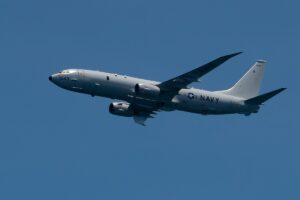
P-8A IOC. Naval Air Systems Command (NAVAIR) on April 24 announced the Navy declared Initial Operational Capability (IOC) for the P-8A Poseidon Increment 3 Block 2 system. IOC followed the first phase of Initial Operational Test performed by Air Test and Evaluation Squadron One (VX-1) with support from the Maritime Patrol and Reconnaissance Aircraft Program Office, NAVAIR said. P-8A is the Navy’s long-range anti-submarine warfare (ASW) aircraft with intelligence, surveillance and reconnaissance capabilities. This latest increment adds upgrades to the aircraft airframe and avionics system, and new airframe racks, radome, antennas, sensors, and wiring. Other improvements include a new combat systems suite with “improved computer processing, higher security architecture, a wideband satellite communication system, an ASW signals intelligence capability, a track management system, and additional communications and acoustics systems to enhance search, detection and targeting capabilities,” NAVAIR said.
KC-135 Comms. The fiscal 2026 National Defense Authorization Act established a floor of 466 KC-135 and KC-46 tankers this year and 478 by the start of fiscal 2027, and Air Force Chief of Staff Gen. Kenneth Wilsbach says that the service will meet the goals on the way to 502 tankers, which defense authorizers mandate by the beginning of fiscal 2029. The Air Force’s fiscal 2027 budget includes $105 million for 315 proliferated low-earth orbit hybrid SATCOM terminals and Viasat Ku-band array kits, and the KC-46As are already receiving similar hybrid SATCOM, according to Wilsbach.
HII TTLR. HII on April 27 said received a contract from the Defense Innovation Unit (DIU) to deliver a Torpedo Tube Launch and Recovery (TTLR) system, designed to autonomously deploy and recover its Remus unmanned underwater vehicle (UUV) from submarines. The company has delivered over 650 Remus vehicles to over 30 countries over two decades. In June 2025, the Navy and Woods Hole Oceanographic Institution (WHOI) marked the first forward-deployed torpedo tube launch and recovery of a Remus 600 UUV from the Virginia-class submarine USS Delaware (SSN-791). SSN-791 and an embarked unmanned undersea vehicle squadron-one (UUVRON-1) workforce conducted the Yellow Moray UUV development operation with three fully autonomous launch and recovery sorties via the torpedo tube. Then in July 2025, HII, WHOI and the Navy’s Undersea Warfare Center Division Newport completed the first recovery of the newest generation REMUS 620 into a Virginia-class submarine torpedo tube and shutterway test fixture at Seneca Lake, N.Y.
…L3Harris Too. HII’s announcement follows a similar March 25 announcement by L3Harris Technologies of an Other Transaction Authority contract from the DIU to deliver its own TTLR system that deploys and retrieves the company’s Iver4 90 autonomous underwater vehicles via submarine torpedo tubes. L3Harris added its TTLR system delivered the first U.S. Navy submarine and aviation-approved AUV lithium-ion battery technology that allow longer duration missions and “hot-swap capability for continuous operations.” The company said both U.S. and allied navies have previously validated its TTLR system to conduct intelligence, surveillance, reconnaissance, mine detection and seabed warfare missions via AUVs.
New C-UAS HPM System. ThinKom last week said it is self-funding a mobile high-power microwave (HPM) for fire-on-the-move operations against drone swarms. Alecto features California-based ThinKom’s VICTUS steerable, mechanical phased-array antenna technology and vacuum electronics for power generation, which “eliminates the need for prior target knowledge, which is essential for countering rapidly evolving UAS technologies,” the company said. “Alecto combines the HPM advantage of a deep magazine and low cost per shot, with rapid beam steering and instantaneous effects, enabling it to effectively defeat swarms.”
U.S. Laser Producer. Aurelius Systems last week announced a new division focused on manufacturing high-power fiber laser source modules in the U.S. to fill a gap in the domestic supply chain for laser sources, which the San Francisco-based company said is increasingly dominated by China. Aurelius, developer of the Archimedes autonomous directed energy laser system for countering drones, said Aurelius Manufacturing’s first product “is a compact, rack-integrated fiber laser source module rated at multi-kilowatt output” that will be available for directed energy and industrial manufacturing applications. The laser sources are designed “with full domestic traceability and no dependency on foreign allocation schedules,” it said.
Small UAS. Mistral Inc. said on April 27 it has received a $20 million award from the Army to provide the FUSE-developed THOR drone in support of the Army’s Company-Level sUAS Directed Requirement effort. “The THOR Group 2 drone is a military tactical, fully autonomous multi-rotor mini-UAS designed for a wide range of operational applications and reconnaissance missions, emphasizing rapid deployment and flexible payload carriage. Backpack-carried and rapidly assembled, THOR is designed to support small tactical teams with a flexible aerial capability spanning reconnaissance, surveillance, target acquisition/identification, communications relay, electronic warfare support, resupply/cargo, and configurable effects options as mission requirements evolve,” Mistral said in a statement. The Company-Level sUAS program is intended to rapidly field UAS capabilities to support maneuver units while also informing the future Medium Range Reconnaissance Requirement, with the Army having worked with Performance Drone Work’s C-100 and Anduril Industries’ Ghost X UAS to date.
C-UAS Marketplace Expands. The new counter-unmanned aircraft system (C-UAS) marketplace that catalogs counter-drone systems and equipment for potential purchase by the Defense Department, the interagency and allies, now includes Romania as a potential customer. The DoD’s Joint Interagency Task Force (JIATF)-401, which manages the C-UAS Marketplace, said the U.S. Army secretary and Romanian defense minister signed an agreement last week enabling the NATO ally to purchase technologies on the marketplace. The United Kingdom previously signed onto the marketplace and the U.S. Army secretary has a goal of 25 partner nations to be part of the framework for interoperable C-UAS by this summer.
DropShip First Flight. Pyka last week said its DropShip heavy-lift autonomous aircraft successfully completed its first flight after the concept for the Group 3+ unmanned aircraft system (UAS) was conceived six months ago. DropShip can carry up 550-pounds of payload, depending on range, and is aimed at fulfilling missions in austere and contested logistics environments. The hybrid propulsion DropShip builds on the company’s legacy serving the agriculture industry with its autonomous Pelican crop dusting aircraft. The autonomous platform has more than 10,000 flights across agriculture and logistics, Pyka says.
…AIR First Flight. Israel’s AIR last month said its autonomous AIR Cargo-Heavy Lift UAS had its first successful flight test and is ready for production. The Group 4 vertical takeoff-and-landing UAS has a payload capacity of about 550 pounds and a 70 cubic-foot cargo bay and is geared to operate in remote and contested environments, maritime operations, and for humanitarian aid and commercial cargo delivery. AIR said 25 units have been ordered and paid for.
Long-Range UAS. The Air Force Research Laboratory has awarded DZYNE Technologies a “multi-million dollar contract” to purchase three ULTRA Turbo unmanned tactical reconnaissance unmanned aircraft system (UAS), which can operate above 18,000 feet and remain aloft for three days. The California-based company last week said the award is a key milestone for the Group 5 ULTRA to become a program of record. The UAS has more than 450 pounds of payload capacity.
Autonomous Drone Raise. SkyfireAI last week said it raised $11 million in a seed round led by Mucker Capital to accelerate development of its artificial intelligence platform for autonomous multi-ship drone operations in support of public safety and defense customers. The Huntsville, Ala.-based startup says its software platform “supports the full mission lifecycle, from planning and deployment to orchestration and operational oversight, helping organizations scale drone programs while remaining grounded in operational realities.”
SRMs Down Under. Australia last Wednesday said it has selected Northrop Grumman as the preferred industry partner to establish solid rocket motor (SRM) production in the country. The government is investing an initial $91 million to establish SRM production in Australia. Minister for Defence Industry Pat Conroy’s office stated that the country will begin producing rocket motors for Guided Multiple Launch Rocket System missiles by 2030 and that a dedicated manufacturing complex for high-rate production will be operational in 2033.
…Potential Expansion. Conroy’s office also said it will work with two Australian companies, DefendTex and Black Sky Industries, and Anduril Industries’ Australian subsidiary, to assess their respective “novel manufacturing methods” as potential longer-term opportunities for additional domestic SRM production once the work with Northrop Grumman has been established. “By partnering with experienced and proven international rocket motor manufacturers, the program will build local industry capability at speed, support Australian businesses and create highly skilled jobs,” it said.
Australia Picks PrSM. Australia announced on April 28 it has picked Lockheed Martin’s Precision Strike Missile (PrSM) and HIMARS launcher to fulfill the Australian army’s requirement for a new long-range strike capability. The selection follows a competitive evaluation process that involved also assessing Kongsberg’s Naval Strike Missile, with Australia planning to invest $2.3 billion over the next decade on the PrSM and HIMARS capabilities. “As the 2026 National Defence Strategy sets out, the Australian Defence Force (ADF) requires greater capacity for long-range strike to defend Australia,” the country said in a statement.“A second long-range fires regiment will significantly enhance the ADF’s ability to engage targets at ranges of up to 500 [kilometers], transforming to more than 1,000kms with future increments of PrSM. This will increase our capacity to respond effectively to contingencies in our region and work with our allies and partners.” The update follows Australia’s progress building a production line for Lockheed Martin’s GMLRS rocket, to include recently firing the first domestically-manufactured weapon, and having previously established a cooperative program with the U.S. to work toward building PrSM in the country as well.
ERIS Deals. The Army said on May 1 it has awarded contracts to Pacific Defense Strategies, SRC and Herrick Technologies Laboratories to work on prototyping the Electromagnetic Warfare Rapid Integration System (ERIS). The value of the deals has not yet been disclosed. “ERIS is a forward-looking initiative designed to counter sophisticated radio frequency threats through adaptable, scalable technology,” the Army wrote in a statement. “This program will demonstrate that small, modular electromagnetic warfare systems can be deployed from air, ground and autonomous platforms, providing the U.S. Army with the flexibility to control the electromagnetic spectrum.” The Army noted ERIS is the first official program to award contracts under the Capability Program Executive for Intelligence and Spectrum Warfare’s new open solicitation authority utilizing the Commercial Solutions Opening process. In the second phase of ERIS, the Army said it will conduct a downselect to a single system to support an operational demonstration.
Hanwha Picks Opelika. South Korea’s Hanwha announced it has officially picked Opelika, Ala., as the location for its new site to support U.S.-based integration and testing of its K9 family of mobile howitzers. Hanwha Defense USA said it signed a three-year lease for the project, which is part of the company’s effort to establish a multi-site, U.S.-based Artillery Production Complex purpose built for domestic manufacturing of howitzers. In late March, HDUSA confirmed it will offer its K9 Mobile Howitzer for the Army’s Mobile Tactical Cannon competition and was planning to establish a new site in Alabama to support production. “This investment demonstrates HDUSA’s commitment to localizing production as part of its submission of Hanwha’s K9 Mobile Howitzer in response to the U.S. Army’s Mobile Tactical Cannon Request for Prototype Proposal,” HDUSA said in a statement. “HDUSA will continue to evaluate future phases and locations as we expand our U.S. artillery systems footprint. The company is committed to developing the workforce of the future necessary for long-term sustainment and technology insertion activities.”
Record BlackSky Award. BlackSky Technologies last Thursday said it wone a nearly $30 million contract from an international defense customer for a one-year subscription for its space-based tactical Earth imagery, the company’s largest award yet for its “Assured” access offering. BlackSky said the customer went from a six-figure “Early Access” pilot to the Assured access contract in under six months. “With latency as an operational priority, our customer required a true tactical ISR framework capable of matching the sophistication and speed of their day-to-day mission,” Brian O’Toole, BlackSky’s CEO, said in a statement.
Saronic-Taiwan MoU. Autonomous unmanned surface vessel (ASV) developer and manufacturer Saronic Technologies last month said it signed a memorandum of understanding (MoU) with Taiwan’s state-owned National Chung-Shan Institute of Science and Technology to explore collaborating on artificial intelligence-enabled maritime capabilities such as ASVs. The organizations will also examine how Texas-based Saronic’s ASVs, which have commercial and military uses, can support Taiwan’s needs. Saronic said AI-enabled command and control software and integration are part of the MoU.
5G Sentry Upgrade. Anduril Industries has to its Sentry family of autonomous surveillance towers (ASTs) with a 5G Comms Sentry Tower for high-speed, low-latency cellular connectivity in remote and austere environments. Anduril’s Sentry ASTs are already in use by Customs and Border Protection for border security. The CST was developed with the federal division of Finland telecommunications company Nokia, leveraging its 5G technology for the resilient and secure networking solution.
RTX Raises Dividend. RTX last Thursday said its board declared a quarterly dividend of 73 cents per share, a more than 7 percent increase over the current 68 cents dividend. The dividend will be payable on June 11.
Microelectronics Commons Awards. The Defense Department last week announced $200 million in Other Transaction Authority agreements to 26 projects in the Microelectronics Commons, renewing funding for the projects that first received funding in fiscal year 2024. The new funds are aimed at accelerating domestic research at the eight Microelectronics Commons Hubs to operational deployment. The regional hubs are prototyping technology and expanding the pipeline of domestic semiconductor talent. Year one awards totaled $70 million.
Tunisia FMS. The State Department said on April 27 it has approved a potential $95 million Foreign Military Sale (FMS) with Tunisia for equipment to support the third phase of its border security project. Under the deal, Tunisia would receive Border Reaction Unit commercial vehicles, vehicular radios, base stations, border surveillance and relay tower thermal cameras, radars, shelters, environmental sensors, generators, solar systems, explosive, chemical and radiation detectors, binoculars, command and control hardware and software, common operating picture software, operations center hardware, spare parts and in-country training, according to the department. “The proposed sale will improve Tunisia’s long-term defense capacity to defend its sovereignty and territorial integrity, and to meet its national defense requirements,” the State Department said in a statement. The principal contractors for the FMS case would be L3Harris Technologies and Toyota.