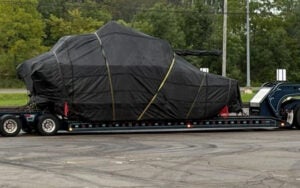
The E-8C JSTARS. The Air Force currently conducts ground moving target indication with the E-8. (Air Force photo)
The U.S. Air Force, which has been preparing to replace its aging E-8C JSTARS ground-surveillance aircraft with a modified civil jet, has begun exploring whether a different approach might be more effective in highly contested environments.Any changes in the acquisition plan could be reflected in the Air Force’s fiscal year 2019 budget request, due out early next year, the service said Sept. 12.Increasing threats, such as advanced air defenses fielded by potential adversaries, “are driving us to evaluate alternative approaches,”…
Defense Secretary Pete Hegseth said Wednesday the Trump administration plans to continue its push for at least $350 billion in defense funds via the reconciliation process “regardless of what happens […]
A small, bipartisan group of senators is backing the Fast Tracking European Investment in Ukraine’s Defense Act, S. 5175, to hasten the export of allied buys of U.S. munitions for […]
Rep. Jim Himes (D-Conn.), the ranking member of the House Permanent Select Committee on Intelligence, plans to increase the committee’s contractor oversight if the Democrats win control of the House […]
A new Congressional Budget Office report estimates the cost of the Iran war through Aug. 1 as $38 billion and says that the U.S. has likely depleted between one-half and […]
The U.S. Air Force, which has been preparing to replace its aging E-8C JSTARS ground-surveillance aircraft with a modified civil jet, has begun exploring whether a different approach might be more effective in highly contested environments.
Any changes in the acquisition plan could be reflected in the Air Force’s fiscal year 2019 budget request, due out early next year, the service said Sept. 12.
The E-8C JSTARS. (Air Force photo)
Increasing threats, such as advanced air defenses fielded by potential adversaries, “are driving us to evaluate alternative approaches,” said Capt. Emily Grabowski, an Air Force spokeswoman. “Although we are exploring options, there are many steps still to be taken before any force structure proposals are included” in the FY 2019 budget.
While the Air Force has spent months considering three civil jets — one airliner and two business jets — to potentially replace JSTARS, those aircraft “are not survivable in a highly contested space, unless surrounded by fighters and support planes,” said Richard Aboulafia, vice president of analysis at the Teal Group. “Possible alternatives include some kind of low-observable platform working with unmanned aerial vehicles.”
The Air Force has said generally that one way it could protect its sensor capabilities against advanced threats in 2030 and beyond is by disaggregating them among multiple platforms.
“I think the US military has been living in something of a contested airspace holiday period thanks to Iraq and Afghanistan,” Aboulafia said. “The reality is that against threats like China or Russia, many enabler planes like JSTARS are quite vulnerable.”
For now, the Air Force is proceeding with the current competition, with a contract award slated for summer 2018. Three firms are contending: Northrop Grumman [NOC] has proposed the General Dynamics [GD] Gulfstream G550 business jet, Boeing [BA] has offered a 737 jetliner and Lockheed Martin [LMT] has put forth a Bombardier Global 6000 business jet.
But news of the new study caused alarm on Capitol Hill. Five lawmakers sent a Sept. 8 letter to Defense Secretary Jim Mattis warning about a potential capability gap if the JSTARS replacement is delayed.
“While the rationale for this decision has not yet been made known to us, canceling or delaying would be ill-advised and directly impact our combatant commanders who employ this asset in theater,” the letter says. “Combatant commanders have made clear in congressional testimony and in private meetings with us their urgent requirement for the capability provided by JSTARS, including the desire for considerably more coverage than the current legacy fleet is able to provide.”
The lawmakers are all from Georgia, which hosts the JSTARS fleet at Robins Air Force Base. They are Sens. Johnny Isakson (R) and David Perdue (R) and Reps. Sanford Bishop (D), Tom Graves (R) and Austin Scott (R).
Air Force Secretary Heather Wilson informed Isakson about the study last week, said Amanda Maddox, a spokeswoman for the senator.
“We are currently awaiting a full briefing on the Air Force’s plan moving forward,” Maddox said.
During Senate consideration of the FY 2018 defense authorization bill this month, Isakson and Perdue plan to offer an amendment to require the Air Force to proceed with its current plan for replacing JSTARS, unless a new approach would not increase capability gaps.
JSTARS, or the Joint Surveillance Target Attack Radar System, is a modified Boeing 707 jetliner. The Air Force has 16 of them. Grabowski said the Air Force intends to fly them through FY 2023. Northrop Grumman is the JSTARS prime contractor.
NATIONAL HARBOR, Md. – A Senate Armed Services panel chair today said boosters of the Golden Dome program still have work to do to increase support on Capitol Hill while […]


 By
By