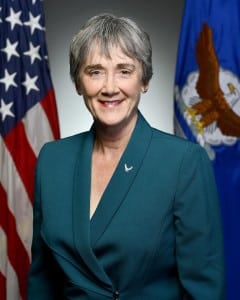
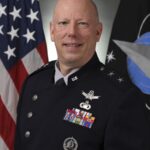
Air Force Secretary Heather Wilson (Air Force photo)
The U.S. Air Force has begun preparing for the possibility that Congress will have to pass a continuing resolution (CR) to keep the government running when fiscal year 2018 begins in a little over a month, service Secretary Heather Wilson said Aug. 25.The Air Force could “adapt” to a “very short” CR, and it is working with lawmakers to ensure it can start new programs if the FY 2018 defense appropriations and authorization bills are not enacted by Oct. 1,…
President Donald Trump on Wednesday called on Congress to pass and send a second reconciliation bill to his desk by June 1. The deadline follows congressional Republicans’ backing a pursuit […]
Upgrades to the GPS ground system–the Architecture Evolution Plan (AEP)–is an option under consideration by the Defense Department’s space acquisition chief, as problems continue in fielding the GPS Next Generation […]
Senate Budget Committee Chair Lindsey Graham (R-S.C.) said Wednesday, with the White House’s backing, his panel will move “expeditiously” on crafting a second reconciliation bill, citing priorities for defense and […]
Defense Secretary Pete Hegseth on Thursday acknowledged the Pentagon could potentially ask Congress for $200 billion in supplemental funding to support the ongoing operation against Iran and replenish munitions used […]
The U.S. Air Force has begun preparing for the possibility that Congress will have to pass a continuing resolution (CR) to keep the government running when fiscal year 2018 begins in a little over a month, service Secretary Heather Wilson said Aug. 25.
The Air Force could “adapt” to a “very short” CR, and it is working with lawmakers to ensure it can start new programs if the FY 2018 defense appropriations and authorization bills are not enacted by Oct. 1, Wilson told reporters at the Pentagon.
Air Force Secretary Heather Wilson (Air Force photo)
But a long-term CR would create severe problems, especially if Congress does not prevent the return of across-the-board funding cuts required by the Budget Control Act (BCA) of 2011, Wilson warned.
“If we were to have to go through sequester again, it would be devastating to the force,” Wilson said. “We’d have a significant reduction in flying hours. Of course, [there would be] no new starts. We’ve got munition stockpiles that we need to replenish.”
Re. Adam Smith (D-Wash.), the top Democrat on the House Armed Services Committee, said in June that while his panel’s FY 2018 defense authorization bill contains $631.5 billion in base budget funding, $28.5 billion above the Trump administration’s request, base funding will be slashed to $549 billion if the BCA caps return (Defense Daily, June 28).
Turning to various other topics, Wilson said she was impressed with what she saw earlier this month at the Air Force’s light-attack aircraft experiment, which has been evaluating four industry-provided aircraft at Holloman Air Force Base in New Mexico since late July (Defense Daily, Aug. 1). A report on the experiment is due by year’s end, and it could help the Air Force decide whether to pursue an acquisition program.
To ease the Air Force’s pilot shortage, Wilson announced several efforts to boost retention, including increased financial incentives and the appointment of Brig. Gen. Mike Koscheski to lead the service’s air crew crisis task force.
Wilson noted that she and Air Force Chief of Staff Gen. David Goldfein recently returned from a 10-day trip to U.S. Central Command’s area of responsibility. They visited Afghanistan, Iraq, Jordan, Kuwait, Qatar and the United Arab Emirates.
During the trip, Wilson was encouraged by the Iraqi military’s success against the Islamic State with the help of U.S. and coalition air power. Wilson, who served in the House of Representatives until early 2009, was also impressed by how intelligence has become tightly tied to operations, including precision weapons.
But Wilson expressed concern that the Air Force is not as ready for a high-end fight as it should be, particularly one involving an adversary armed with integrated air defenses.
“That doesn’t mean we won’t go,” she said. “It means fewer will come back.”
U.S. Northern Command (NORTHCOM) used a counter small unmanned aircraft system (sUAS) flyaway kit (FAK) in the early hours of the strikes against Iran on Feb. 28, according to Air […]

 By
By