Welsh Supports Studying F-22 Production Line Restart
Pat Host
SHARE:
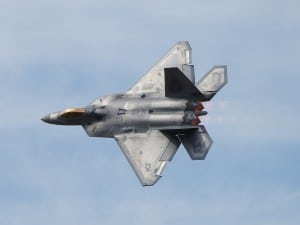
An Air Force F-22 Raptor. Photo: Air Force.
Outgoing Air Force Chief of Staff Gen. Mark Welsh endorses the service studying the financial feasibility of re-starting the F-22 production line because of the aircraft’s “remarkable” potential.“We’re using it in new and different ways, it’s been a spectacular success,” Welsh told an audience at an Air Force Association (AFA) event in Arlington, Va. “Going back and looking, including raising the idea of ‘can you build more,’ is not a crazy idea.”Welsh said the Air Force is currently performing such…
A small, bipartisan group of senators is backing the Fast Tracking European Investment in Ukraine’s Defense Act, S. 5175, to hasten the export of allied buys of U.S. munitions for […]
Rep. Jim Himes (D-Conn.), the ranking member of the House Permanent Select Committee on Intelligence, plans to increase the committee’s contractor oversight if the Democrats win control of the House […]
A new Congressional Budget Office report estimates the cost of the Iran war through Aug. 1 as $38 billion and says that the U.S. has likely depleted between one-half and […]
NATIONAL HARBOR, Md. – A Senate Armed Services panel chair today said boosters of the Golden Dome program still have work to do to increase support on Capitol Hill while […]
Welsh Supports Studying F-22 Production Line Restart
Pat Host
SHARE:
Outgoing Air Force Chief of Staff Gen. Mark Welsh endorses the service studying the financial feasibility of re-starting the F-22 production line because of the aircraft’s “remarkable” potential.
“We’re using it in new and different ways, it’s been a spectacular success,” Welsh told an audience at an Air Force Association (AFA) event in Arlington, Va. “Going back and looking, including raising the idea of ‘can you build more,’ is not a crazy idea.”
An Air Force official said the F-22 is an early adopter of Open Mission System (OMS) standards. Photo: Air Force.
Welsh said the Air Force is currently performing such a study at the behest of Congress, looking into the potential cost, positives and negatives of such an endeavor. Lockheed Martin [LMT] spokesman John Losinger said Thursday that the company would support the Air Force with any data it needs to respond to the recent congressional subcommittee request directing the service to assess the cost and feasibility of restarting F-22 production. Lockheed Martin developed the F-22.
Thought leaders and industry have thrown around ideas for what capabilities might be found in a sixth-generation fighter jet. But Welsh raised the idea of modifying the F-22 and re-opening the production line at a cheaper rate in place of developing another fighter aircraft. The F-22 is considered a fourth-generation fighter while the F-35, currently in production, is fifth generation.
The House Armed Services Committee (HASC) in its early May bill report accompanying its fiscal year 2017 bill directed Air Force Secretary Deborah James to conduct a comprehensive assessment and study of the costs associated with resuming F-22 production and provide a report by the end of the year. The committee wants to know anticipated future air superiority capacity and capability requirements based on anticipated near-term and mid-term threat projections in both air and on the ground.
HASC also wants to know F-15C retirement plans and service life extension programs, estimated next-generation aircraft initial operating capability (IOC) dates and estimated end-of-service timelines for existing F-22As. The committee wants to know estimated costs to restarting F-22 production, including the estimated cost of reconstituting the F-22 production line and the time required to achieve low-rate production. HASC also wants to know the estimated cost of procuring another 194 F-22 aircraft to meet the requirement for 381 jets, which is Air Combat Command’s (ACC) requirement. HASC said the initial requirement was 749 aircraft and that 187 jets were produced.
The committee, finally, wants to know factors impacting F-22 restart costs, including the availability and suitability of existing F-22A production tooling and opportunity for foreign export and partner nation involvement if section 8118 of the 1998 Defense Appropriations Act prohibiting export of the F-22 were repealed.
Welsh believes the F-22 production line talk is starting a necessary conversation about the role of airpower and national priorities. Calling fighter; bomber and intelligence, surveillance and reconnaissance (ISR) aircraft the “meat and potatoes” of the Air Force, Welsh said these platforms are in demand with combatant commands and cannot be taken for granted.
“You can’t keep cutting the number of fighter squadrons we have,” Welsh said.
Welsh retires July 1. He’ll be succeeded by Air Force Vice Chief of Staff Gen. David Goldfein if he is confirmed by the Senate.
An HII [HII] shipbuilding executive last week told lawmakers how the company plans to improve and accelerate shipbuilding throughout via workforce improvements, adding new shipbuilding infrastructure and reinforcing distributed shipbuilding […]