President Donald Trump signed the $1.3-trillion fiscal year 2018 omnibus appropriations bill into law March 23, saying the need for increased military funding outweighed his misgivings about several non-defense aspects of the bill.The omnibus (H.R. 1625), which combines 12 annual appropriations bills into one package, provides $700 billion for defense, an increase of about $80 billion over FY 2017, and $591 billion for a wide range of non-defense programs. At a White House news conference, Trump said he was unhappy with the…
Defense Secretary Pete Hegseth said Wednesday the Trump administration plans to continue its push for at least $350 billion in defense funds via the reconciliation process “regardless of what happens […]
A small, bipartisan group of senators is backing the Fast Tracking European Investment in Ukraine’s Defense Act, S. 5175, to hasten the export of allied buys of U.S. munitions for […]
Rep. Jim Himes (D-Conn.), the ranking member of the House Permanent Select Committee on Intelligence, plans to increase the committee’s contractor oversight if the Democrats win control of the House […]
A new Congressional Budget Office report estimates the cost of the Iran war through Aug. 1 as $38 billion and says that the U.S. has likely depleted between one-half and […]
President Donald Trump signed the $1.3-trillion fiscal year 2018 omnibus appropriations bill into law March 23, saying the need for increased military funding outweighed his misgivings about several non-defense aspects of the bill.
The omnibus (H.R. 1625), which combines 12 annual appropriations bills into one package, provides $700 billion for defense, an increase of about $80 billion over FY 2017, and $591 billion for a wide range of non-defense programs.
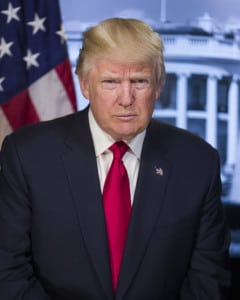
President Donald Trump. Photo: White House.
At a White House news conference, Trump said he was unhappy with the bill’s high total price tag, the lack of full funding for his proposed border wall and the absence of a resolution for a contentious immigration issue.
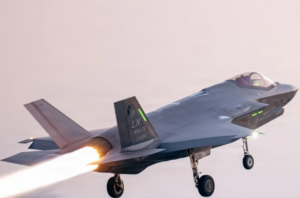
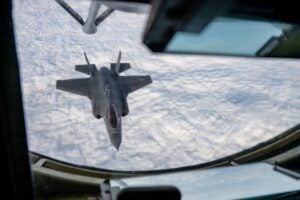
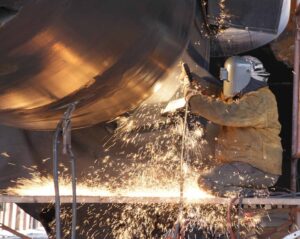
But he said he was forced to sign the legislation to strengthen the armed forces. He highlighted several specific procurement items in the omnibus, including $10.2 billion for 90 Lockheed Martin [LMT] F-35 Joint Strike Fighters and $23.8 billion for 14 Navy ships.
“We have to have, by far, the strongest military in the world,” Trump said. “And this will be, by far, the strongest military that we’ve ever had.”
Joining Trump at the White House, Defense Secretary Jim Mattis welcomed the bill’s enactment, saying “we received the largest military budget in history, reversing many years of decline and unpredictable funding.”
Trump’s signature also avoids a federal government shutdown. The continuing resolution that temporarily funded the government was set to expire March 23.
Trump’s approval came hours after the Senate passed the omnibus by a 65-32 vote early March 23. The House passed the bill by a 256-167 vote March 22 (Defense Daily, March 22).
John Luddy, vice president for national security policy at the Aerospace Industries Association, called the defense funding boost “a big step in the right direction.” But Luddy said similar levels of defense spending will be needed “for at least the next five years” to support the Defense Department’s new national defense strategy, which emphasizes the need to focus on the return of great-power competition.
NATIONAL HARBOR, Md. – A Senate Armed Services panel chair today said boosters of the Golden Dome program still have work to do to increase support on Capitol Hill while […]


 By
By