Excessive Helicopter Weight Challenges Army Aviation
Pat Host
SHARE:
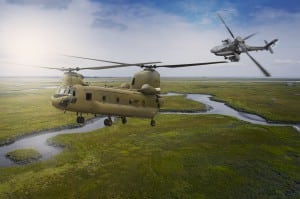
CH-47F Chinook and AH-64E Apache. Photo courtesy Boeing.
ATLANTA--The increasing weight of Army helicopters has become such a problem a key officer believes it is limiting, as opposed to providing, options to a commander. U.S. Army Aviation Center of Excellence and Fort Rucker Commanding General Maj. Gen. William Gayler said Friday the service aircraft have been gaining weight “for all the right reasons,” including new technology designed to protect crew or passengers. This technology includes countermeasures to protect helicopters from ground-fired missiles. Army Aviation Center of Excellence Capability…
The White House has detailed “a number of concerns” with the newly-passed House version of the next defense policy bill, to include the legislation’s limits on procuring Navy ships built […]
The House on Wednesday narrowly voted to pass its $1.15 trillion version of the fiscal year 2027 National Defense Authorization Act (NDAA) and a blueprint for a third reconciliation bill […]
Senate appropriators have pressed Pentagon leadership on the decision to include funds in the Iran war supplemental request for items beyond the current military operation, while Defense Secretary Pete Hegseth […]
House Republicans on Wednesday unveiled a blueprint for a third reconciliation bill that includes $60 billion for defense, a figure slightly below the Trump administration’s request to cover Iran war […]
Excessive Helicopter Weight Challenges Army Aviation
Pat Host
SHARE:
ATLANTA–The increasing weight of Army helicopters has become such a problem a key officer believes it is limiting, as opposed to providing, options to a commander.
U.S. Army Aviation Center of Excellence and Fort Rucker Commanding General Maj. Gen. William Gayler said Friday the service aircraft have been gaining weight “for all the right reasons,” including new technology designed to protect crew or passengers. This technology includes countermeasures to protect helicopters from ground-fired missiles. Army Aviation Center of Excellence Capability Development and Integration Directorate Director Col. Thomas von Eschenbach said Tuesday in an interview these include aircraft survivability technologies like detect or defeat technologies and expendable flares.
CH-47F Chinook and AH-64E Apache. Photo courtesy Boeing.
The problem, Gayler said, is that increased weight decreases maneuverability, available ammunition and the number of warfighters the aircraft can hold. He said the Army is currently using nine UH-60 Black Hawks to move a platoon, which consists of between 16 and 44 soldiers, when it could be using four Black Hawks.
“We need range, speed and endurance and the ability to operate in all environments,” Gayler told an audience here at Army Aviation Association of America convention.
Gayler said increasing weight also increases weight and risk. He said increased weight drives higher fuel consumption, operating cost and an additional number of forward refueling points.
Army officials believe that current aircraft can only perform with a full tactical load on 84 percent of the earth’s surface. von Eschenbach said the Army calculates altitude and temperature to see how well aircraft can perform, so the service has to make these trades in fuel or ammo or personnel to reach peak performance at those “hot and high” altitudes. He said these trades include what loads they can carry, how much fuel and which weapon systems can be brought on board.
The Army hopes to solve this power problem with a next-generation engine. The Improved Turbine Engine Program (ITEP) hopes to develop an engine that is 50 percent more powerful and consumes 25 percent less fuel while providing 20 percent longer engine life than current rotorcraft turbine engines. The new engine will power both the AH-64 Apache and UH-60 Black Hawk aircraft. von Eschenbach said Gayler is preparing for a key Milestone A briefing for ITEP. Army Program Executive Officer for Aviation Brig. Gen. Bob Marion said Saturday the service’s intent was to get to Milestone A this quarter, or by June 31.
General Electric [GE] and Honeywell [HON] Pratt & Whitney [UTX] joint venture called Advanced Turbine Engine Company (ATEC) are working on ITEP.
Senate Democrats on Tuesday blocked a vote to advance consideration of the chamber’s $1.14 trillion fiscal year 2027 National Defense Authorization (NDAA). The procedural vote was 46-50, failing to reach […]