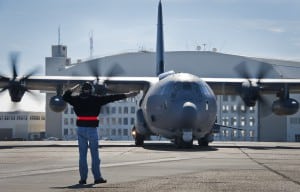
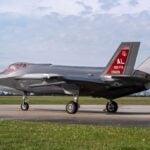
An AC-130J taxis the runway for its first official sortie Jan. 31, 2014, at Eglin AFB, Fla. Photo: Air Force.
U.S. Air Force Special Operations Command (AFSOC) is making progress in getting funding to demonstrate a laser gunship prototype but remains well short of what it needs, according to the command’s leader.AFSOC, which wants to test a 60-kilowatt, solid-state laser on an AC-130 gunship by fiscal year 2022, is poised to receive $34 million for that effort in the Trump administration’s fiscal year 2019 budget request. But the command still needs to come up with another $58 million from FY…
A new Congressional Budget Office report estimates the cost of the Iran war through Aug. 1 as $38 billion and says that the U.S. has likely depleted between one-half and […]
NATIONAL HARBOR, Md. – A Senate Armed Services panel chair today said boosters of the Golden Dome program still have work to do to increase support on Capitol Hill while […]
An HII [HII] shipbuilding executive last week told lawmakers how the company plans to improve and accelerate shipbuilding throughout via workforce improvements, adding new shipbuilding infrastructure and reinforcing distributed shipbuilding […]
The House on Tuesday passed a stopgap funding bill to keep the government open through Dec. 11, sending the temporary funding measure that also includes funds to support ongoing shipbuilding […]
U.S. Air Force Special Operations Command (AFSOC) is making progress in getting funding to demonstrate a laser gunship prototype but remains well short of what it needs, according to the command’s leader.
AFSOC, which wants to test a 60-kilowatt, solid-state laser on an AC-130 gunship by fiscal year 2022, is poised to receive $34 million for that effort in the Trump administration’s fiscal year 2019 budget request. But the command still needs to come up with another $58 million from FY 2020 to FY 2022 to meet its goal, said Air Force Lt. Gen. Brad Webb, AFSOC’s commander.
An AC-130J taxis the runway for its first official sortie Jan. 31, 2014, at Eglin AFB, Fla. Photo: Air Force.
“I would couch this as a semi-good news story,” Webb testified April 11 before the Senate Armed Services Committee’s emerging threats and capabilities panel.
His comments came in response to Sen. Martin Heinrich (D-N.M.), who expressed concern that work on the laser gunship, or Airborne High Energy Laser (AHEL), is occurring too slowly and that AHEL might not be ready for fielding until about 2030 without a more robust push.
“I don’t disagree with your assessment at all,” Webb told Heinrich.
Heinrich, whose state is home to Air Force directed energy and special operations units, indicated he would try to assist AFSOC with funding for AHEL.
“We look forward to helping you with that goal,” the senator told the general.
AFSOC would use the $34 million requested in FY 2019 to continue designing the gunship, acquire the laser and beam control subsystems, and finish risk reduction for the aircraft, among other activities, budget documents show. AHEL is funded at $15.7 million in FY 2018.
According to the Air Force Scientific Advisory Board, a laser mounted on an AC-130 could be used for offensive purposes, such as attacking buildings, cell towers, generators and vehicles, and to improve defenses against shoulder-launched, surface-to-air missiles (Defense Daily, Dec. 12, 2016).
While there has been criticism among missile defense advocates of Golden Dome’s development pace after the signing of an executive order in January last year, Space Force Gen. Michael Guetlein, […]


 By
By