 By
By 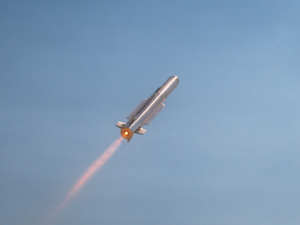
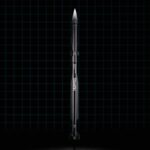
RTX’s [RTX] Raytheon has announced a new rocket motor-powered version of its Coyote drone interceptor, confirming it recently completed three tests of the rapidly-developed variant.
“What that does, essentially, is you get upgraded propulsion for faster launch and higher velocity flight. And then with the seeker [and] warhead, it really gets after the sort of more cutting edge drone capabilities that we’re seeing from the adversary,” Tom Laliberty, Raytheon’s president of land and air defense systems, told reporters during a briefing ahead of the Association of the U.S. Army’s annual conference in Washington, D.C. “These upgrades are all compatible with the existing infrastructure that are in operational use. So think, the launch cells themselves, the radar that’s used to guide a Coyote to the target and the command and control system that’s used to essentially manage these engagements.”
Along with detailing the new Coyote Block 2C+RM, which went from conceptual design to testing in about 15 months, Laliberty confirmed Raytheon is expecting its first international contracts soon for the interceptor capability, with planned customers Qatar and Jordan.
Last September, the Army awarded RTX an eight-year, $5.04 billion contract for Coyote interceptors, launchers and Ku-band radio frequency system radars in support of the Low, slow, small-unmanned aircraft Integrated Defeat System program, also called LIDS (Defense Daily, Sept. 29 2025).
Laliberty described the current Coyote Block 2C as the “workhorse of the U.S. Army’s counter-UAS capability,” noting the Raytheon has “essentially quadrupled” its production output of the interceptor over the last 18 months “and we plan to double that again by the middle of next summer.”
“[It’s] extremely active and accurate in the current fight, with well over 600 combat defeats of attack UAS and drones. And throughout all that, we’ve had great collaboration with the Army to ensure that we continue to advance the Coyote capabilities so that we keep pace with the evolving threats,” Laliberty said.
Along with upgrading from a turbine engine to the solid rocket motor capability, Laliberty noted the new Coyote Block 2C+RM variant features a new warhead and seeker, while declining to quantify specific increases in range and speed.
“We’ve improved the seeker and we’ve improved the warhead, and those two additions make the missile more effective against the set of threats that the U.S. Army is seeing,” Laliberty said. “What I would just say is it’s significant in terms of the range difference and in the. what I call just, end game capabilities of the missile when you think about where velocity might come to play. But I really can’t get into the specifics of any of the actual numbers on that.”
Laliberty also declined to specify who builds the rocket motor for the new Coyote variant.
“For competitive reasons, again, to be respectful to our partner, we’ve been asked not to share that at this point,” Laliberty said.
Army officials have been present at each of the three recent tests, according to Laliberty, with additional Coyote Block 2C+RM tests scheduled into the first half of 2027.
“The initial test series included several first-of-its-kind events, including confirmation of initial integration with the current counter-drone architecture and the first launches of a Coyote effector equipped with a tactical rocket motor to improve threat engagement times and faster successive shots,” RTX said in a statement.
Laliberty says Raytheon sees the Block 2C+RM as part of a family of systems approach for Coyote, rather as the sole configuration moving forward, noting that production of the upgrade could be cut into follow-on contracts.
“We’ve got an ongoing investment from Raytheon, but now we essentially need some government sponsorship as it kind of transitions into the program of record, and that’s still kind of ongoing with the Department of War in terms of how all of that is going to be structured”
Laliberty also provided an update on continued testing of the Coyote Block 3NK non-kinetic version of the interceptor, while declining to specify the capability used to deliver effects.
“[It] continues to do extremely well in testing. Each summer the Army does a series of testing associated with Coyote and has been including the non-kinetic capability in that testing and it’s gone extremely well. I’m not aware that the Army’s released any information about operational use at this point, but like I said, the testing has gone extremely well. And that non-kinetic capability is being offered to foreign partners as well and included in these FMS cases,” Laliberty said.
RTX said in February that it had conducted a demonstration last October with the new non-kinetic Coyote Block 3NK where it successfully defeated swarms of unmanned systems (Defense Daily, Feb. 11).