 By
By 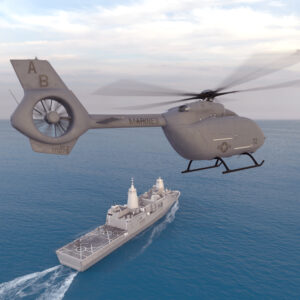
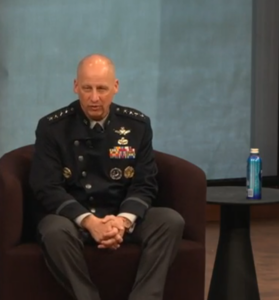
NATIONAL HARBOR, Md.–The Marine Corps is “keeping open [its] options” on whether it will move forward with one or multiple vendors for the next phase of its Aerial Logistics Connector (ALC) program to develop an unmanned cargo-carrying air platform, an official told Defense Daily on Monday.
Col. Richard Rusnok, branch head of Marine Aviation’s Cunningham Group, provided the ALC update as the service continues flight testing with industry prototypes with an aim to have a capability ready for fielding within five years, adding that an eventual decision to support fielding is likely to be made “in the next couple years.”
“We’re treading very carefully into that water, but I think we’re going to make a decision here in the next couple years. And I think at that time, because [they’re both] in-production platforms, it’ll be very rapid transition to fielding,” Rusnok said in an interview following a panel discussion at the Navy League’s Sea-Air-Space conference. “I don’t want to commit us to anything in particular. I think we’re still really trying to figure out what the optimal acquisition game plan is.”
The Marine Corps in April 2024 selected Airbus U.S. for the competitive ALC development effort, and its team for the initiative includes Shield AI, L3Harris Technologies [LHX] and Parry Labs (Defense Daily, May 14, 2024).
Airbus has said its MQ-72C, the unmanned version of its UH-72 helicopter being developed for ALC, is intended to have a cruise speed of 135 knots, a maximum takeoff weight of over 8.300 pounds and a range above 350 nautical miles.
The Marine Corps in July 2024 also selected Near Earth Autonomy and its partners Honeywell [HON] and Leonardo Helicopters for the ALC development program, and the team is working with an autonomous Leonardo AW139 helicopter to inform future efforts (Defense Daily, Oct. 28, 2024).
“Those platforms offer very different scales and capabilities. And so, we’re looking to hit the right point in the cost curve and to make sure that it fits into the rest of the [Marine Air-Ground Task Force],” Rusnok said.
The Marine Corps has also tapped Sikorsky [LMT] to help inform ALC and demonstrate its optionally-piloted UH-60 Black Hawk, which utilizes the company’s Matrix autonomy software.
Rusnok said the Marine Corps has been conducting a “bunch of experimentation” with the ALC offerings to inform next steps, often utilizing the Weapons and Tactics Instructor course at Yuma Proving Ground in Arizona as main venue, mostly with test platforms in an “optionally-piloted mode.”
“In some ways, [we’re] just alternating back and forth between the two platforms and getting it in the hands of Marines so we can see where the holes are, how they want to use it. And then, from there we’re going to, at some point in time, we’re going to downselect and make a decision,” Rusnok said.
Carl Forsling, Airbus U.S.’ senior director of strategy and business development, told Defense Daily earlier this month the company had begun flight tests with Naval Air Systems Command this spring.
“What we do expect is, as this program continues, to do increasingly mission representative tasks and increasingly realistic integration with Marine Corps units, whether that’s at exercises or in normal unit type operational environments. So we’re looking forward to that continuing through the rest of this year and ‘27,” Forsling said.
Airbus U.S. said last week it had completed a fourth autonomous flight test with its H145 helicopter informing MQ-72C development, with the demonstration focused on refining the aircraft’s perception system “to ensure it provides accurate, real-time information to an autonomous pilot ensuring obstacles are avoided within a landing zone”
“This test was vital for us to show the Lakota Connector’s development in performing aerial logistics missions for the U.S. Marine Corps,” Rob Geckle, chairman and CEO of Airbus U.S., said in a statement. “Perception systems can make or break the success of an unmanned mission in the field, and I am excited to see our aircraft perform so well under uncertain conditions.”
Airbus U.S. has now flown over 50 hours of autonomous flight and has tests planned through the end of the year as it “targets a production-ready capability as early as 2028,” a company spokesperson told Defense Daily.
The Marine Corps has yet to finalize a culminating demonstration for the current ALC phase, Rusnok noted, as it eyes moving into a subsequent effort to continue prototyping.
“Really, what it comes down to is it’s not just the platform. It’s all the other stuff too below the waterline…We’ve got to figure out where this sits in our formations. We’re going to figure out how many of them we’re going to need to meet the need across the entirety of the MAGTF. So there’s a lot of work that we have to do to get there,” Rusnok said. “I’m pretty confident that the technology is going to mature to the point where we’re going to be wondering why we went so long without something like this.”