 By
By 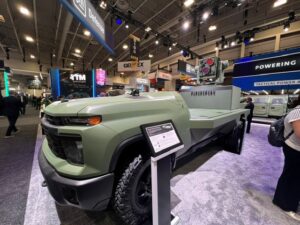
GM Defense [GM] on Monday unveiled its new Unmanned Ground Vehicle (UGV), based on the commercial Chevrolet Silverado 3500 heavy-duty truck, with plans to have a technology demonstrator ready for use by June 2027.
“What you see here with our Unmanned Ground Vehicle is a direct reflection of how we listen to the Army and how we pay attention to the changing character of warfare. We’re watching closely the developments in Ukraine, the Middle East and how the Army is organizing to campaign in the Indo-Pacific. And all of those observations are pointing to a very clear need: more robotic and autonomous capability to deliver operational effect and to reduce risk for our soldiers. GM Defense is ready to help the Army move in that direction by bringing the speed, scale and innovation of the commercial sector to bear on the defense mission,” Pete Johnson, GM Defense’s vice president of business development for integrated vehicles, told reporters at the Association of the U.S. Army’s annual conference.
GM Defense’s rollout of the UGV comes as the Army is taking a new approach to rapidly prototyping and assessing potential unmanned vehicle requirements, to include a new ground robotics effort focused around three problem statements for autonomous resupply, breaching and multi-mission capabilities, and a recent effort to find platforms for casualty evacuation in the “last tactical mile” of operations (Defense Daily, Aug. 14).
Johnson said the new UGV is aimed at a capability in the Army’s new Project Sustainment space focused on unmanned ground vehicles for supply distribution, with the service announcing in July it had picked AM General, American Rheinmetall, Carnegie Robotics, HDT Robotics and Stratom for a prototyping effort to inform future requirements (Defense Daily, July 10).
“There’s a range of autonomous activities [right now] from Last Tactical Mile, Engineering Breaching, and Project Sustainment. [Those] were kind of the three that went out. We thought that we fit very well with the Project Sustainment space, and so that’s kind of where we’ve driven most of our development toward,” Johnson told Defense Daily following the briefing.
“For that first phase, we weren’t ready. There are obviously companies that were much further along. But again, this is where we feel very strongly that one of the things we have in our base DNA on bringing the commerciality and being able to have a path to production and scaling and affordability. We still thought it was very important for us to communicate to the Army to say, ‘We might offer value in this space and we’ll be ready to show you that, but we won’t meet your timelines.’ And so we’re going to be a first follower, for sure,” Johnson added.
Johnson said GM Defense began concept development on the UGV in late spring to early summer, with the company partnering to use Scout AI’s autonomy stack, and said the base platform brings “a proven and affordable commercial baseline with an open interface and a modularity approach for sensors, autonomy stack, command and control and mission autonomy.”
“There is not a connection tied directly to a program line that you can see, and so there is risk. I think there’s risk for industry. There’s certainly risk that the government is taking, but the need is what’s clear. You can see just looking at the experience in Ukraine and the Middle East and how people are thinking about the kind of threats that they’re going to have to fight through in the Indo-Pacific. You can see the importance of this activity, and so I think it’s worth the risk,” Johnson said.
GM Defense does not currently have a scheduled plan to deliver a platform for testing, while pointing to the June timeframe as communicating when it will have a demonstrator ready for potential use and the company currently assessing opportunities to showcase the platform for the Army.
“We just want to be very transparent with when we think we’re going to be able to deliver real capability,” Johnson told Defense Daily.
The UGV has capability to handle up to 8,000 pounds of payload, supplies 102 kilowatt hours of onboard energy utilizing GM Defense’s Ultium-based battery technology and has silent watch capability to power systems quietly when the vehicle is stopped.
“It’s a very capable platform for hauling supplies. And, certainly, think of all the trucks that are on the road that have to support an Army on the move. This could go a long way to reducing the amount of truck risk that you have out there as well,” Johnson said.
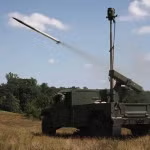
The UGV on the AUSA show floor is integrated with AeroVironment’s [AVAV] Locust X3 laser weapon system, while Johnson noted the platform is designed to be modular to host a variety of different payloads and effectors.
“It’s a multi-mission platform. It’s a blank slate, whatever you want it to be. There are a lot of different missions that you can be, but one of the really important missions that you can probably sense in the environment right now is counter-UAS.” Johnson said.
Johnson also reiterated affordability as key to meeting potential requirements in the Army’s pursuit of new UGV capabilities.
“Not that it isn’t always, but the pressure to get very, very cheap and more attritable capability is [there]. Because, since you’re unmanned now, you’re going to employ at higher levels of risk potentially, and so you’ve got to be prepared to deal with that,” Johnson said.