 By
By 
Army Secretary Dan Driscoll on Monday teased plans to detail major acquisition reforms for the service in the coming weeks, vowing to “change the way we buy equipment.”
Driscoll, in an address, pressed for shedding older equipment and more rapidly fielding innovative capabilities, detailed opportunities to bring in private capital investment for Army projects and said the service should adopt the Silicon Valley business model moving forward.
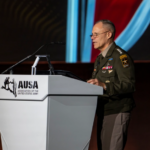
“No one can predict the next war, but we cannot wait. We cannot fucking wait to innovate until Americans are dying on the battlefield. We must act now to enable our soldiers. Our window to change is right now and we have a plan to do it. We will set the pace of innovation. And we will win with silicon and software and not our soldiers’ blood and bodies,” Driscoll said in remarks at the Association of the U.S. Army conference in Washington, D.C.
“I used to be in the Army, became a lawyer, worked in investment banking, venture capital and now I’m back in the Army. I did a full circle. After seeing the power of combining venture capital money and mentorship with startup culture, I can say, unequivocally, that the Silicon Valley approach is absolutely ideal for the Army,” Driscoll added.
Driscoll’s comments follow his roll out of the Army Transformation Initiative earlier this year, which included plans to cut “obsolete” programs such as the Joint Light Tactical Vehicle, Humvee, AH-64D Apache, the M10 Booker and Gray Eagles as well as potentially ending development of the Improved Turbine Engine Program, Future Tactical UAS and the Robotic Combat Vehicle (Defense Daily, May 1).
The plan is intended to free up billions of dollars in resources that Driscoll has said previously would be used to procure more drones and counter-drone capabilities, AI-driven decision-making tools and “lethal, battle-ready” tanks and attack aircraft.
“This is the inflection point where we turn it all around. Soldiers are energized. American companies want to partner with us. The President and Secretary of War are giving us unprecedented top-cover. The future is now,” Driscoll said. “[Soldiers] struggle to communicate beyond line-of-sight. And you wonder why the hell you can’t just use the smartphone in your pocket. Before and after work, our soldiers live in the real world. But, while they’re on duty, they time travel to the early 2000s, at best or earlier.”
While Driscoll did not offer specifics on the reforms set to be detailed soon, his remarks follow recent comments from Defense Secretary Pete Hegseth who also said to expect “generational” acquisition reforms to be rolled out in October (Defense Daily, Sept. 30).
“We are going to completely disrupt the system that held the Army back for decades and lined the primes’ pockets for so long,” Driscoll said. “We will break down barriers until we measure acquisitions not in years and billions but months and thousands.”
Driscoll, however, did allude to potential changes to the Army’s acquisition enterprise, noting a plan to combine certain offices “under a single organization” that reports to senior Army leadership.
“For decades, our [Program Executive Offices] trudged through a process-oriented acquisitions cycle that was really good at slow, expensive and sub-optimal outcomes. Process-oriented systems are over-complicated, over-regulated and over-due for reform. In the private sector, process-oriented systems are a thing of the past because they simply can’t keep pace with change. The traditional 12 to 18 month contracting cycle is just no longer feasible, tech advancement moves too fast for multi-year acquisitions,” Driscoll said.
During the AUSA conference week, Driscoll noted that he will be meeting with industry partners alongside Treasury Secretary Scott Bessent to discuss opportunities to “augment Army resources through private investment.”
Driscoll noted the push for more private capital investment opportunities follows the launch of the Army’s new FUZE initiative last month, which he described as a “cradle-to-grave capital funding model.”
The FUZE initiative will consolidate the xTech, Small Business Innovation Research and Technology Transfer, Manufacturing Technology and Technology Maturation Initiative innovation programs into a single acquisition framework (Defense Daily, Sept. 19)
“It will identify promising startups, quickly fund them and get minimally viable products to soldiers in weeks,” Driscoll said. “FUZE, like VC firms, will be successful because we will work with agile, innovative, hungry startups that live on the very edge of innovation.”
The Army plans to invest $750 million through FUZE in 2025 and will grow that to $765 million in 2026, Driscoll noted, with the program accounting for a “150 percent increase in the Army’s funding towards emerging tech and innovation.”
Driscoll added the goal with FUZE is to get on contract within 70 days with startups that have never worked with the Army, and for firms that have worked with the service previously that could be condensed to 10 days.
“FUZE finds and grows capabilities then feeds them into our broader acquisitions system,” Driscoll said.