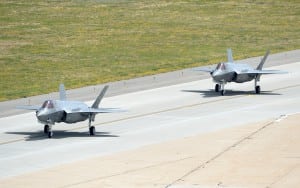
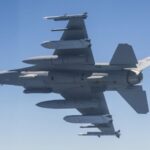
The first two combat-coded F-35A Lightning II aircraft arrive at Hill Air Force Base, Utah, Sept. 2, 2015. Photo: Air Force.
The Pentagon’s chief weapon tester predicts the F-35 program might not start initial operational test and evaluation (IOT&E) until late 2018 at the earliest and 2020 at the latest.In his annual report released Tuesday, Pentagon Director of Operational Test and Evaluation (DOT&E) Michael Gilmore said the F-35 program will more likely start IOT&E in early 2019 based on ongoing problems and delays and the required time for IOT&E spin-up. IOT&E determines whether systems are operationally effective and suitable and supports…
President Donald Trump on Wednesday called on Congress to pass and send a second reconciliation bill to his desk by June 1. The deadline follows congressional Republicans’ backing a pursuit […]
Upgrades to the GPS ground system–the Architecture Evolution Plan (AEP)–is an option under consideration by the Defense Department’s space acquisition chief, as problems continue in fielding the GPS Next Generation […]
Senate Budget Committee Chair Lindsey Graham (R-S.C.) said Wednesday, with the White House’s backing, his panel will move “expeditiously” on crafting a second reconciliation bill, citing priorities for defense and […]
Defense Secretary Pete Hegseth on Thursday acknowledged the Pentagon could potentially ask Congress for $200 billion in supplemental funding to support the ongoing operation against Iran and replenish munitions used […]
The Pentagon’s chief weapon tester predicts the F-35 program might not start initial operational test and evaluation (IOT&E) until late 2018 at the earliest and 2020 at the latest.
In his annual report released Tuesday, Pentagon Director of Operational Test and Evaluation (DOT&E) Michael Gilmore said the F-35 program will more likely start IOT&E in early 2019 based on ongoing problems and delays and the required time for IOT&E spin-up. IOT&E determines whether systems are operationally effective and suitable and supports the decision to proceed beyond low rate initial production (LRIP).
The first two combat-coded F-35A Lightning II aircraft arrive at Hill Air Force Base, Utah, Sept. 2, 2015. Photo: Air Force.
These problems delaying IOT&E include: continued schedule delays in completing Block 3F mission systems development and flight testing, which DOT&E estimates will likely complete in July 2018; delayed and incomplete Block 3F developmental testing (DT) weapons delivery accuracy events and ongoing weapons integration issues and continued delays in completing flight sciences test points, particularly those needed to clear the full F-35B Block 3F flight envelope. This will result in a phased release of Block 3F envelope across the variants, with the full Block 3F envelope for the F-35B not being released until mid calendar year 2018, Gilmore said.
Other DOT&E F-35 criticisms include: further delays in completing gun testing for all three variants and recently discovered gun sight deficiencies; continued shortfalls and delays with the Autonomic Logistics Information System (ALIS) and late delivery of ALIS version 3.0. ALIS version 3.0, DOT&E said, the final planned version for systems development and demonstration (SDD), is at risk of slipping from early 2018 into mid-2018.
Senate Armed Services Committee (SASC) Chairman and F-35 critic John McCain (R-Ariz.) in a statement Tuesday slammed F-35 prime contractor Lockheed Martin [LMT] and CEO Marillyn Hewson. McCain said the company put out a press release citing a Hewson pledge to President-elect Donald Trump to aggressively drive down the cost of the program. McCain, in his statement, said this pledge was surprising considering he was recently informed about the F-35’s SDD phase being delayed another seven months, which he said will cost taxpayers at least $500 million.
“With this latest delay, I am deeply concerned about the (Defense) Department’s currently plan for follow-on modernization,” McCain said, vowing to continue to make streamlining the acquisition system and exercising rigorous oversight of the F-35 program priorities. “It’s likely that the true cost could be more than twice the $500 million projection.”
Pentagon weapons czar Frank Kendall defended the program in a Dec. 19 letter to McCain. Kendall said DoD should plan for delivery of Block 3F capability by May 2018, a seven month extension from the previous SDD baseline estimate. Kendall said although this delay will increase the cost of SDD, he believes all of this cost can be covered from funds within the program. DoD, he said, is also working to control and minimize the SDD budget increase and, at this time, hopes to hold it to approximately $500 million. Kendall said DoD is planning for event-based contingencies that may require additional funds.
In good news for the F-35 program, a Marine Corps fighter squadron deployed for Japan equipped with the F-35B short takeoff and landing variant (STOVL), marking the first overseas stationing of the aircraft since the service declared initial operational capability (IOC) last year (Defense Daily, Jan. 10).
The F-35 Joint Program Office (JPO) did not return a request for comment by press time Tuesday. The F-35 is developed by Lockheed Martin with subcontractors BAE Systems and Northrop Grumman [NOC].
U.S. Northern Command (NORTHCOM) used a counter small unmanned aircraft system (sUAS) flyaway kit (FAK) in the early hours of the strikes against Iran on Feb. 28, according to Air […]