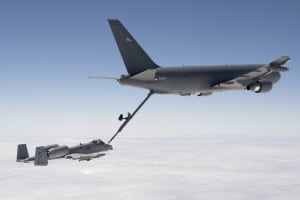
A KC-46 refuels an A-10 during testing. Photo: Air Force.
The Air Force needs more new aerial refueling tankers than the 179 Boeing [BA] KC-46s it plans to buy and is considering incremental upgrades and a follow-on KC-Z aircraft to fill its quota, according to Air Mobility Command Chief Gen. Carlton Everhart.“When I look at the order of 179 aircraft, I often ask myself, and I ask my teammates on my staff, is it enough?” Everhart said Tuesday at the Air Force Association’s annual Air, Space, Cyber Conference at National…
President Donald Trump on Wednesday called on Congress to pass and send a second reconciliation bill to his desk by June 1. The deadline follows congressional Republicans’ backing a pursuit […]
Upgrades to the GPS ground system–the Architecture Evolution Plan (AEP)–is an option under consideration by the Defense Department’s space acquisition chief, as problems continue in fielding the GPS Next Generation […]
Senate Budget Committee Chair Lindsey Graham (R-S.C.) said Wednesday, with the White House’s backing, his panel will move “expeditiously” on crafting a second reconciliation bill, citing priorities for defense and […]
Defense Secretary Pete Hegseth on Thursday acknowledged the Pentagon could potentially ask Congress for $200 billion in supplemental funding to support the ongoing operation against Iran and replenish munitions used […]
The Air Force needs more new aerial refueling tankers than the 179 Boeing [BA] KC-46s it plans to buy and is considering incremental upgrades and a follow-on KC-Z aircraft to fill its quota, according to Air Mobility Command Chief Gen. Carlton Everhart.
“When I look at the order of 179 aircraft, I often ask myself, and I ask my teammates on my staff, is it enough?” Everhart said Tuesday at the Air Force Association’s annual Air, Space, Cyber Conference at National Harbor, Md. “Based on the needs of our joint fight and our nine combatant commanders, I am telling you now that 179 is not enough. … We are going to need more tankers.”
KC-46 refuels A-10 during testing on July 15. Photo: Air Force.
The KC-46 does not have to fill the entire bill, but the KC-135 fleet must eventually be replaced with either it or a follow-on tanker that has not been designed yet, he said.
“The initial 179 buy gives command the strategic agility to take advantage of technology and we are working with our industry partners to drive innovation and to close some of the capability gaps that we think are out on the horizon,” Everhart said.
The Air Force officially needs 479 tankers to perform all of its global aerial refueling duties, which include gassing up attack aircraft over Iraq and Afghanistan as well as passing gas to NATO aircraft and accompanying bombers on long-haul flights. The entire fleet – including the KC-10 and KC-135 – needs upgrading and the 179 KC-46s are just the beginning, he said.
“I am not really enamored with the exact number,” Everhart said. “I know what I need to meet wartime requirements and that’s the number I will drive to. … Whether the majority is KC-Z or KC-46, I’m looking for the next leap in technology but I don’t want to be held to that because things change and we need to look at our adversary and what capability they bring on.’
The Air Force will launch a study this year to explore capabilities that might be included in the KC-Z follow-on tanker to the KC-46. The interim KC-Y tanker is representative of incremental technological upgrades to the existing platform based on a Boeing 767. It will need to bridge the gap between the end of KC-46 deliveries around 2028 and the introduction of a new tanker in 2035 or so, Everhart said.
Once the upcoming KC-Z study is done, the Air Force will begin programming funding for development into its out-year budget plans around 2030-2035 timeframe, he said.
“We have done air refueling basically the same way since it was invented,” Everhart said.
Potential improvements to the age-old process of joining two airborne, human-piloted planes with a hose include automating one or both of the aircraft, he said. The Air Force has engaged industry in recent forums to discuss that and other possibilities to make the process more efficient.
Any tanker beyond the KC-46 must be able to refuel fifth-generation aircraft like the F-35, which because of its stealth capabilities will fly into anti-access, area-denial environments. Future tankers will need to penetrate the same environments protected by integrated air defense systems.
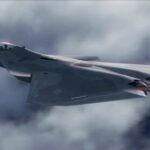
The KC-Z will likely be a stealth aircraft or at least incorporate low-observable technology that reduces its radar signature. It also could have a non-traditional airframe shape, moving away from the tube-and-wings design of commercial aircraft to a flying- or blended-wing design similar to the B-2 Spirit bomber, Everhart said.
Future tankers may be equipped with self-defense weapons like high-energy lasers to shoot down incoming missiles, he said.
“A low observable [tanker] may be a new platform that’s out there that we’ve never seen before,” Everhart said. “The blended wing, for example … or the hybrid wing, I love that design. … We are just at the tip of the iceberg of what’s out there that we can apply to big airplanes.”
U.S. Northern Command (NORTHCOM) used a counter small unmanned aircraft system (sUAS) flyaway kit (FAK) in the early hours of the strikes against Iran on Feb. 28, according to Air […]

 By
By