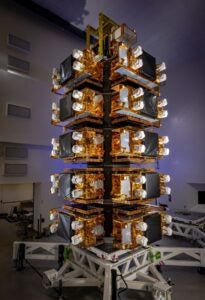
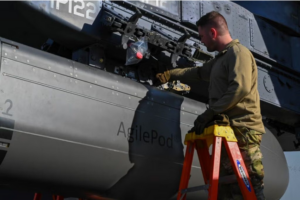
The U.S. Space Force is meeting with companies this week in the Washington, D.C., area for an Evolved Strategic satellite communication (ESS) reverse industry day–the latter a term for companies briefing defense officials on their concepts and technologies to solve existing or nascent military problems.
This week’s meetings follow an ESS ground segment reverse industry day sequence that began last August.
Last summer, Space Force’s Space Systems Command (SSC) chose Boeing [BA] over Northrop Grumman [NOC] for a $2.8 billion contract to build the first two ESS satellites (Defense Daily, July 7, 2025).
Space Force has looked to deploy ESS in fiscal 2030 to achieve an initial operational capability in fiscal 2032.
The Space Force is still looking into how many ESS satellites it wants, but a program official said that the constellation will have more than six.
“The ESS system of systems is composed of cryptographic, ground, and space segments procured by the Space Force and a user terminal segment procured by the individual [military] services,” SSC has said. “The first four satellites will be delivered under a cost reimbursement contract. As part of the larger $12 billion ESS Space Segment acquisition, additional satellites are planned to be procured through fixed price contract actions that may be awarded as sole source to support Full Operational Capability and attain global coverage, including enhanced Arctic capability.”
ESS is to replace the six Lockheed Martin [LMT] Advanced Extremely High Frequency (EHF) satellites for U.S. nuclear command, control, and communications (NC3). The Extended Data Rate (XDR) Advanced EHF has supplemented the five orbiting Military Strategic Tactical Relay (Milstar) satellites built by Lockheed Martin. The Milstar satellites feature low-data rate (LDR) and medium-data rate communications. Last year, the Pentagon moved nearly entirely off of LDR to XDR for NC3.
DoD has about 1,000 protected terminals for NC3.
One key NC3 terminal modernization effort is the Family of Advanced Beyond Line of Sight Force Element Terminals (FAB-T FET) by RTX‘s [RTX] Raytheon division.
The Air Force’s B-52 bombers are to carry the FETs. The service’s RC-135 Rivet Joints were to carry FETs as well, but U.S. Strategic Command ended that effort in favor of other NC3 methods. In addition to FET, a second part of FAB-T consists of 84 command post terminals fielded on U.S. Air Force E-4B National Airborne Operations Center and U.S. Navy E-6B Take Charge and Move Out planes.
The terminals are to withstand electromagnetic pulse and to be compatible with Milstar, Advanced EHF, and ESS constellations.
The Air Force’s fiscal 2026 budget request said that production of FET would begin in the second quarter of fiscal 2026 after a Milestone C low-rate initial production decision, but the latter is delayed, as the Air Force and Raytheon look to solve B-52 FET integration issues caused by possible flight effects of the envisioned parabolic antennas for FET.
The Air Force originally awarded the FAB-T contract to Boeing in 2002, but, after concerns about Boeing’s performance, re-opened the bidding and awarded the contract to Raytheon in June 2014.