In decades past, the U.S. Army would use “pink teams” and “heavy weapons teams” in which Boeing [BA] AH-64 Apaches served as a shield for Bell [TXT] OH-58D Kiowa Warrior scout helicopters. The Army then moved to RQ-7 Shadow drones as reconnaissance stand-ins when the service retired the OH-58D in 2017.
In future manned-unmanned teaming, the Army wants to field en masse drones that have multiple sensors on them.
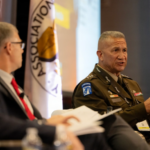
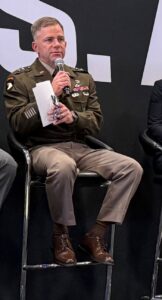
“When we lost the 58Ds, we put in Shadows–a great platform, but that did not drive the integration and interoperability we need to go out and fight,” Army Maj. Gen. Cain Baker, the commander of the Army Aviation Center of Excellence (COE) at Fort Rucker, Alabama said during a Wednesday panel discussion at the Association of the U.S. Army conference in Washington, D.C. “As we look at the manned-unmanned aspect of that, we need systems that we can deploy in mass and have multiple sensors–not just RF [radio frequency] and EO/IR [electro-optical/infrared].”
“We need collaborative behaviors that we’re able to operate with those systems out in front of us so we know how how they’re going to react, and we can use that to fight with our manned assets,” he said. “We’ve got to have network capability out to the tactical edge.”
The Army has said that it wants replacements for Textron‘s [TXT] RQ-7 Shadow in the Group 3 unmanned aircraft system (UAS) category and General Atomics Aeronautical Systems, Inc.‘s MQ-1C Gray Eagle drones in UAS Group 4 for Army division and corps-level reconnaissance (Defense Daily, Aug. 12, 2025).
“At the end of the day, there’s an interdependence we have to have between those [replacement drone systems] and our manned platforms,” Baker said.
Acting Army Chief of Staff Gen. Christopher LaNeve designated Fort Rucker as the UAS Autonomy Center of Excellence (Defense Daily, Oct. 13).
“I tell people I will feel complete as the COE commander when I walk outside of Fort Rucker, and I see a Group 3 UAS leading out to the training area with an Apache or a Black Hawk,” Baker said on Tuesday.
For all echelons, the Army wants information exchange among drones and manned platforms. Having multiple iPads on helicopters leads to information overload for pilots and is not the right path, Baker said.
“We’re putting stuff in the cockpit today–a lot of generating stuff,” he said. “This is not where we need to have our pilots–multiple iPads, multiple data [feeds] coming in. The radios are increasing…This speaks to the collaborative behaviors we’ve got to have on these platforms. When they’re out operating as teams, they’re talking together, sharing multiple sensor information, they know how to maneuver around a threat when they see a threat without having to go back to a cockpit on every single spot report. On a ‘pink team,’ that 58D crew in front of me was not calling me every two seconds. It knew how to maneuver. It knew the PRI [primary radio frequency] I needed to accomplish my task. Those are the behaviors we’re putting on platforms today. We’ve experimented with them. We have tested them.”