 By
By 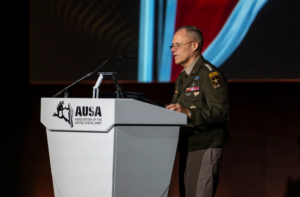
The Army’s acting chief of staff announced Tuesday said he has redesignated the service’s Futures and Concepts Command (FCC) to become the recently-announced Futures and Autonomous Systems Command (FASCOM).
Gen. Christopher LaNeve, who also serves as vice chief, approved the move after Acting Army Secretary Adam Telle signed a memo on Oct. 1 to establish FASCOM, with the service detailing the new command’s initial set of projects and plans to develop corps-level autonomous capabilities and formations based around unmanned capabilities.
“We are incorporating autonomous and unmanned systems at every single echelon across the formation with the force structure to match, including introducing UAS and robotics military specialties to integrate these technologies at the point of need,” LaNeve said in remarks at the Association of the U.S. Army’s annual conference in Washington, D.C.
The Army’s move on creating FASCOM follows Defense Secretary Pete Hegseth’s recent announcement on plans for the Pentagon to stand up a new four-star Autonomous Warfare Command (AutoWarCom) (Defense Daily, Sept. 30).
“The Department of War is committed to not only experimenting, testing and rapidly fielding advanced technologies, but to also proliferate proven technologies throughout our formations,” LaNeve said in his speech.
Along with FASCOM, the Army’s recent memo also called for establishing a new Program Acquisition Executive (PAE) for Autonomy focused on efforts to rapidly field such capabilities by fiscal year 2028 (Defense Daily, Oct. 5).
“This goes beyond drones,” LaNeve said in a separate statement on Tuesday. “FASCOM will pioneer operational concepts that harness autonomous capabilities across all warfighting functions.”
The Army confirmed that FASCOM will be led by a three-star general officer and the new command will consolidate the work done by the current Combat Capabilities Development Command, Medical Research and Development Command, 75th Innovation Command, Joint Modernization Command and the Transformation Decision Analysis Center.
“This change unifies expertise that the new Portfolio Acquisition Executive for Autonomy will depend on to meet Acting Secretary Telle’s directive to rapidly integrate autonomous technologies across the Army,” the service said in a statement.
The redesignation of FCC comes less than a year after it was officially activated in February (Defense Daily, Feb. 20).
Lt. Gen. Michael McCurry is the current commanding general of FCC, which functions as a major subordinate command along with Army Recruiting Command and Combined Arms Command under the newly-formed Transformation and Training Command, which was created after the merging of Army Futures Command with Training and Doctrine Command.
The Army said LaNeve has given FASCOM an initial task to develop corps-level autonomous capabilities, noting the service’s five corps will “test equipment, evaluate tactics and make recommendations on accomplishing autonomous mission sets.”
“This approach leverages experimentation to validate concepts that can then be scaled across the Army,” the Army said.
Initial projects for FASCOM’s autonomous development plan include “the testing of an autonomous fires battery and autonomous watercraft company in I Corps, an autonomous armored reconnaissance company in III Corps, an autonomous breaching company in V Corps, autonomous aerial ISR and lift companies in XVIII Airborne Corps and the pairing of manned and unmanned rotary wing aircraft in 8th Army,” according to the Army.
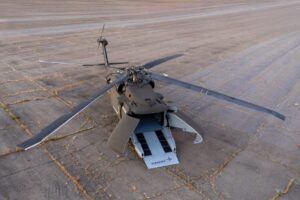
On the last of the five projects, the Army said the idea was formulated at the Army Aviation Center in Fort Rucker, Alabama, and is intended to give “attack aviation pilots direct control of UAS sensors to enable over-the-horizon targeting and synchronize manned-unmanned fires.”
“Fort Rucker is unique in that we can bring together warfighting experts and cutting-edge commercial capabilities to test technology the way we intend to fight it. To ensure that we move swiftly to achieve the Army’s autonomy goals, as of today Fort Rucker will serve as our UAS Autonomy Center of Excellence,” LaNeve said in a statement.
LaNeve has also directed FASCOM to work on creating new capability-based formations built around autonomous long-range fires, protection, tanks, logistics and obstacle breaching, the Army noted.
“These capabilities were specifically selected for their role in enabling operational maneuver and are aligned to the four elements of convergence, strike, close battle, and endurance outlined in the operational warfighting guidance released by the U.S. Army last week,” the Army said.