 By
By 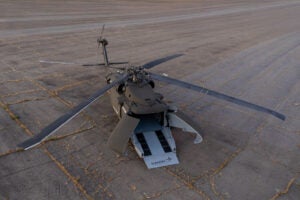
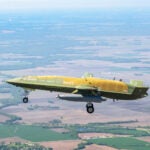
Sikorsky [LMT] and Boeing [BA] on Monday each unveiled concepts for new large unmanned platforms, with the former’s U-Hawk based on the UH-60L Black Hawk helicopter that it aims to fly in 2026 and the latter detailing its tiltrotor CxR platform envisioned as a loyal wingman.
Both firms are highlighting the new capabilities at this week’s Association of the U.S. Army Conference in Washington, D.C., with each having said they intend to inform customers’ potential requirements for deploying such systems to support future combat and contested logistics missions.
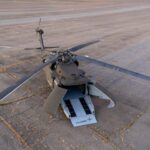
“[U-Hawk] is designed to do direct support [for] the maneuver commander. So as the Army is conducting an air assault, you would envision the U-Hawk flying ahead of the soldiers. As the U-Hawk comes into the landing zone, first it dispenses launched effects out of the sides of the aircraft…and then it lands, it disembarks the [unmanned ground vehicle] and then the aircraft departs. And this is done ahead of any soldiers putting boots on the ground,” Ramsey Bentley, director of strategy and business development for Sikorsky Advanced Programs, told reporters in a briefing.
Chris Speights, Boeing’s chief engineer for vertical lift, told reporters recently the CxR, Collaborative Transformational Rotorcraft, is envisioned as a “modular core that we can adapt for things like a loyal wingman collaborative rotorcraft that would partner with an aircraft like an Apache or even the Little Bird or whatever else you may have.”

“We are sharing the concepts with the customer so that we can get feedback and tailoring to make sure that we’re honing in on the right problem statements and the right needs. But all of our analysis shows that this is absolutely meeting the needs…as a collaborative aircraft,” Speights said. “When we get alignment on requirements, the market, customer feedback and everything’s aligned, I think that would allow us to go through a very rapid development cycle leveraging our Phantom Works team.”
For the U-Hawk, Bentley said Sikorsky took a UH-60L and “completely removed the cockpit, the pilot and also the crew chief stations,” redesigned the front end of the aircraft, added clamshell doors and ramps for cargo loading purposes and utilized its MATRIX autonomy capability to turn it into an unmanned platform.
“As the Army looks at reducing their Lima-[mode] fleet, we’re looking at a way to reuse those aircraft and do so economically,” Bentley said.
Beth Parcella, Sikorsky’s vice president of strategy and business development, described the U-Hawk as a “true Group 5 UAS.”
“I think the payload [capacity] is what really distinguishes this from competitors,” Parcella said.
Sikorsky has been testing MATRIX on the Black Hawk for several years, noting it allows the platform to be operated from a tablet, and in early 2022 completed the first ever completely unmanned, autonomous flight with a UH-60A (Defense Daily, Feb. 9 2022).
“What if I can fly a Black Hawk completely autonomously? Now I have a vertical lift UAS that can carry 10,000 pounds,” Rich Benton, Sikorsky vice president and general manager, told reporters.
Parcella added that Sikorsky see U-Hawk’s potential missions ranging from “delivering swarms of drones, from launched effects quivers, carrying cargo in a contested logistics environment, driving on and off uncrewed ground vehicles, operating in a counter-UAS function, roll on and roll off of supplies.”
Speights told reporters that CxR is envisioned as a Group 4 or 5 UAS that utilizes a tiltrotor design with a single propulsion system powered by a gas turbine engine, with Boeing leveraging its experience with the V-22 program.
“And that would enable it to fully support the types of attack, reconnaissance and scout missions that the Apache performs or needs to perform. It would be able to carry the payloads that are relevant for Apache types missions. It would create a larger sensor volume than what larger launched effects would see. And it will have the speed and range and endurance that helps meet the needs of the mission both today and in the future,” Speights said.
Boeing envisions CxR operating at speeds of up to 200 to 250 knots as it works collaboratively with Army’s manned rotorcraft fleet, to potentially include the future Bell [TXT]-built MV-75 FLRAA.
For the logistics-focused variant of CxR, Speights says the platform would partner with plans like Boeing’s Chinook heavy-lift helicopter while carrying payloads in the range of 1,000 to 2,000 pounds.
“In a contested logistics environment that can make all the difference if you’re bringing critical munitions to the battle and not risking human life,” Speights said.