Raytheon’s economic impact to Arizona now tops $2.6 billion
New report reveals company’s growing statewide benefit
PR Newswire
PHOENIX, Oct. 2, 2019
PHOENIX, Oct. 2, 2019 /PRNewswire/ — Raytheon Company (NYSE: RTN) makes a $2.6 billion annual economic impact to Arizona, according to a new study conducted by Arizona State University’s Seidman Institute. The research firm analyzed Raytheon contributions to the state in the form of wages, taxes, suppliers and other key indicators.
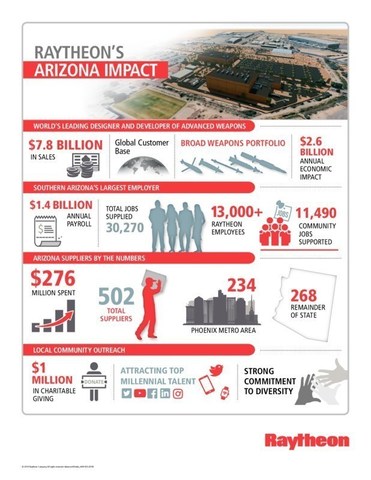
The latest study shows Raytheon’s annual impact across Arizona has grown by more than $500 million in the last three years. Increased sales, new hiring and additional infrastructure have helped to fuel the increase.
“Raytheon’s continued growth in Arizona is having a substantial, positive effect around the state,” said Wes Kremer, Raytheon Missile Systems president. “With nearly 13,000 employees now working in Arizona and a strong, statewide network of over 500 suppliers, the company provides a significant boost to Arizona’s economy.”
In 2018, Raytheon executives along with federal, state and local leaders formally dedicated six new buildings at the company’s Tucson plant site. The company has since completed infrastructure expansion and hired more than 2,000 new workers. Raytheon plans additional hiring over the next three years, as well as investments and improvements in manufacturing, engineering technology and facilities infrastructure in order to meet growing customer demand.
“Raytheon is one of our state’s most valuable assets,” said Arizona Gov. Doug Ducey. “This high-tech powerhouse is a major jobs creator, and its products help to defend freedom around the globe. Arizona will continue to foster a pro-growth tax and regulatory environment that allows Raytheon to thrive in our state for years to come.”
Raytheon employees volunteer thousands of hours annually in Arizona classrooms, tutoring students in math and science. The company sponsors numerous outreach efforts to help spark student interest in science, technology, engineering and math. Raytheon also supports military veterans and their families through various programs.
As Raytheon continues to grow in Arizona, so will the company’s need for top talent. Raytheon is investing in statewide programs designed to help cultivate STEM skills that lead to rewarding careers for Arizona’s future innovators.
About Seidman
The Seidman Research Institute is the consultancy arm of W. P. Carey School of Business, Arizona State University. First established in 1985 to serve as an applied business research and consultancy resource for the southwest business community, we currently offer a diverse range of business and economics consulting services to public and private sector clients throughout North America.
About Raytheon
Raytheon Company, with 2018 sales of $27 billion and 67,000 employees, is a technology and innovation leader specializing in defense, civil government and cybersecurity solutions. With a history of innovation spanning 97 years, Raytheon provides state-of-the-art electronics, mission systems integration, C5I® products and services, sensing, effects and mission support for customers in more than 80 countries. Raytheon is headquartered in Waltham, Massachusetts. Follow us on Twitter.
Media Contact
John Patterson
520.440.2194
rmspr@raytheon.com

 View original content to download multimedia:http://www.prnewswire.com/news-releases/raytheons-economic-impact-to-arizona-now-tops-2-6-billion-300929924.html
SOURCE Raytheon Company