NRL power-beaming demonstrated on International Space Station
PR Newswire
WASHINGTON, April 14, 2020
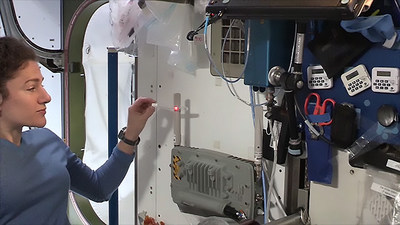
WASHINGTON, April 14, 2020 /PRNewswire/ — International Space Station astronaut Jessica Meir completed the first U.S. Naval Research Laboratory power-beaming demonstration in orbit February 12, 2020, using relatively simple components suitable for STEM activities.
Meir showed how NRL’s LEctenna™, a light-emitting rectifying antenna, converted a wireless network signal, similar to home networks, into electric power. While the current generated and light emitted was a small amount, the setup proved the concept in space.
“While this is a cool device on its own, our collaborators [at NRL] have begun investigating the wide range of possible applications for this technology in the real world,” Meir said. “We could find ways to wirelessly charge our mobile devices or remotely power drones. But one of the most interesting applications that they’re looking into is space-based solar panel arrays.”
Led by electronics engineer Paul Jaffe, researchers at NRL are investigating space solar and power beaming as a potential source of clean energy for a variety of military and civilian applications.
Space solar is simply using solar panels in space to harvest the sun’s energy, where collecting rays would be unaffected by clouds or other interference. Power beaming would send the collected energy down to Earth, where it would be converted back – just like LEctenna™ did – to usable energy.
“Some people might know about power beaming, such as for their toothbrush, or putting their phones on a charging pad,” Jaffe said. “What’s really exciting about it though, is that power can be sent wirelessly over much larger distances.”
The LEctenna™ demonstration proved the concept of power beaming in space, but was primarily a STEM project to inspire the next generation of innovators launched by the Department of Defense Space Test Program mission. It’s simple, relatively low-cost design to convert electromagnetic waves to electric power can be replicated by students.
“LEctenna™ was a cool demonstration to raise awareness,” said Elias Wilcoski, an NRL research physicist. “We want to show students that this is technology that they can do themselves. If we can get them excited about it and space solar and power beaming, we can help bring more scientists and engineers into the fields to ensure the viability of our future.”
About the U.S. Naval Research Laboratory
NRL is a scientific and engineering command dedicated to research that drives innovative advances for the Navy and Marine Corps from the seafloor to space and in the information domain. NRL headquarters is located in Washington, D.C., with major field sites in Stennis Space Center, Mississippi; Key West, Florida; and Monterey, California, and employs approximately 2,500 civilian scientists, engineers and support personnel.
Media Contact:
J. Raynel Koch
nrlpao@nrl.navy.mil
(202) 767-0428 office
(202) 424-9955 mobile
 View original content to download multimedia:http://www.prnewswire.com/news-releases/nrl-power-beaming-demonstrated-on-international-space-station-301040307.html
SOURCE U.S. Naval Research Laboratory