 By
By 
The Army is planning an imminent award for its Common Autonomous Multi-Domain Launcher (CAML) Medium platform, potentially within the next 30 days, a lead official said Wednesday.
“We just finished our source selection effort,” Lt. Gen. Frank Lozano, program acquisition executive for fires, said during a panel discussion at the Association of the U.S. Army’s annual conference in Washington, D.C.
The update follows the Army’s decision to focus on a Medium-sized variant as a lead effort. Lozano confirmed the service is planning to initiate a CAML Light effort in partnership with Australia in 2027 before launching a CAML Heavy initiative around the 2028/2029 timeframe.
“We’re looking at a strategy here…where we have every missile [currently] having its own unique launcher and trying to collapse down to a maximum of three. But that generically is the timeline, and we massage and adjust that timeline as we learn more about industry’s capabilities to deliver what we need,” Lozano said.
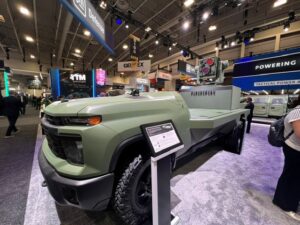
The Army has previously said CAML is intended to be an “autonomous, optionally crewed, highly mobile, air-transportable, multi-domain (offensive and defensive) fires launcher with the potential to augment or replace existing Army launchers.”
CAML platforms are expected to encompass a launcher platform, a leader vehicle with an autonomy kit and either an automated resupply vehicle or an “inherent autonomous resupply capability,” the Army has said.
The Army has already selected Georgia Tech Research Institute (GTRI) to serve as the weapon systems integrator for CAML Medium, recently awarding the non-profit a $33.4 million deal for the work (Defense Daily, Sept. 1).
The service described the deal as “the first key step in the development” of CAML, while noting that subsequent awards were scheduled in the coming months covering the autonomous mobility platform and additional components of the program.
Lozano, in a recent media roundtable, described the Army’s process to coalesce around a medium-sized platform as its initial effort for CAML, after having previously planned to concurrently pursue a heavy version as well.
“We issue these RFIs, we issue these requests for solution briefs, we hold capability demonstrations, and industry is learning through the process as well as my team. And so, what we learned was the capabilities that got demonstrated and proposed to us from a CAML perspective, the platforms were heavier than we wanted them to be. And when I interface with the combatant commands and the requirements community, who are part of the PAE, and I look at the different missile and munition mixes that we’re going to place on these CAML systems, we start to define what we might want this system to look like. And so, what we started to see was the formation of a CAML Medium variant,” Lozano previously said.
Lozano has said that a CAML Medium was envisioned to be capable of carrying munitions such as Tomahawk missiles, PAC-3 MSE interceptors, “probably” the future low-cost interceptor, the Lockheed Martin [LMT]-built MLRS family of munitions as well as Indirect Fire Protection Capability interceptors.
“When I started to define the number of interceptors that I wanted this particular system to carry and I started to communicate with the combatant commands to understand how this system would be employed, we started to realize that a 60,000-pound gross vehicle weight platform was just going to be too heavy. And so, what we settled on in talking with everybody involved was a CAML Medium variant that would have a top-end gross vehicle weight rating of 36,000 pounds. And that gave us the right platform with the right munitions mix, with the formations and the employability that we wanted for that particular system,” Lozano said in the recent media roundtable.
On the forthcoming CAML Light effort, Lozano said Acting Army Chief Gen. Christopher LaNeve directed that PAE Fires execute that program with Australia “to help the Australians meet some of their capability requirements.”
“We have a solicitation, an RFI, ready to issue that will be followed up by an industry day,” Lozano said.
The Army could look to make selections for CAML Light prototyping in the spring 2027 timeframe, according to Lozano.
“That could then support a potential live fire demonstration [at the] Talisman Sabre [exercise] in the June/July timeframe. That would then allow us to make a downselected award on that effort,” Lozano said.
On the future CAML Heavy, Lozano said the Army envisions that platform as handling “some of our larger missile systems, potentially a Leviathan and [Long-Range Hypersonic Weapon], maybe a stack of Tomahawk missiles, right, and have a larger capability.”