Joint Task Force-Gold, which is to help ensure that the planned Golden Dome for America (GDA) missile defense system is ready for operations, plans to have an initial stage of cyber protection and passive anomaly detection in place by the end of the year.
“Our mission continues to grow,” Army Col. Kevin Stonerook, the deputy of JTF-Gold at U.S. Northern Command, told reporters on Wednesday at the Association of the U.S. Army’s annual conference in Washington, D.C.
The task force has about 100 personnel and a headquarters at Peterson Space Force Base, Colo. “One of the things that has become a new mission set for us is we did have some major involvement in the defensive cyber of the missile defense system,” Stonerook said. “We are helping put together the ‘team of teams,’ all the different stakeholder community, vendors and other government agencies to really provide a cyber warfare capability for GDA. That’s one of the main things we’re focused on.”
Army Lt. Gen. John Rafferty, the commander of Army Space and Missile Defense Command (SMDC) and JTF-Gold, said that SMDC has chosen a unit to help integrate systems, including command and control (C2), for GDA.
“So now, if you array sensors and interceptors and C2 platforms from across the country, you can use any sensor, best shooter, and C2 in that disaggregated way,” he said.
On Sept. 17, Space Force Gen. Michael Guetlein, the direct reporting program manager for GDA, told the Ohio Space Forum in Cleveland that the first stage of Golden Dome, to be complete by 2028, would focus on protecting against “a coercive decapitation or rogue nation attack against the homeland.” Stage 2, to be completed by 2035, would be the full version of GDA. Aviation Week first reported Guetlein’s remarks.
In May, Guetlein said that a more than $1.2 trillion, 20-year GDA cost estimate by the Congressional Budget Office did not reflect “what we’re building” (Defense Daily, May 14).
It appears that Guetlein’s comments last month indicate that the 2028 architecture for Golden Dome, which he has not disclosed thus far, would be much less expansive than that envisioned by President Trump in Executive Order (E.O.) 14186. In May last year, the Pentagon said that GDA would be a “system of systems” to protect the United States from “aerial attacks from any foe.”
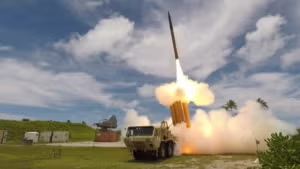
In many respects, that 2028 architecture could be the existing Ground-based Midcourse Defense at Fort Greely, Alaska with a few alterations, such as the RTX [RTX] and Lockheed Martin [LMT] Patriot system and Lockheed Martin Terminal High Altitude Area Defense batteries and added protection for U.S. Strategic Command and the National Capital Region.
One source said that defense companies are publicly discussing the full up 2035 architecture due to the huge sums involved but know that the 2028 architecture is going to be nowhere close to the Trump advocated concept.