Navy Begins Airworthiness Tests of LRASM Aboard Super Hornet
Valerie Insinna
SHARE:
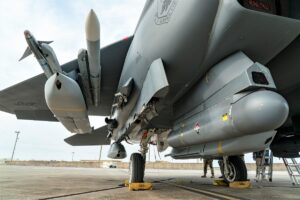
Long Range Anti-Ship Missile (LRASM) prototype captive-carry flight tests on the F/A-18E/F Super Hornet.
(Photo: U.S. Navy)
The Navy in November started initial testing of the Long Range Anti Ship Missile (LRASM) aboard its F/A-18E/F Super Hornet.The initial airworthiness testing was conducted with LRASM mass-simulator vehicle at Patuxent River Naval Air Station, Md., said Lockheed Martin [LMT], which manufactures LRASM.Before the military conducts flight tests with an actual missile, it attaches a simulator vehicle with the same weight and size to evaluate whether carrying the missile would place too much strain on the aircraft. The Navy plans…
President Donald Trump on Wednesday called on Congress to pass and send a second reconciliation bill to his desk by June 1. The deadline follows congressional Republicans’ backing a pursuit […]
Upgrades to the GPS ground system–the Architecture Evolution Plan (AEP)–is an option under consideration by the Defense Department’s space acquisition chief, as problems continue in fielding the GPS Next Generation […]
Senate Budget Committee Chair Lindsey Graham (R-S.C.) said Wednesday, with the White House’s backing, his panel will move “expeditiously” on crafting a second reconciliation bill, citing priorities for defense and […]
Defense Secretary Pete Hegseth on Thursday acknowledged the Pentagon could potentially ask Congress for $200 billion in supplemental funding to support the ongoing operation against Iran and replenish munitions used […]
Navy Begins Airworthiness Tests of LRASM Aboard Super Hornet
Valerie Insinna
SHARE:
The Navy in November started initial testing of the Long Range Anti Ship Missile (LRASM) aboard its F/A-18E/F Super Hornet.
Long Range Anti-Ship Missile (LRASM) prototype captive-carry flight tests on the F/A-18E/F Super Hornet. Photo: U.S. Navy
The initial airworthiness testing was conducted with LRASM mass-simulator vehicle at Patuxent River Naval Air Station, Md., said Lockheed Martin [LMT], which manufactures LRASM.
Before the military conducts flight tests with an actual missile, it attaches a simulator vehicle with the same weight and size to evaluate whether carrying the missile would place too much strain on the aircraft. The Navy plans to run additional rounds of tests to evaluate how the missile impacts noise and vibration on the aircraft, Lockheed Martin said.
Four of the six planned mass simulated vehicle tests have been completed so far, said Mike Fleming, LRASM director at Lockheed Martin Missiles and Fire Control.
“The LRASM airworthiness flights on the Super Hornet put us one step closer to fielding this urgently needed capability for our warfighters,” Fleming said in a news release. “The flight data acquired validates the LRASM system design and clears the way for the test program to continue.”
LRASM is a precision-guided, anti-ship standoff missile the Navy designed to find and strike targets without having to rely on data links, GPS coordinates or other platforms that provide targeting information.
“LRASM testing will continue in 2016 with a fully instrumented measurement vehicle and sensor suite captive carry flights to prove out flight characteristics and maturity of the subsystems,” Fleming said in an emailed statement to Defense Daily. The instrumented measurement vehicle, which is not a functional weapon, will allow the Navy test the functions of components and systems inside LRASM.
The program is on track for first LRASM launch from a Super Hornet after the aircraft integration is complete, he added. Early operational capability is anticipated in 2018 for the B-1B and in 2019 for the F/A-18E/F.
The LRASM program was originated by the Defense Advanced Research Projects Agency (DARPA) before becoming a joint program with the Navy and Air Force. So far the program has conducted three flight tests of LRASM on the Air Force’s B-1B bomber. LRASM’s design is based on Lockheed Martin’s Joint Air to Surface Standoff Missile Extended Range (JASSM-ER), which allows the military to save money through common parts and assembly processes, Lockheed said.
U.S. Northern Command (NORTHCOM) used a counter small unmanned aircraft system (sUAS) flyaway kit (FAK) in the early hours of the strikes against Iran on Feb. 28, according to Air […]