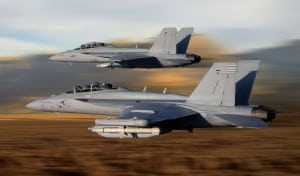

The Navy wants more EA-18G Growlers not just because it would be nice to have, but because not having them would represent an “increased” risk in the electromagnetic attack area, according to Chief of Naval Operations Adm. Jonathan Greenert.
Despite concerns over a growing strike fighter gap, Greenert clearly feels that the area of chief concern for the service is not the availability of strike aircraft, but the ability of the Navy to penetrate an “anti-access/area denial” environment, based on his comments Tuesday before the House Appropriations defense subcommittee about why he put 22 Growlers in the Navy’s unfunded priority list submitted recently to Congress.
“A lot of what we’re about on the future, as I mentioned, is electromagnetic spectrum and we’ve got to jam, spoof and depress as necessary, so the Growler’s got to get us in there,” Greenert said. “Our adversaries and potential adversaries in technology — advanced radar, I kind of mentioned it, many bands. X band is your lower frequency and that’s your original detection, but then you’ve got S band and other bands to target. We’ve got to understand all of that and we’ve got to operate in it and jam it.”
In recent years, Congress has shown a greater concern over the strike fighter shortfall, but it’s not an issue that appears to phase Navy leadership, who believe the F-35 will get here on time and that legacy F/A-18 Hornets can be extended. Instead, Greenert feels the weight on his shoulders of being the service that everyone depends on as far as electronic attack.
“As we look out and as we’ve done studies and look into the future, and we are the DOD electronic attack source, I view it as increased risk and a hedge as we look at the Growler line potentially closing,” he said.
Congress is probably not going to both buy 22 Growlers and buy 22 Super Hornets — the latter of which it had funded in last year’s budget via advance procurement funding — so the question is whether appropriators will continue to favor the strike fighter gap or whether the Navy’s arguments about a need for electronic attack will sway them. Or, if they determine that there isn’t enough money for either after all.