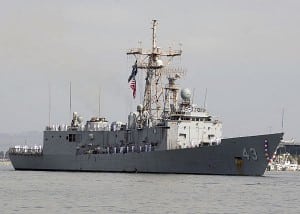
USS Thach (FFG 43), an Oliver Hazard Perry-class guided-missile frigate. Photo: U.S. Navy.
The Navy is building up to a fleet of 308 ships by 2021, but that fleet size will not be enough to address growing security challenges and an increasing number of adversaries with near-peer capabilities, two former Navy officials told a House panel on Wednesday.The service would be better served by a fleet of at least 350 ships, but to get there the Defense Department should needs to revamp its bureaucratic acquisition structure, said John Lehman, former Secretary of the…
Defense Secretary Pete Hegseth said Wednesday the Trump administration plans to continue its push for at least $350 billion in defense funds via the reconciliation process “regardless of what happens […]
A small, bipartisan group of senators is backing the Fast Tracking European Investment in Ukraine’s Defense Act, S. 5175, to hasten the export of allied buys of U.S. munitions for […]
Rep. Jim Himes (D-Conn.), the ranking member of the House Permanent Select Committee on Intelligence, plans to increase the committee’s contractor oversight if the Democrats win control of the House […]
A new Congressional Budget Office report estimates the cost of the Iran war through Aug. 1 as $38 billion and says that the U.S. has likely depleted between one-half and […]
The Navy is building up to a fleet of 308 ships by 2021, but that fleet size will not be enough to address growing security challenges and an increasing number of adversaries with near-peer capabilities, two former Navy officials told a House panel on Wednesday.
The service would be better served by a fleet of at least 350 ships, but to get there the Defense Department should needs to revamp its bureaucratic acquisition structure, said John Lehman, former Secretary of the Navy, and retired Adm. Robert Natter, former commander of U.S. Fleet Forces Command from 2000 to 2003. Lehman, who served in the Reagan administration, and Natter testified in front of the House Armed Services seapower and projection forces subcommittee.
USS Thach (FFG 43), an Oliver Hazard Perry-class guided-missile frigate. Photo: U.S. Navy.
Given the growing Chinese navy, improving state of the Russian navy and increased North Korean ballistic missile threat, the U.S. Navy needs at least 350 ships, Natter said.
“All you have to do its look at the number of ships we had when I was commander of the Seventh Fleet in Asia and the opposition that we faced in those days,” he said. “The problems today are much more serious, and the numbers that potential adversaries have are much more serious than when I was there. And yet, the numbers of our ships and aircraft are smaller.”
Some experts argue that the Navy can accomplish its mission with fewer vessels because of the advances in shipboard technology that allow the service to project power at longer distances than ever before, he noted.
“The uncomfortable little truth, though, is that although our ships are indeed better than they were in the past, our potential adversaries are not producing buggy whips and ships with sails either. In fact, some, not most, but some of their technologies are in fact better than ours today,” he said.
Lehman said that he agreed that the service needs at least 350 ships and 15 aircraft carriers. That can be achieved if Congress is successful in reforming and streamlining the “vast, choking bureaucracy” in the Defense Department and returns to fixed-price contracting structures, he said.
According to the former Navy secretary, the biggest vulnerability in the current fleet is in the area of anti-submarine warfare, caused primarily by the retirement of the Oliver Hazard Perry-class frigates. The Littoral Combat Ship (LCS) is slated to take the place of the legacy ships. But Lehman argued those ships, as well as the future, multi-mission “frigate” version, will not match its predecessor in capability.
“We have no frigates in the fleet. This is unbelievable,’ he said. “I am a strong supporter of the LCS and have been from the beginning. I think both of the version are good ships for certain roles but they will never be frigates. I don’t care how big a plug you put in and how much fuel you stuff in.”
The service should do everything it can to preserve shipbuilding capability for both LCS shipbuilders—Lockheed Martin [LMT] and Austal USA in Mobile, Ala.—but ultimately Lehman said he did not believe the Navy should increase its planned LCS buy, which was truncated from 52 to 40 ships in the fiscal 2017 budget request. Navy officials have said cutting the program could lead to one shipbuilder going out of business once the service downselects to a single vendor.
The Navy in 2021 is scheduled to hit its 308-ship requirement—although that number may change in the upcoming force structure assessment the service plans to finalize this summer. Even obtaining a 308-ship fleet will be difficult in today’s budgetary environment, Natter acknowledged.
The service will need either additional funding to supplement to its shipbuilding account during the procurement of the Ohio replacement submarines, or a separate department-wide account to fund the new boomers like HASC has pursued in the past, he said. Otherwise, reaching 308 ships will not be achievable.
Both former officials said that aerial refueling should be the primary role of the Navy’s first unmanned carrier drone, effectively agreeing with the service’s decision to shift the Unmanned Carrier Launched Airborne Surveillance and Strike program to an unmanned tanker.
NATIONAL HARBOR, Md. – A Senate Armed Services panel chair today said boosters of the Golden Dome program still have work to do to increase support on Capitol Hill while […]