Search

F-35 Program Office, Contractor To Discuss Fighter Jet’s Deficiencies

The U.S. Defense Department’s F-35 Lightning II joint program office (JPO) plans to hold a “consideration summit” with prime contractor Lockheed Martin [LMT] in the “spring-summer timeframe” to discuss how to fix about 200 deficiencies that have been identified with the fighter jet and related equipment, according to the JPO’s leader.

The shortfalls involve capabilities that have been delivered and are not performing to contract specifications or warfighter requirements. They need to be corrected but are not significant enough to prevent troops from flying the aircraft, said Navy Vice Adm. Mat Winter, the F-35’s program executive officer. 

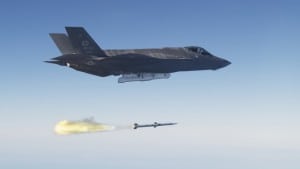
An F-35 firing an AMRAAM. Photo: Raytheon.

“When you accept a house and you go into the bathroom and the molding behind the toilet doesn’t match exactly, are you going to not accept the house because of that? No, but you’re going to ask them to come in and fix it,” Winter told reporters Feb. 28. “That’s what I have.”

Winter said he wants to ensure that the fixes are not paid for with money intended for future improvements, such as Block 4 hardware and software upgrades.

“I am not going to correct that deficiency with Block 4 money, for example, and pay for it twice,” he said.

Another upcoming event this year is close-air-support (CAS) and reconnaissance testing starting in April and occurring mainly at Edwards Air Force Base in California. The CAS portion will include “limited” weapons firings, Winter said.

In addition, the F-35’s initial operational test and evaluation (IOT&E) is slated to start in September and run through May 2019. The IOT&E could pave the way for the start of full-rate production.

A series of cold-weather tests ended in early February at Eielson Air Force Base in Alaska. The JPO is awaiting the results from operational testers.

Next week, the U.S. Marine Corps intends to begin an at-sea period on the USS Wasp (LHD-1)amphibious assault ship to prepare for its first F-35B maritime deployment.

On the international front, the first of 40 F-35As for South Korea is scheduled to be unveiled in March. The British Royal Air Force is expected to declare an initial operational capability with the F-35B in December.

Also this year, sustainment efforts overall will expand to 366 jets at 19 bases, up from 280 aircraft at 15 bases today, Winter said.
Congress Updates

SASC’s FY ‘27 NDAA Sticks With Army’s Plan For Legacy Aviation Procurement Cuts

The Senate Armed Services Committee’s (SASC) version of the next defense policy sticks to the Army’s proposed plan to cut procurement of its legacy aviation fleet, and does not authorize […]


SASC Approves $1.14 Trillion FY ‘27 NDAA With ‘Right to Repair’ Reform, Stock Buyback Restriction

The Senate Armed Services Committee (SASC) has approved its $1.14 trillion version of the next defense policy bill, adopting “right to repair” reform to provide the military services’ greater ability […]


House Appropriators Unveil $1.07 Trillion FY ‘27 Defense Bill, Restore Funds For E-7, Army Aviation

House appropriators on Wednesday released their $1.07 trillion fiscal year 2027 defense spending bill, with the legislation reversing Army aviation cuts, restoring funding for the Air Force’s E-7 Wedgetail program […]


MOSA Implementation By Pentagon Lagging, GAO Official Says

While the Modular Open Systems Approach (MOSA) has been a requirement for major defense acquisition programs since January 2019 and other Defense Department acquisitions since January 2021, few programs are […]

F-35 Program Office, Contractor To Discuss Fighter Jet’s Deficiencies

F-35 Program Office, Contractor To Discuss Fighter Jet’s Deficiencies
An F-35 firing an AMRAAM. (Photo: Raytheon)

The U.S. Defense Department’s F-35 Lightning II joint program office (JPO) plans to hold a “consideration summit” with prime contractor Lockheed Martin [LMT] in the “spring-summer timeframe” to discuss how to fix about 200 deficiencies that have been identified with the fighter jet and related equipment, according to the JPO’s leader.

The shortfalls involve capabilities that have been delivered and are not performing to contract specifications or warfighter requirements. They need to be corrected but are not significant enough to prevent troops from flying the aircraft, said Navy Vice Adm. Mat Winter, the F-35’s program executive officer. 

An F-35 firing an AMRAAM. Photo: Raytheon.

“When you accept a house and you go into the bathroom and the molding behind the toilet doesn’t match exactly, are you going to not accept the house because of that? No, but you’re going to ask them to come in and fix it,” Winter told reporters Feb. 28. “That’s what I have.”

Winter said he wants to ensure that the fixes are not paid for with money intended for future improvements, such as Block 4 hardware and software upgrades.

“I am not going to correct that deficiency with Block 4 money, for example, and pay for it twice,” he said.

Another upcoming event this year is close-air-support (CAS) and reconnaissance testing starting in April and occurring mainly at Edwards Air Force Base in California. The CAS portion will include “limited” weapons firings, Winter said.

In addition, the F-35’s initial operational test and evaluation (IOT&E) is slated to start in September and run through May 2019. The IOT&E could pave the way for the start of full-rate production.

A series of cold-weather tests ended in early February at Eielson Air Force Base in Alaska. The JPO is awaiting the results from operational testers.

Next week, the U.S. Marine Corps intends to begin an at-sea period on the USS Wasp (LHD-1)amphibious assault ship to prepare for its first F-35B maritime deployment.

On the international front, the first of 40 F-35As for South Korea is scheduled to be unveiled in March. The British Royal Air Force is expected to declare an initial operational capability with the F-35B in December.

Also this year, sustainment efforts overall will expand to 366 jets at 19 bases, up from 280 aircraft at 15 bases today, Winter said.