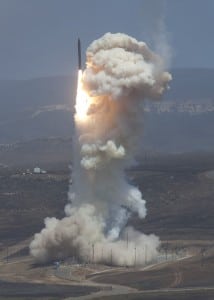
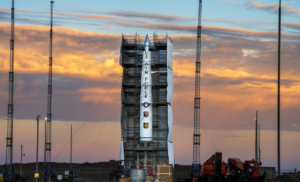
A Ground-based Midcourse Defense interceptor launch.
Photo: Missile Defense Agency.
The Department of Defense has asked Congress to approve shifting $416 million in previously approved funds to beef up missile defenses and other anti-missile efforts, a DoD official said Sept. 28.The reprogramming request would buy 20 more ground-based interceptor (GBI) missiles to counter long-range ballistic missiles, said Rob Soofer, deputy assistant secretary of defense for nuclear and missile defense policy.The Ground-based Midcourse Defense (GMD) system, whose prime contractor is Boeing [BA], already is slated to reach 44 fielded GBI's, mostly…
A new Congressional Budget Office report estimates the cost of the Iran war through Aug. 1 as $38 billion and says that the U.S. has likely depleted between one-half and […]
NATIONAL HARBOR, Md. – A Senate Armed Services panel chair today said boosters of the Golden Dome program still have work to do to increase support on Capitol Hill while […]
An HII [HII] shipbuilding executive last week told lawmakers how the company plans to improve and accelerate shipbuilding throughout via workforce improvements, adding new shipbuilding infrastructure and reinforcing distributed shipbuilding […]
The House on Tuesday passed a stopgap funding bill to keep the government open through Dec. 11, sending the temporary funding measure that also includes funds to support ongoing shipbuilding […]
The Department of Defense has asked Congress to approve shifting $416 million in previously approved funds to beef up missile defenses and other anti-missile efforts, a DoD official said Sept. 28.
The reprogramming request would buy 20 more ground-based interceptor (GBI) missiles to counter long-range ballistic missiles, said Rob Soofer, deputy assistant secretary of defense for nuclear and missile defense policy.
The Ground-based Midcourse Defense (GMD) system, whose prime contractor is Boeing [BA], already is slated to reach 44 fielded GBI’s, mostly at Fort Greely in Alaska, by year’s end. But missile defense advocates say more interceptors are needed to counter the growing threat from North Korea.
A Ground-based Midcourse Defense interceptor launch. Photo: Missile Defense Agency.
While GMD has had a long, troubled test history, it shot down an intercontinental ballistic missile (ICBM) target for the first time in a May test.
The reprogramming also would: fund sensor improvements, including software upgrades to the missile-tracking Sea-Based X-Band Radar (SBX); accelerate destroyer upgrades to accommodate the new Standard Missile-3 (SM-3) Block IIA interceptor; and provide more testing for the SM-3 Block IIA.
The request also contains money to “defeat” missiles before they are launched, Soofer said at a Capitol Hill conference on the nuclear triad. Details are classified.
The money for the reprogramming would come from various fiscal year 2017 operation and maintenance accounts.
Soofer said DoD is also working on a FY 2018 supplemental appropriations request for both missile defense and missile defeat. The department might send that request to Capitol Hill within the next few weeks.
DoD’s funding moves come as Pyongyang continues its accelerated campaign to develop and test ballistic missiles and nuclear weapons. In August, President Trump pledged to increase missile defense spending by “billions of dollars” to defend against North Korea.
But Kingston Reif, director for disarmament and threat reduction policy at the Arms Control Association, argued it would be premature to buy more GBIs now, as GMD still has a ways to go to prove it can defend the United States. For example, the system has yet to be tested against more than one target or against complex countermeasures, he said.
While there has been criticism among missile defense advocates of Golden Dome’s development pace after the signing of an executive order in January last year, Space Force Gen. Michael Guetlein, […]


 By
By