 By
By 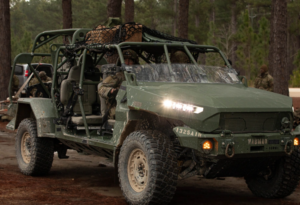
While the Army has already boosted the planned acquisition objective for the GM Defense [GM]-built Infantry Squad Vehicle to 12,000 vehicles, the company’s top executive has said he believes the service will “double that” figure amid the increased demand for the platform.
Steve duMont, president of GM Defense, told reporters he sees the potential boost to the procurement projection as encompassing the full ISV family of vehicles including the base nine-seat troop carrier variant, the newer five-seat, cargo-carrying ISV-utility and the currently in-competition ISV-Heavy platform.
“We’ll look at future defense budgets, like we always do. But I’m really confident that this will be around for a long time,” duMont said during a briefing at the Association of the U.S. Army’s annual conference in Washington, D.C.
The Army approved GM Defense’s ISV, based on the ZR2 variants of the company’s Chevrolet Colorado midsize truck, for full-rate production in April 2023, with the company having delivered hundreds of the lightweight, air-droppable platforms to date (Defense Daily, April 5 2023).
The original acquisition objective for ISV was to build nearly 650 vehicles for airborne brigades, duMont noted, with the Army then moving to significantly expand acquisition plans as it made the platform a focal point capability for its mobile brigade combat teams.
“When you take a look at the current snap to the chalk line for the acquisition objective, it really focuses heavily on the mobile brigades. Now, I think you’re going to see a movement beyond the mobile brigades, both Active and Guard,” Pete Johnson, GM Defense’s vice president of business development for integrated vehicles, said during the briefing.
The Army this year began buying the new ISV-Utility, the platform’s first production variant, which involved reconfiguring the base vehicle’s design to allow soldiers to carry more equipment in the back, to include energy storage units or enabling the launch and recovery of drones.
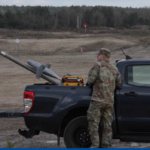
“I think as those vehicles get out of soldiers, they’re going to find other uses for them. So it’s everything from carrying mission kits, counter-UAS with mobile mortar capability, mobile command and control, anything that needs to be ‘shoot on the move’ and fits into that vehicle, it’s a great opportunity to do that,” duMont said.
Following the briefing, Johnson told Defense Daily the ISV-Utility will “definitely be the majority variant” for the total fleet, noting those vehicles have already been delivered to the 101st Airborne Division, the 25th Infantry Division and the Virginia National Guard.
The Army on Sept. 21 awarded GM Defense a $697.7 million contract modification for engineering change proposals related to the ISV-Utility.
GM Defense is also currently competing against defense newcomer and major automotive maker Ford [F] and the smaller, family-owned off-road vehicle company BC Customs in the ISV-Heavy (ISV-H) prototyping effort, with the Army targeting the second half of fiscal year 2027 to make a production decision (Defense Daily, July 30).
“The ISV-H will provide critical operational capabilities, including exportable power to support tactical operations and onboard power to enable mission command while maneuvering. The ISV-H deploys worldwide by sea, air and land modes to support strategic deployment and operational maneuver of the Army’s Maneuver Brigade Combat Teams (MBCT),” the Army wrote in an earlier notice.
Johnson told Defense Daily the Army has asked the ISV-Heavy competitors to deliver three prototypes by the end of March 2027, which will go through a user assessment and additional Army testing through June, with the service having laid out plans for an initial acquisition objective of just over 600 vehicles.
“There is a sense that there is this huge need for power and energy out there, And there’s also a desire to try to get rid of trailer generators, or at least reduce the amount of trailer generators that are out there. Any ISV-Heavy can satisfy all those requirements as well. So if you just think through the lens of power generation, not just mission command on the move, which is the initial focus for the ISV-Heavy program, you can see a need for additional deployments out there, plus just additional payload,” Johnson said.