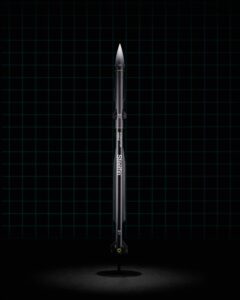
Anduril Industries said that it has contracts for the company’s Steelfin, a two-stage interceptor that is to be low-cost, modular, and adaptable to take on a variety of air and missile threats.
Last week, Anduril President Chris Brose told reporters that Steelfin is “not a glossy rendering with details to follow” but instead a system that the company has been developing for the last several years and one that has received contracts from customers the company declined to disclose.
The ability to fly Steelfin “with different rocket motors, different seekers, to be able to swap components out to be able to reconfigure the system for a range of different threats is a feature we built into this,” Brose said. “It’s something we’re already demonstrating.”
“Steelfin variants are compatible with established land- and sea-based launch infrastructure, including the M903A2, Mk 41 Vertical Launch System [VLS], Typhon, and other emerging containerized launch systems,” according to Anduril. “Similarly, Steelfin is designed to integrate with any fielded fire control software system (AEGIS, IBCS, etc.), ensuring that it fits seamlessly into established battle management processes and procedures.”
For Steelfin, “we did not want to provide a logistics problem to the [military] services that they are already having trouble with overcoming so we need to fit into existing capacity as well as give them optionality for the future as you need to distribute and spread these capabilities out,” Steve Milano, Anduril’s senior director of missiles, told reporters last week.
RTX‘s [RTX] Raytheon builds the M903A2 for Patriot missiles. Lockheed Martin builds the shipborne Mk 41 VLS and the ground-based Typhon for missiles such as Raytheon’s SM-6 and Tomahawk.
While the Ukrainian effort to turn back the Russian invasion has been a test case in the use of low-cost interceptors to down one way attack drones, missiles have required higher cost, non-Ukrainian interceptors, such as the Lockheed Martin [LMT] PAC-3 Missile Segment Enhancement (MSE).
“We’re using the flexibility across the Steelfin framework and the architecture to be able to match the best capability to the threat,” Milano said. “That gives us the ability to scale up production when necessary for low-cost threats and scale up the capability for exquisite threats.”
Anduril’s unit cost target for Steelfin, however, still looks to be several hundred thousand dollars at least.
“On the higher end, think of a more exquisite version of the Steelfin layering somewhere above PAC-3 MSE and below THAAD, accomplishing 100 percent of that mission at a fraction of the cost,” Milano said. “In a separate configuration, looking more like a PAC-3 type mission, accomplishing 80 percent of that mission at less than 50 percent of the cost. Looking at the [counter drone] lower end of the spectrum…the Steelfin enters into that market and provides greater than 80 percent of the capability of an SM-2 for a third of the cost.”