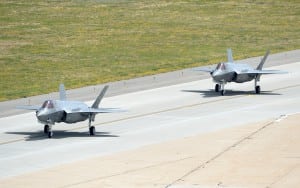
The first two combat-coded F-35A Lightning II aircraft arrive at Hill Air Force Base, Utah, Sept. 2, 2015. Photo: Air Force.
The U.S. Air Force’s new unfunded priorities list includes billions of dollars to buy more aircraft in fiscal year 2018, including F-35A fighter jets, MC-130J special operations transports and KC-46A tankers.The Air Force would spend $1.8 billion to buy 14 more Lockheed Martin [LMT] F-35A Lightning IIs, boosting its total FY 2018 purchase to 60 jets, the document shows. While the Air Force’s recently unveiled budget request would provide $5.4 billion for 46 F-35As, service officials have said they want…
A Republican senator on Armed Services Committee on Thursday said that defending against Iranian drones has been challenge for U.S. warfighters and will be an area of focus in the […]
The Pentagon is “working options” for a potential supplemental spending request to fund the operation against Iran and replenish munitions used in the strike campaign, with a senior official noting […]
Senate Armed Services Committee (SASC) Chairman Roger Wicker (R-Miss.) on Thursday proposed a rapid effort to supply Ukraine with low-cost weapons to aid that country in turning back Russia. “We […]
A group of four Congressional Democrats want to codify President Donald Trump’s push to hold defense firms accountable for prioritizing production investments over paying out stock buybacks, and are seeking […]
The U.S. Air Force’s new unfunded priorities list includes billions of dollars to buy more aircraft in fiscal year 2018, including F-35A fighter jets, MC-130J special operations transports and KC-46A tankers.
The Air Force would spend $1.8 billion to buy 14 more Lockheed Martin [LMT] F-35A Lightning IIs, boosting its total FY 2018 purchase to 60 jets, the document shows. While the Air Force’s recently unveiled budget request would provide $5.4 billion for 46 F-35As, service officials have said they want to reach an annual production rate of 60 as soon as possible (Defense Daily, May 23).
The first two combat-coded F-35A Lightning II aircraft arrive at Hill Air Force Base, Utah, Sept. 2, 2015. Photo: Air Force.
“With increased funding, we would invest in these capabilities now to ensure they do not compete for funding with critical nuclear and space requirements in the out-years,” the document says.
The unfunded list also contains $1.2 billion to buy 12 more Lockheed Martin MC-130J Commando IIs to address “emergency warfighting readiness requirements.” The budget request would fund five MC-130Js.
The Air Force would also like $600 million to buy three more Boeing [BA] KC-46A Pegasus tankers, adding to the 15 aircraft in its budget request. The service is eager to replace its KC-135 Stratotankers, which are over a half-century old.
Several items on the list would speed up the development of the EC-X, the replacement for the EC-130H Compass Call electronic-attack aircraft. But the program’s fate is unclear. While the Air Force has picked L3 Technologies [LLL] to lead the replacement effort, Boeing has filed a protest with the Government Accountability Office (GAO), citing a lack of competition (Defense Daily, May 25). The GAO is expected to weigh in on the challenge by late August.
The list also includes $147 million to conduct risk reduction for the Air Force’s Penetrating Counterair Aircraft, which might be the service’s sixth-generation fighter; $181 million to improve the Northrop Grumman [NOC] B-2 bomber; $191.3 million to buy three General Dynamics [GD] Gulfstream C-37B transport planes; and $103.2 million to retrofit C-5 and C-17 transports with countermeasures to defend against shoulder-launched missiles.
The list contains tens of millions of dollars for “game-changing technology,” including $70 million for a high-power microwave weapon prototype to knock out digital electronics, $15 million to develop an ultra-endurance aerial platform to conduct surveillance, and $10 million for a hypersonic weapons prototype.
The unfunded list totals $10.7 billion, with readiness and modernization accounting for $6.7 billion, or almost two-thirds. It includes $1.8 billion for infrastructure, $772 million for space, $563 million for cyberspace and $360 million for nuclear deterrence operations. Various airmen needs, such as communications gear, explosive detection equipment, night-vision devices and F-35 maintenance training instructors, total $504 million.
The Pentagon is bargain shopping for Group 1 drones, as other countries, including Ukraine and China, have taken advantage of consumer electronics-level prices to bolster their stables. “In last spring’s […]

 By
By