Top U.S. Air Force officials are standing behind a significant increase in funding the service is proposing for its controversial Long Range Stand-Off (LRSO) nuclear cruise missile for fiscal 2018.There seems to be “broad bipartisan support for LRSO,” Gen. Stephen Wilson, Air Force vice chief of staff, said Thursday at a Mitchell Institute for Aerospace Studies breakfast on Capitol Hill.The Air Force's latest budget request would ramp up development work on the program, granting it $451 million – up significantly…
Defense Secretary Pete Hegseth said Wednesday the Trump administration plans to continue its push for at least $350 billion in defense funds via the reconciliation process “regardless of what happens […]
A small, bipartisan group of senators is backing the Fast Tracking European Investment in Ukraine’s Defense Act, S. 5175, to hasten the export of allied buys of U.S. munitions for […]
Rep. Jim Himes (D-Conn.), the ranking member of the House Permanent Select Committee on Intelligence, plans to increase the committee’s contractor oversight if the Democrats win control of the House […]
A new Congressional Budget Office report estimates the cost of the Iran war through Aug. 1 as $38 billion and says that the U.S. has likely depleted between one-half and […]
Top U.S. Air Force officials are standing behind a significant increase in funding the service is proposing for its controversial Long Range Stand-Off (LRSO) nuclear cruise missile for fiscal 2018.
There seems to be “broad bipartisan support for LRSO,” Gen. Stephen Wilson, Air Force vice chief of staff, said Thursday at a Mitchell Institute for Aerospace Studies breakfast on Capitol Hill.
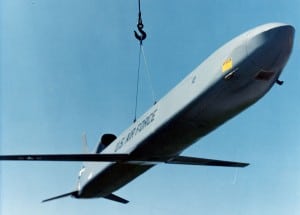
The Air Launched Cruise Missile would be replaced by LRSO. Photo: Air Force.
The Air Force’s latest budget request would ramp up development work on the program, granting it $451 million – up significantly from the $95.6 million it is currently receiving.
In fiscal 2017 the Air Force will expand office staff, facilities, and infrastructure in preparation of technology maturation and risk reduction phase, according to the service’s budget documents. Fiscal 2018, activities will include aircraft integration operations to ensure the weapon could be carried by B-52, B-2, and B-21 bombers, as well as test activities and support for design validation.
“This capability is absolutely essential,” Wilson said, adding that the Air Force is prioritizing funding for the program and “we will continue to advocate for it.”
The LRSO will replace the aging air-launched cruise missile (ALCM) and is expected to be fielded by 2030. Some lawmakers are pushing back on the program, arguing its conventional and nuclear capabilities increase the risk of miscalculation by adversaries; Sen. Ed Markey (D-Mass.) in March introduced legislation that would limit funding for the weapon at 2017 levels until Congress reviews the new administration’s Nuclear Posture Review now underway and expected to be completed this year. The bill remains in the Senate Armed Services Committee.
Gen. Robin Rand, commander of the Air Force’s Global Strike Command, said Thursday at a House Armed Services strategic forces subcommittee hearing that the LRSO is “not a new capability, it’s an improved capability over the ALCM that we currently have.”
Rand said he has seen no indication of a delay in the acquisition process for the TMRR phases of the LRSO and Ground-Based Strategic Deterrent (GBSD) programs – the latter is another big-ticket item that will replace the decades-old Minuteman III intercontinental ballistic missile, to be deployed in the late 2020s.
The GBSD program would receive $216 million in the Air Force’s budget request, up from the current $114 million. Boeing [BA], Northrop Grumman [NOC], and Lockheed Martin [LMT] have confirmed bids for the GBSD contract; Lockheed has also said it was bidding for LRSO.
The Air Force plans to award up to two contracts at the end of this fiscal year for each program’s advanced development phase. The service requested a total of $183 billion for fiscal 2018, an increase from the current $171.2 billion.
NATIONAL HARBOR, Md. – A Senate Armed Services panel chair today said boosters of the Golden Dome program still have work to do to increase support on Capitol Hill while […]


 By
By