 By
By 
HUNSTVILLE, Ala. – Top officials at U.S. Space Command said they see space fires, including laser weapons, as a threat to defend against as well as a resource to attack others in conflict.
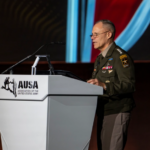
“In this domain, the threats are as dizzying as they are diverse: reversible jammers, cyber attack weapons, direct descent anti-satellite (ASAT) missiles, high energy lasers, co-orbital ASATs, and even potentially a nuclear ASAT on orbit, which is an outcome we could not tolerate,” Gen Stephen Whiting, Commander of U.S. Space Command (SPACECOM). said here at the annual Space and Missile Defense Symposium on Wednesday.
Whiting said one of SPACECOM’s moral responsibilities is to “help protect the joint force and the nation from space-enabled attack, [so] our space assets need to shoot, move and communicate, just like the rest of the joint force, so that our space assets can enable the joint force to shoot, move and communicate. In short, space needs to fight like the joint force, to empower the joint force’s ability to fight and undermine our adversaries’ ability to do so.”
While Whiting did not describe exactly what kinetic and non-kinetic space fires are, on Tuesday his deputy, Lt. Gen. Rick Zellmann, fleshed out some of what space fires can mean.
The U.S. is beginning to improve the resilience of space systems on orbit through a proliferation of constellations versus a few exquisite systems, and is considering the next steps to protect these assets.
“So let’s take the next step forward,” Zellman said. “If you have 10,000 satellites that are providing you a service, surely you’re not going to try and attack with a direct-ascent ASAT at 10,000 satellites…I’d encourage our adversaries to try to shoot down 10,000 satellites, but I don’t think they will, so just like we do, our targeting folks will try to find the various nodes where you can get a one-to-many solution.”
Zellmann said one-to-many anti-satellite solutions are cyber attacks and “the other is directed energy, because that doesn’t cost you much for a shot, so those two technologies are the ones I’d be concerned about.”
He added another method to defeat large constellations of satellites is using cheap one-way attack drones to destroy the small number of satellite ground stations and communication hubs.
This is “something I think we’re seeing playing out in real time in the Middle East, which is if you have a fixed facility, a cheap one-way attack drone is going to find you and kill you,” Zellman said.
He highlighted those 10,000 satellites inevitably come down to a “small number of landing sites and those are all susceptible to those one-way attack systems.”
Zellmann said the next step is figuring out how to “diversify or proliferate the ground systems” so there are not only a small number of nodes available for an adversary to attack.
Space Fires Regimes
Zellmann also spoke to how quickly space fires policy regimes are changing and getting approval.
He divided space fires into ground-to-space using satellite communications jamming, space-to-space orbital warfare, which led to the creation of Space Command and the Space Force, and space-to-ground, referring to Golden Dome’s space-based interceptors.
Zellmann said space-to-space warfare had become palatable to policy leaders because “luckily, our adversaries started to populate some of those systems first, which made it more palatable within our policy circles to essentially sanction space-to-space and that’s really why you see a Space Command and a Space Force and why we have orbital warfare.”
He did not name specific effectors for space-to-space warfare, but Zellmann said Whiting would like to see “active protection on board some of our systems so they can protect themselves, to a degree.”
While he sees space-to-ground warfare as the next logical jump, Zellmann was surprised to see it emerge so quickly, expecting it only after retirement.
“But along comes Golden Dome for America and we’re going to have space-based interceptors and so I think the policy hurdle has been crossed,” Zellman said.
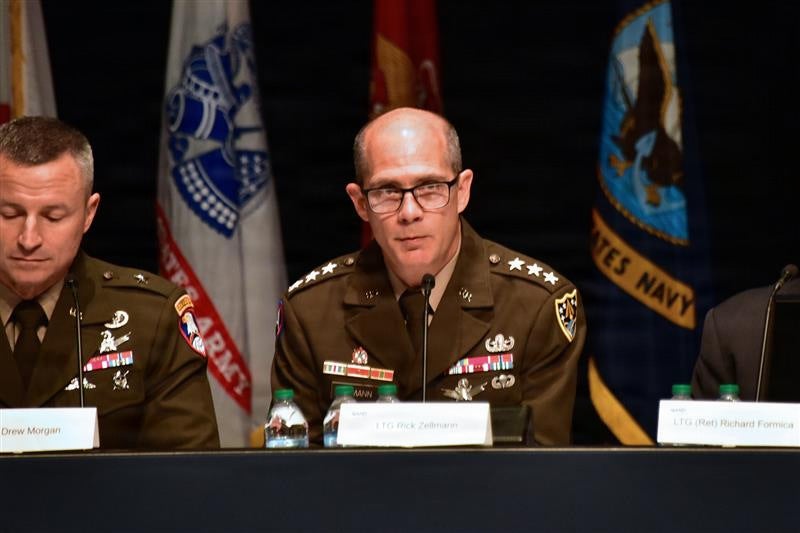
He also noted capabilities for space fires are largely divided between Space Force as well as the Army and Marine Corps.
“The Army, the Marine Corps, they also have some of these fires that they can do from ground to space,” Zellman said. “We’ve essentially outsourced that, we’ve decentralized that so that the other combatant commands can see to those fires because they have to be integrated with the operations, the timing and tempo that they’re conducting.”
However, orbital warfare and space-to-ground with SBIs “will still be the purview of Space Command,” he said.
Priorities and Survivability
Whiting said space survivability isn’t just good or nice to have, but “it is need to have.”
To achieve more space survivability, Whiting said the kit must be durable while pointing to his fiscal years 2029-2033 integrated priorities list. The list consists of the top five capabilities Space Command needs to meet command responsibilities.
He called this no mere wish list, but “a clear demand signal to several audiences, describing the warfighting capabilities we need to meet our mission. Number one and two are integrated space fires and counter-pLEO that enable us to establish space superiority.”
Proliferated LEO (pLEO) refers to the proliferated constellations of Low Earth Orbit satellites.
‘We’re a combatant command and we fight to win wars. To win, we need credible, acknowledged kinetic and non-kinetic fires,” Whiting said. “They are a key component of how we establish space superiority and restore credible deterrence.”
The remaining three priorities are joint integrated space command and control to “enhance machine-to-machine connectivity to support decision making and battle management of the global space fight on tactically relevant timelines,” dedicated space domain awareness for engagements to conduct advanced space domain awareness operations in support of space fires and protection and sustained space maneuver.
“Today our satellites are limited by the fuel they launch with, which leads to a psychology of scarcity. Husbanding that fuel often overrides desired warfighting maneuvers. That must change, we must be able to actively avoid threats and maneuver to gain a position of advantage on our opponents,” Whiting said.
In May, Whiting said he wanted to be able to give satellites the ability to maneuver away from a threat and reduce opponents’ probability to kill them as well as increase on-orbit refueling for some satellites (Defense Daily, May 12).
In April, Whiting spoke about the Defense Department’s need to develop a space maneuver warfare strategy, to make them less predictable and more survivable (Defense Daily, April 15).