
Munitions Shortages. According to the Government Accountability Office (GAO), the Defense Department is plagued with “persistent shortages” of munitions. The congressional audit arm on Sept. 24 published a classified report entitled, DOD Munitions: Planning and Leadership Needed to Address Persistent Shortages (GAO-26-107800C). Due to the report being classified, all that was made publicly available was the title, report number and date of publication.
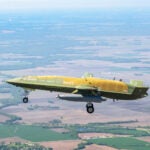
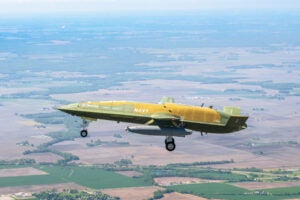
Jet-Powered Drone. AEVEX Corp. last week introduced Specter, a turbojet-powered one-way attack aircraft developed with additive manufacturing company Divergent, that can be ground-launched and air-launched. Specter has software-defined capabilities and a modular airframe for different payload types and mission effects and is designed for operations in contested environments, AEVEX said. “Specter reflects our lessons learned on capability from delivering thousands of autonomous systems in theater,” Manan Patel, AEVEX’s chief technology officer, said in a statement. “We are not optimizing for a fixed requirement, we are building an architecture that adapts.”
Flight Autonomy Partners. Skyryse, the developer of a flight autonomy operating system, and BAE System’s Australia-based subsidiary, have partnered on software-defined autonomous flight applications. SkyOS is the Skyryse’s operating system it says is aircraft-agnostic and can be used for fully-autonomous, remotely-piloted, and piloted missions for aircraft. BAE Australia is bringing its Vehicle Management System used to power several autonomous platforms in air and land domains. “SkyOS is uniquely positioned because it combines human-rated flight software with autonomous capabilities in a certifiable, software-defined platform,” Mark Groden, founder and CEO of Skyryse, said last week in a statement. “Together with BAE Systems Australia, we’re exploring how that foundation can enable the next generation of optionally piloted and autonomous aircraft, including future clean-sheet designs.”
IVEWS LRIP. The Air Force has awarded Northrop Grumman a more than $87 million contract for integration on F-16 fighters of low-rate initial production (LRIP) units of the company’s AN/ALQ-257 Integrated Viper Electronic Warfare Suite (IVEWS), which Northrop Grumman said in July had become a service program of record. The new contract “moves IVEWS one step closer to the field and builds on a rigorous test campaign where two systems have already accumulated more than 500 flight hours across 350 sorties,” the company said. In March 2022, the Air Force chose IVEWS over the AN/ALQ-254 Viper Shield by L3Harris Technologies. IVEWS is to detect and identify aircraft threats without adding to pilot workload and to permit simultaneous geo-location, operation with Northrop Grumman’s AN/APG-83 Advanced Electronically Scanned Array Scalable Agile Beam Radars, as well as jamming and avoiding radio frequency threats. IVEWS is to replace the older Northrop Grumman ALQ-131, Raytheon ALQ-184 electronic countermeasure pods, the Raytheon High-speed Anti-Radiation Missile Targeting System, and older radar warning receivers.
$27 Billion Shortfall. Ukrainian Pres. Volodymyr Zelenskyy said on Friday that President Trump had agreed at the United Nations meeting in New York City to provide licensing to Ukraine to build Patriot interceptors. U.S. financing of weapons for Ukraine has dried up during the Trump administration, but allied countries have been able to buy U.S. weapons systems for Ukraine through the NATO-led Prioritized Ukraine Munitions List (PURL), which may be even more of a lifeline for Ukraine now, as Zelenskyy said on Friday that Ukraine has a $27 billion budget deficit–most funding drones, missiles, and other supplies. “A third of this funding is for drones for January, February, and March of 2027, and if we do not order and pay for them in October and November, we will face a serious challenge,” he said.
Satellite Infrastructure. On Sept. 23, the Senate passed by unanimous consent S. 1962, the Secure Space Act, co-sponsored by Sen. Deb Fischer (R-Neb.), the chair of the Senate Armed Services Committee’s strategic forces panel, and Sen. Ben Ray Luján (D-N.M.). The legislation would prohibit the Federal Communications Commission (FCC) from granting satellite licenses or U.S. market access for foreign-licensed satellite systems produced or provided by “an entity” judged as a national security risk. “The threat foreign adversaries pose to our satellite infrastructure cannot be overstated,” Fischer said in a statement. “Countries like China and Russia are constantly trying to infiltrate our networks and get ahead. I am thankful my colleagues understand the importance of this legislation and the national security risks we face.” The bill would amend the Secure and Trusted Communications Networks Act of 2019 to cover both geostationary and non-geostationary orbit satellites and would apply to new licenses and authorizations issued after the bill’s enactment, which would require the FCC to establish implementing regulations within one year.
300 Corsairs Accepted. This month the Defense Department announced the Defense Contract Management Agency (DCMA) South’s Red River contracting office successfully inspected and accepted 300 Saronic Corsair autonomous surface vessels for the Navy as of June. The office supports 626 defense contractors with a total value of over $19 billion across Louisiana, Oklahoma, Arkansas and North Texas. DoD said DCMA’s support for the ASVs is part of the department’s “prioritization of rapid prototype to production of ASVs like the 24-foot Corsair, using other transaction authorities (OTAs)” DCMA South Red River commander, Army Lt. Col. David Volz, said in a statement. He added that while OTAs do not require the same level of oversight as FAR-based contracts, “they can allow non-traditional defense contractors to rapidly deliver effective combat systems to the warfighter. Such was the case at the Saronic Technologies facility in Austin.”
…Prep for Epic Fury. Volz said Navy’s Program Acquisition Executive for Robotic Autonomous Systems and the Navy overall requested some surge support from DCMA in late February to meet “immediate and urgent operational requirements” that turned out to be Operation Epic Fury, the attack on Iran. Volz said his team’s early support and expertise helped lead to the Corsairs being used to rescue downed helicopter pilots as well as in one-way attack configurations on Iranian facilities. Saronic’s facility launched in June 2025, with the company having never mass produced ASVs previously. In the first year, the DCMA team supported the facility developing manufacturing processes to speed up delivery. “In the beginning, my quality assurance team at the Austin facility inspected one or two vessels a week. Today we’re looking at many times more ASVs than that first month, and we’re capable of expanding our inspection and acceptance schedules even further,” William Harris, quality assurance supervisor with DCMA South Red River, added.
Saronic Cert. Saronic on Sept. 23 announced it achieved the ISO 9001:2015 certification for the sales, design, and manufacturing of Autonomous Surface Vessels (ASVs) at its facilities in Austin, Texas, issued by ABS Quality Evaluations. The company said this certification is the “international standard for quality management systems and the benchmark used across the defense, maritime, and industrial sectors to verify that an organization can consistently deliver products that meet customer and regulatory requirements.” The company said this provides an independent assurance to Saronic customers that its Austin-built vessels are built to a documented, auditable and repeatable standard as it scales up production of its 34-foot Cosrsair and 180-foot Marauder ASVs.
Marauder Production. Saronic on Sept. 17 announced its Franklin, La., facility completed a hull flip on their third Marauder 180-foot autonomous surface vessels. The company calls this a “major production milestone” with craft four and five also moving through the production line. While the first one is on the water and the second marauder is “close behind,” the company billed its Franklin shipyard as expanding to have the capacity to produce 20 marauders per year, or one every 18 days.
CNIC. Vice Adm. Brad Collins took over as Commander of Navy Installations Command (CNIC), succeeding Vice Adm. Scott Gray during a change of command ceremony at the Washington Navy Yard on Sept. 24. This marked the end of a three-year tour by Gray, who while in the role reorganized the Shore Enterprise and established CNIC as the Shore Type Commander (TYCOM). CNIC is responsible for worldwide U.S. Navy Shore installation management, designing and developing integrated solutions for sustainment and development of Navy shore infrastructure and quality of life programs. It oversees 10 Navy regions, 71 installations and 63,000 employees. In a news release, the Navy said Gray modernized shore management through requirements-based budgeting and data analytics while leading the integration of over 10,700 billets across public works departments, defense fuel support points, and the Navy Petroleum Office. He also notably established Task Force Shore within the Pacific Fleet Maritime Operations Center and fortified “strategic posture worldwide from advancing the AUKUS partnership at NSA Stirling to executing major infrastructure investments in Guam, Spain, and homeports across the fleet,” the service said. Gray is next headed to the Pentagon to serve as the Deputy Chief of Naval Operations for Navy Sustainment, leading a newly established office to integrate and synchronize capabilities. The Senate confirmed him for the latest position in July. Collins previously served as CNIC Chief of Staff and commander of Navy Region Northwest; Navy Region Europe, Africa, Central; and Navy Region Hawaii.
Italian Destroyers. Orizzonte Sistemi Navali (OSN), a joint venture between Italian manufacturers Fincantieri and Leonardo, signed a $4.2 billion contract with Europe’s (Organization for Joint Armament Cooperation (OCCAR) for the development, production, logistic studies and initial in-service support of two new generation DDX destroyers for the Italian Navy. Under the program, the companies said OSN plans to enter into subcontracts of $2 billion to Fincantieri and $1.9 billion to Leonardo in the coming weeks. “The DDX program is set to redefine the Italian Navy’s capability profile in the field of air and missile defense through a significant generational leap involving both the naval platform – designed and developed by Fincantieri as system integrator, together with its increasingly advanced digitalization – and the combat system, designed and developed by Leonardo,” the companies said in a joint statement. They said the ships will be designed to operate within interconnected multinational forces, feature high levels of digitalization, automation and integration among sensors and weapon systems. The ships are planned to be 590 feet long, a displacement of nearly 15,000 tons, a range of 4,000 nautical miles and a crew of 251.
Osprey Sonobuoy Tests. The Navy on Sept 23 announced a joint Navy-Marine Corps test team performed the first lot acceptance test of sonobuoys from an MV-22B Osprey off Sam Clemente Island, Calif on Aug. 19. This test demonstrated the ability of Ospreys to be used as an alternate platform for the Navy sonobuoy quality assurance program. Managed by the Air Anti-Submarine Warfare Systems Program Office, this assurance program subjects random production samples to over-water testing to evaluate the sonobuoy’s reliability and acoustic performance before delivering vendor inventory to operational squadrons. The Navy historically relied on P-3C Orion aircraft assigned to Air Test and Evaluation Squadron 30 to perform quality assurance drops using automated launchers, but the service said now this test proves Ospreys can act as a substitute if the primary test platforms are not available. The Navy said this will help prevent testing backlogs and keep deliveries on schedule. The Osprey version does not use automated launch containers, but aircrew manually launching buoys from the rear cargo ramp.
Sub Masts. Earlier this month the Navy awarded L3Harris Technologies a $139 million contract to continue producing new construction and in-service submarine low-profile photonics masts (LPMs), spares and engineering support. The company on Sept. 21 said LPMs replace traditional hull-penetrating periscopes with telescoping arms equipped with high-definition visible and infrared imaging, providing 360-degree visibility and enhanced optical and sensor capabilities for the Navy’s submarine fleet. The work under the latest Sept. 4 contract will occur at its Northampton, Mass., facility and is expected to be finished by September 2030. The company said this award specifically provides engineering support for the LPM Type 20 and Type 24 systems to the U.S. Navy, as the prime contractor and design agent for LPM, including design and testing through fleet delivery.
U.S.- Australia-Japan Dialogue. U.S. Australian and Japanese officials recently met at the Pentagon to discuss additional cooperation for mutual sustainment of their naval forces on Sept. 17, the Navy said this month. American participants at this flag-level principals summit included Elizabeth Nashold, acting deputy Chief of Naval Operations for installations and logistics, OPNAV N4, and Rear Adm. Mike Carl, director logistics division, OPNAV N4L. This followed a logistics agreement signed by all three navies in July 2025 before that year’s Tailsman-Sabre exercise. The agreement established a trilateral Naval Logistics Working Group (NLWG) that meets multiple times per year to pursue sustainment initiatives. The Navy said so far NLWG members facilitated the transfer and real-time 3D printing of repair parts, supported the evaluation of bolt-on cradle systems to enable expeditionary reload of vertical launch systems (VLS) on partner surface vessels, integrated logistics cells into wargames, and shared data on innovative methods for refueling and repair. At this meeting principals agreed to have NLWG expand information sharing on wargames, exercises, and major conferences planned for the coming year. They are also looking into further work on contingency planning for sustainment, policy alignment and technical demonstrations for advanced manufacturing, medical logistics, unmanned systems, as well as contracting methods for transfer of fuel, food, repair parts, and medical equipment.
A Little Less. The dollar value of orders the Pentagon’s Drone Dominance Program (DDP) will place for an upcoming “bomber/dropper” competition will be $30 million instead of the previously announced $32 million, a spokesperson for the program told Defense Daily last week. The DDP plans to order 1,200 drones to the winners of the competition set for October at Camp Grayling, Mich. Seventeen companies have been selected to compete across three missions in a vendor-operated qualifier effort that will be followed shortly after by a military-operated Gauntlet (Defense Daily, Sept. 22).
Private Capital Platform. The private investment firm HighPost Capital, LLC, last Friday said it has created a new investment vertical targeted at national security markets. HighPost Aerospace, Defense, and Cybersecurity is targeting autonomy and unmanned systems, space and launch support, C5ISR and secure communications, mission engineering and technical services, cyber and data security, and the specialized manufacturing and supply chain underneath it all.
CIDAR Challenge Final. The Defense Advanced Research Projects Agency recently concluded its Computational Detection and Ranging (CIDAR) challenge, which pushed competitors to develop passive imaging algorithms that could measure distances out to 10 kilometers while matching the latency and accuracy of current active ranging systems. None of the performers met the performance threshold but “made impressive progress toward this deliberately difficult objective,” the agency said last Friday. Competitors that had won $50,000 semifinal prizes in January and participated in the recent final were Applied Research Associates, Dutton-Topper Devices, Embry-Riddle Aeronautical Univ., Purdue Univ., and Zetascope.