NATIONAL HARBOR, Md.–The Department of the Air Force is examining multi-year procurement (MYP) and flexible mission rockets as ways to boost launch capacity, in addition to the department’s consideration of launch sites other than Cape Canaveral Space Force Station, Fla., and Vandenberg Space Force Base, Calif.
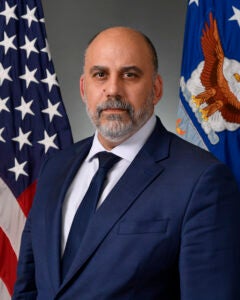
“We wanna see a greater breadth of mission risk profiles that we execute with launch in order to help drive that demand,” Erich Hernandez-Baquero, the department’s space acquisition chief, told reporters on Tuesday at the Air & Space Forces Association’s annual conference here. “The last thing I’ll say there is, I don’t have the answer yet, but it is something that I look at, is how do we create the right demand signal on the government end in order to attract even more investment in that area in order to get to the capacity.”
“One of the blueprints that I’m certainly gonna take a look at is how we’re using multi-year procurement authorities, how we’re setting up all the work that we’re doing to scale munitions production,” he said. “Are there some lessons learned from that that we can apply to what we need to do in order to attract more investment in launch?”
Hernandez-Baquero also said that MYPs in other areas of space acquisition may help remedy supply chain bottle necks–for example, optical communication terminals for Space Development Agency satellites (Defense Daily, Sept. 15).
Last month, Hernandez-Baquero became the new assistant secretary of the Air Force for space acquisition and integration and the Space Force’s service acquisition executive.
In early June, Space Force said that it “has a current, time-critical requirement to launch approximately 500 satellite vehicles by the end of calendar year 2027 where failure to award by Sept. 30, 2026 may trigger unacceptable mission delays and increased costs/effort” (Defense Daily, Sept. 3).
In fiscal 2026, the Air Force projected support for 173 launch operations on the East and West Coasts, up from 25 launches a decade ago.
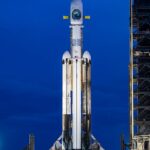
Space Force’s Space Systems Command (SSC) has said it plans to “on-ramp” new launch providers for National Security Space Launch (NSSL) annually, yet thus far only three of seven “on-ramped” companies have had launches that qualify them for task order awards under Phase 3, Lane 1–SpaceX [SPCX], United Launch Alliance (ULA), and Blue Origin. SSC “on-ramped” the latter three in 2024. SSC “on-ramped” Rocket Lab USA [RKLB] and Stoke Space Technologies last year and Impulse Space and Relativity Space‘s Relativity Federal subsidiary this year.
ULA is a Boeing [BA]-Lockheed Martin [LMT] joint venture.
NSSL Phase 3, Lane 1 awards annual task orders for missions involving non-critical payloads, such as Space Development Agency satellites, in which rocket providers can use multiple launches to vault 15,000 pounds of mass to low Earth orbit. NSSL Phase 3, Lane 2 is for launches related to “assured access and the highest reliability for our most demanding, least risk-tolerant payloads,” according to SSC.