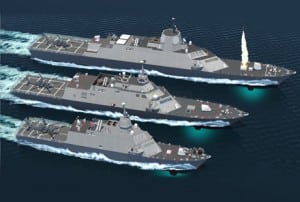
Lockheed Martin's rendering of the three LCS variants for the international market.
The U.S. Navy is close to finalizing a fix for a design flaw that led to propulsion system damage late last year on the USS Milwaukee, a Freedom-class Littoral Combat Ship (LCS-5), a service official said Dec. 8.Lockheed Martin [LMT], the ship’s prime contractor, and a supplier have developed design changes and expect to finish testing them this month, Navy acquisition chief Sean Stackley testified before the House Armed Services Committee’s oversight and investigations subcommittee. If the testing is successful,…
A new Congressional Budget Office report estimates the cost of the Iran war through Aug. 1 as $38 billion and says that the U.S. has likely depleted between one-half and […]
NATIONAL HARBOR, Md. – A Senate Armed Services panel chair today said boosters of the Golden Dome program still have work to do to increase support on Capitol Hill while […]
An HII [HII] shipbuilding executive last week told lawmakers how the company plans to improve and accelerate shipbuilding throughout via workforce improvements, adding new shipbuilding infrastructure and reinforcing distributed shipbuilding […]
The House on Tuesday passed a stopgap funding bill to keep the government open through Dec. 11, sending the temporary funding measure that also includes funds to support ongoing shipbuilding […]
The U.S. Navy is close to finalizing a fix for a design flaw that led to propulsion system damage late last year on the USS Milwaukee, a Freedom-class Littoral Combat Ship (LCS-5), a service official said Dec. 8.
Lockheed Martin [LMT], the ship’s prime contractor, and a supplier have developed design changes and expect to finish testing them this month, Navy acquisition chief Sean Stackley testified before the House Armed Services Committee’s oversight and investigations subcommittee. If the testing is successful, modifications to the high-speed clutch and updates to the machinery control software will be made to LCS-5 and two other Freedom ships with the same problem.
Lockheed Martin’s rendering of the three LCS variants for the international market.
While transiting the Atlantic Ocean last December, LCS-5 had to be towed to a base after its clutch experienced excessive wear during an emergency stop of the ship’s gas turbine engines.
The LCS-5 episode is one of five engineering casualties the LCS program has experienced in the past year. Two of the five were attributed to a failure to follow established maintenance procedures, while the other two were blamed on production deficiencies.
To address those issues, Stackley said that crew training has been enhanced and the production problems have been resolved. An ongoing engineering review by Naval Sea Systems Command is designed to prevent future equipment troubles.
J. Michael Gilmore, the Pentagon’s director of operational test and evaluation, who has been critical of LCS for years, said LCS continues to fall short of reliability requirements. During the subcommittee hearing, he read several comments from sailors who complained about frequent equipment breakdowns.
“We need to acknowledge the many problems that exist and fix them,” Gilmore said.
Stackley agreed that reliability is too low, but he insisted that the program is on track to improve.
“We are going through what’s referred to as reliability growth,” Stackley said. “What we’ve got to do is get there faster on a system by system basis.”
However, Rep. Jackie Speier (D-Calif.), the subcommittee’s ranking member, said the ship’s problems are two numerous and serious to give her confidence in LCS.
“In simple terms, it’s a dud,” Speier said. “We have a ship even the Chinese don’t want to copy.”
While there has been criticism among missile defense advocates of Golden Dome’s development pace after the signing of an executive order in January last year, Space Force Gen. Michael Guetlein, […]


 By
By