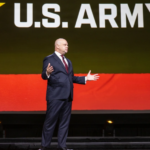
The increasing frequency and widening attack vector of cyber warfare threats is forcing military officials to adopt a more mission specific approach to defensive operations rather than attempting to defend entire networks.A greater emphasis on increasing cyber capabilities in the recently passed fiscal year 2018 National Defense Authorization Act (NDAA) conference report and a push for rapid acquisition with the private sector are aimed at meeting more sophisticated adversarial threats to the domain, according to panelists at Nov. 28’s Fifth Domain Cyber…
Recommended
AV’s New C-UAS Deal Begins With $80 Million Titan Order To Air Force Global Strike Command
Trending
Congress Updates
CBO Says Upfront Costs To Protect Military Installations From Drones Between $1 Million And $74 Million
The initial costs to acquire and deploy counter-small unmanned aircraft system (C-sUAS) defenses at individual Defense Department installations are estimated at between $1.2 million and $73.6 million depending on the […]
House Heads For Recess Without Moving On NDAA After Procedural Vote Fails
The House will leave for the Fourth of July recess without moving forward on its $1.15 trillion fiscal year 2027 National Defense Authorization Act (NDAA), with a procedural vote to […]
Bipartisan Group Of House Members Introduce U.S.-Ukrainian Co-Production Bill For Unmanned Systems
A bipartisan group of six House legislators have introduced the Strategic Unmanned Systems Partnership Act–a bill to improve drone collaboration between the U.S. and Ukraine. Rep. Michael McCaul (R-Texas), the […]
Will $4 Billion For SB-AMTI/Space Data Network Backbone In Supplemental Reduce Or Add To Planned Funding For Systems In Reconciliation?
Nearly all of the Department of the Air Force’s fiscal 2027 procurement and research and development (R&D) budget for space-based air moving target indication (SB-AMTI) and the Space Data Network […]
By