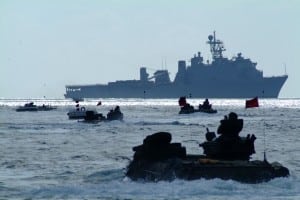
Finding a replacement for older amphibious dock transport ships such as the USS Harpers Ferry (LSD-49), above, is among the issues the Marine Corps, Navy and industry are working through right now regarding the amphibious ship fleet. Photo courtesy U.S. Marine Corps.
By the end of next week the Marine Corps should have enough amphibious combat vehicle prototypes from two competing companies to support the program’s aggressive testing schedule.On Tuesday the service received four amphibious combat vehicle (ACV) prototypes from Science Applications International Corp. [SAIC], bringing that company’s total to six test vehicles delivered, according to Marine Corps Land Systems Program Executive Officer John Garner. “Both contractors are delivering,” Garner told the Senate Armed Services subcommittee on seapower during a June 6 hearing…
More than three dozen industry associations on Monday called on congressional defense committee leaders to scrap a provision in the final version of the next National Defense Authorization Act that […]
Two senior Republicans on the House Armed Services Committee, including a potential frontrunner for the panel’s top GOP role, have officially lost their reelection bids. Reps. Rob Wittman (R-Va.) and […]
Democrats’ sweeping victories in Tuesday’s midterms, taking back control of the House and Senate, are set to reshape key spots atop defense committees, to include House Armed Services panels and […]
As the mid-term elections near with polls showing an increasing likelihood of a switch in majority control in the House and potentially the Senate, three Virginia Republicans on the House […]
By the end of next week the Marine Corps should have enough amphibious combat vehicle prototypes from two competing companies to support the program’s aggressive testing schedule.
On Tuesday the service received four amphibious combat vehicle (ACV) prototypes from Science Applications International Corp. [SAIC], bringing that company’s total to six test vehicles delivered, according to Marine Corps Land Systems Program Executive Officer John Garner.
Finding a replacement for older amphibious dock transport ships such as the USS Harpers Ferry (LSD-49), above, is among the issues the Marine Corps, Navy and industry are working through right now regarding the amphibious ship fleet. Photo courtesy U.S. Marine Corps.
“Both contractors are delivering,” Garner told the Senate Armed Services subcommittee on seapower during a June 6 hearing on Marine Corps ground modernization. “One of them is ahead on the delivery schedule, is meeting all criteria, is ahead on testing. By the end of this week we’ll have 13 vehicles from one of them. We currently have 12 already.”
“The other one we’re accepting four today,” Garner added. “We already had two, so we’ll have six. By the end of next week it will be 15 from one and it will be 12 from the other and that’s enough to fully support the test schedule to maintain the critical milestones.”
Garner did not specify which company was ahead, standard practice for program offices when commenting publicly about ongoing competitions. Defense Daily in April visited the Marine Corps Amphibious Vehicle Test Branch located at Camp Pendleton, Calif., and was shown both BAE Systems’ and SAIC’s progress in delivering vehicles.
So far BAE is ahead of SAIC in delivering engineering and manufacturing development vehicles for testing at various sites around the country. The companies are on contract to each build 16 ACV 1.1 prototypes for the Marine Corps, which should have enough from both competitors by next week to fully support the program’s test schedule.
Garner spoke highly of both the performance of both companies’ vehicles in limited testing accomplished so far. Because both prototypes’ designs rely heavily on commercially available automotive components and non-developmental military-grade armor and other systems, their performance has been predictably at or above expectations, he said.
“These are, in many cases, well developed vehicles and are doing well in the testing and are, in fact, exceeding some of our expectations,” he said. “Between the two competitors we’re going to have a very good selection that will bring really good capabilities to the Marine Corps.”
That selection should occur sometime in July or August of next year when the Marine Corps chooses a single vehicle to enter low-rate initial production.
In the latest U.S. Air Force fighter force structure report submitted to Congress, the service speaks of a “theoretical potential” to achieve a goal of 1,509 combat-coded fighters in the […]


 By