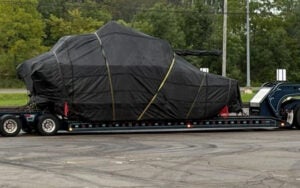
The Typhon launcher by Lockheed Martin [LMT] for such missiles as the Tomahawk and SM-6 by RTX‘s [RTX] Raytheon has more than two and a half years of service in the Philippine military, Army leaders said on Monday at the Association of the U.S. Army’s (AUSA) annual convention in Washington, D.C.
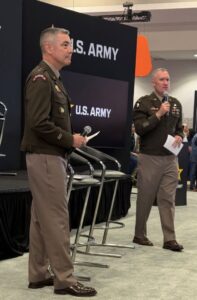
“That system was brought over to the Philippines at the request of the armed forces of the Philippines,” said Army Maj. Gen. Bernard Harrington, the commander of the 7th Infantry Division/Multi-Domain Command-Pacific.
“Based off of our shared interests, that system has maintained forward presence for over 30 consecutive months,” he said. “What that allows us to do is not only train and share lessons on that movement, but also to learn how do you operate and sustain in the environment and how do you protect those types of systems in the environment, how do you connect sensors to shooters persistently forward with our ally.”
The Army and other military services have said that they want to increase their “magazine depth,” their on-hand inventory of munitions and missiles for potential conflicts.
Asked after his AUSA talk what improvements he would like to see with Typhon, Harrington replied, “I don’t think of one particular system.”
“It really is optionality for us,” he said. “We look at the targets in the Pacific and the effect we’re trying to achieve and what’s the right optionality of the things we can integrate–from sensors, to utilizing long range one way attack, USVs [unmanned surface vessels], long-range launched effects, and layering that–whatever the magazine depth is. What can be integrated into this kill web quickest is something I’m interested in. I have the mechanism to be able to integrate it.”
Typhon “has worked out really well as far as you look at their territorial defense, nesting that system,” Harrington said. “I think the indicator is the government of the Philippines, the armed forces of the Philippines asking us to maintain it there now for two and a half years. What that’s allowed us to do is every time the weather, humidity, the road conditions–we’ve had this pretty good feedback loop–things that we would adjust and be able to adjust to.” Harrington said that industry field service representatives for Typhon have been responsive.