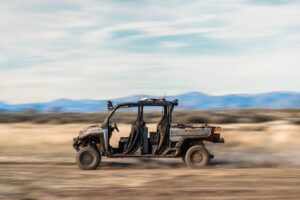
Ukrainian military forces have praised the performance of Forterra‘s Lancer Unmanned Ground Vehicle (UGV) in moving dozens of 155mm artillery shells and other soldier supplies in front-line areas.
Since last year, Ukrainian forces have used more than 100 Lancers, Forterra said, for 1,500 missions, and it appears that Ukraine wants more, should funding materialize.
“The short answer is yes,” Patrick Acox, Forterra’s vice president of defense, said in a Tuesday interview at the Association of the United States Army conference in Washington, D.C. when asked whether there was a way for Ukraine to get more Lancers in spite of the ending of U.S. military aid to Ukraine. “The tactics are being translated right back out to the rest of the world…I know NATO’s interested. Between them, the capability coalitions–the SAG-U, and the localization, we have three main avenues.”
SAG-U is the Security Assistance Group-Ukraine, created nine months after the Russian invasion in February, 2022 to coordinate weapons shipments, other military equipment, logistics, and training for Ukraine. U.S. European Command recently announced a reorganization to move SAG-U tasks to NATO Security Assistance and Training for Ukraine in which Europe would take the leading role.
The gas powered Lancer UGVs, often used under the cover of night to shield them from Russian one way attack drones, can carry 65 155mm shells or other supplies several dozen kilometers. In addition, the Lancer has provided at least 88 medical evacuations so far, according to Forterra.
Ukrainian forces have installed cages on Lancers at times, and in one instance that cage withstood hits from four Russian first person view (FPV) “kamikaze” drones, although there have also been losses of Lancer due to Russian FPVs.
In July, the Maryland-based Forterra said that it had “produced and deployed 105 autonomous Lancer vehicles, in support of Ukrainian forces in the Russo-Ukrainian War.”
“Completing full delivery in under six months, the company designed and built, and deployed the Lancer, a multi-mission autonomous ground vehicle, to provide logistical and combat support on the battlefield,” according to Forterra. “This effort was developed under a U.S. government program in 2024 and was on contract by March of 2025.”
The Lancer is based on the Polaris Ranger 1500 utility vehicle by Minnesota-based Polaris, Inc.