Lack Of Program Office Hinders Air Force Small UAS Procurement
Pat Host
SHARE:
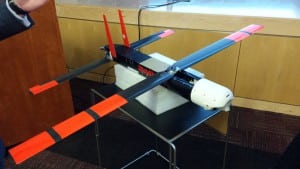
The RTX Coyote small unmanned aerial system (UAS). Photo: Defense Daily.
Air Force procurement of small unmanned aerial systems (UAS) is hindered because the service doesn’t have a program office for that class of air vehicle, according to a service official.Kenneth Briggs, small UAS subject matter expert for Headquarters Air Force/A2CU, said Tuesday he wants to use small UAS like Raytheon’s [RTN] Coyote for tasks like counter terror and counter intelligence. Briggs likes the versatility and affordability that small UAS provide to capabilities like full-motion video.Coyote, for example, is a low-cost,…
The House on Tuesday passed a stopgap funding bill to keep the government open through Dec. 11, sending the temporary funding measure that also includes funds to support ongoing shipbuilding […]
While there has been criticism among missile defense advocates of Golden Dome’s development pace after the signing of an executive order in January last year, Space Force Gen. Michael Guetlein, […]
Rep. Jeff Crank (R-Colo.), a co-chair of the Golden Dome Caucus in Congress and a member of the House Armed Services Committee’s strategic forces panel, discusses the transformative defense investments […]
U.S. Space Force Space Systems Command’s (SSC) Portfolio Acquisition Executive (PAE) for infrastructure–a $4 billion contracting hub for SSC–is completing a move from Los Angeles Air Force Base, Calif. to […]
Lack Of Program Office Hinders Air Force Small UAS Procurement
Pat Host
SHARE:
Air Force procurement of small unmanned aerial systems (UAS) is hindered because the service doesn’t have a program office for that class of air vehicle, according to a service official.
Kenneth Briggs, small UAS subject matter expert for Headquarters Air Force/A2CU, said Tuesday he wants to use small UAS like Raytheon’s [RTN] Coyote for tasks like counter terror and counter intelligence. Briggs likes the versatility and affordability that small UAS provide to capabilities like full-motion video.
Raytheon’s Coyote small unmanned aerial system (UAS). Photo: Defense Daily.
Coyote, for example, is a low-cost, expendable UAS that can be tube-launched from both the ground and air. It can perform surveillance imagery, targeting capability and real-time damage assessment, according to Raytheon.
But Briggs has been stymied by the chicken-or-egg process of traditional acquisition. When he asked the Air Force for money to procure small UAS, Briggs was told he needed both a program office and a requirement. He offered to write the requirement, but was rejected.
“It’s a ‘which comes first,’ problem,” Briggs told reporters at the Pentagon. “Do I need the requirement before I get the program office? But don’t I need a program office to help me build the costing data?”
Briggs said he is working with Air Combat Command (ACC) on how to move toward setting up a Special Program Office (SPO). Briggs said ACC has set up a management office to handle many of his studies and modeling and simulation (M&S) efforts.
Air Force spokeswoman Capt. Trisha Guillebeau said Tuesday as the lead major command ACC is using Air Force processes to stand up a Special Management Office (SMO) to handle the analyses and will transition to acquisitions once the requirement is validated. The SPO, Guillebeau said, is approved and established by the appropriate activity, Air Force Materiel Command (AFMC).
Briggs said he’s also working with Air Force Research Laboratory (AFRL) to put some advance technology demonstration projects together to prove to the Air Force the value small UAS can bring warfighters. Briggs said if he can prove some of his assertions, he hopes that small UAS can become as popular as General Atomics’ MQ-9 Predator UAS.
“That’s what Predator was…an advance technology demonstrator,” Briggs said. “Everyone was like: ‘we need that and we need it now.’”
Guillebeau said there hasn’t been a requirement for this class of vehicle, small UAS, due to limited technology. She said, as such, the Air Force has yet to establish formal documentation, a necessary precursor to SPO establishment.
The Air Force seeks to change this, Guillebeau said, with its Small UAS Flight Plan that highlights recent technology revolutions, the velocity of information and the ability to conceive new operational concepts. The Air Force believes an intersection of unmanned technology maturation with widespread industry innovation will enable the rapid advancement of equivalent UAS capabilities in a compact, cost benefiting and operationally successful way.
In the Small UAS Flight Plan, the Air Force explains that it must take significant steps to integrate and institutionalize an airman-centric family of small UAS systems as exponential force multipliers across the air and cyber domains. The Air Force believes its Flight Plan outlines an aggressive but realistic vision on how to capitalize on small UAS.
Wisconsin’s GOP congressional delegation is urging the Trump administration to support legislative language enabling the Marine Corps to potentially bring in a second Joint Light Tactical Vehicle (JLTV) supplier. The […]